Top Accelerators for B2B SaaS Startups
Find the accelerator built for B2B SaaS, not the one optimized for consumer apps.

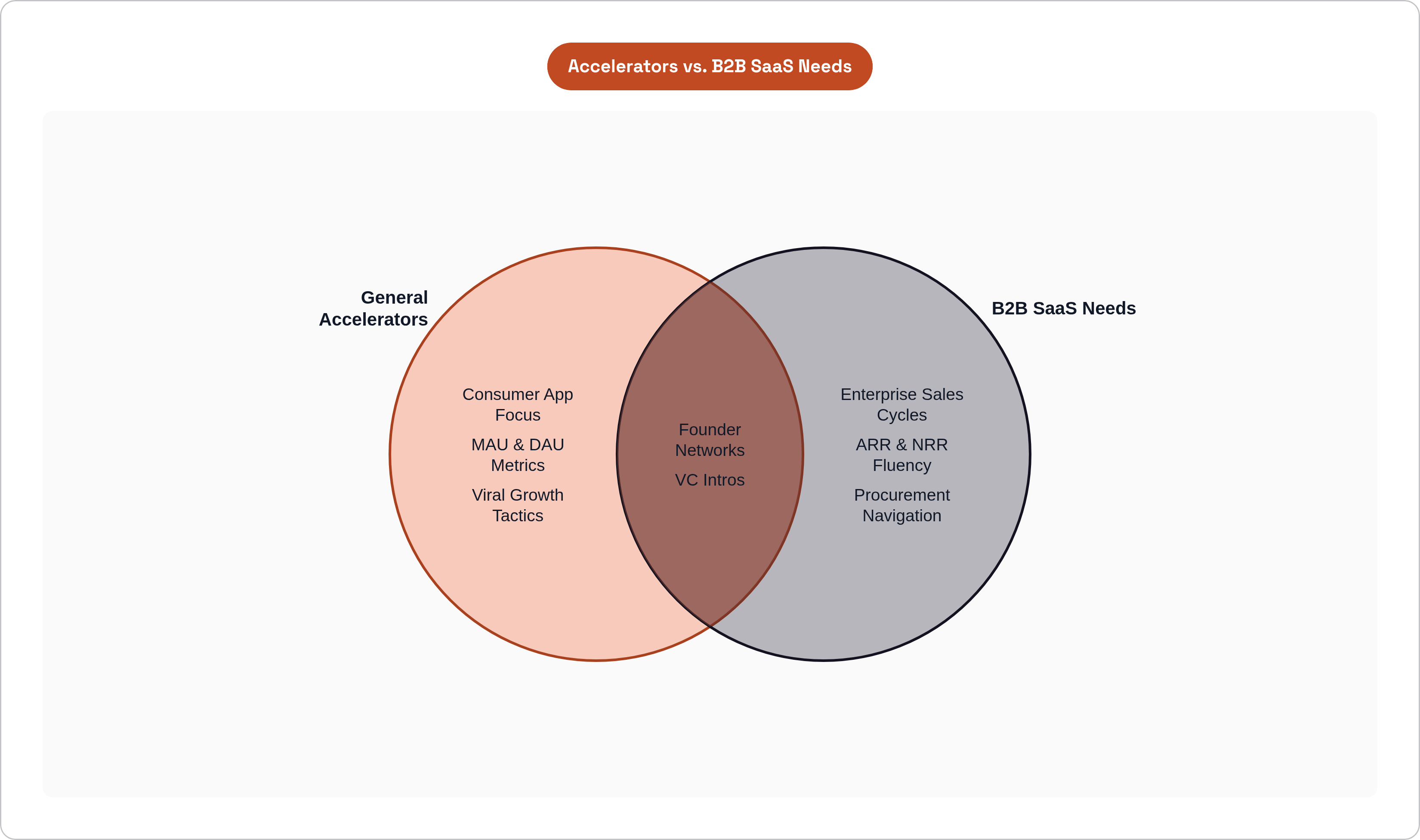
Most accelerators were not built for you. The whole ecosystem skews toward consumer apps, marketplaces, and general tech. If you are building B2B SaaS, that mismatch has real consequences: mentors who have never sold to a procurement team, cohort peers obsessing over daily active users instead of annual contract value, demo days pitched at investors hunting for the next viral app.
Choosing the wrong accelerator does not just waste three or four months. It costs you equity. Most programs take somewhere between 6% and 10% of your company. Spending that on a program optimized for someone else's business model is genuinely painful in retrospect. I have watched founders come out of well-known programs with a thinner cap table and almost nothing that applied to their actual go-to-market problem.
This guide exists so you do not have to learn that lesson firsthand.
One quick distinction before we go further: this is about accelerators, not incubators. Incubators are for idea-stage founders with long, loosely structured timelines. Accelerators assume you already have an MVP and some early traction. Short, cohort-based, intensive. That is the category that matters here.
Three things matter most when you look at any program through a B2B SaaS lens.
Enterprise mentorship. Not "startup mentorship." You need mentors who have actually sold to enterprise organizations, built products for them, or sat on the buying side of a procurement decision. Generalist operators who scaled consumer apps will give you advice that sounds reasonable but falls apart the moment you try to apply it. There is a meaningful difference between someone who knows how to grow a user base and someone who knows how to navigate a six-month enterprise sales cycle with four stakeholders and a legal review at the end. Picking the wrong mentor is like asking a surfer to coach you through a whitewater rapid. Both involve water. The skills do not transfer.
SaaS metrics fluency. The people running the program should speak ARR, NRR, churn, CAC payback, LTV:CAC, and ACV without blinking. If the feedback you get during office hours keeps drifting toward MAU and conversion rates, they are thinking about a different kind of company than yours.
Go-to-market networks. Warm introductions to enterprise buyers, design partners, channel partners, and pilot customers are worth more to a B2B SaaS founder than a long list of VC contacts. VC intros are fine. A warm intro to a VP of Engineering at a mid-market company who is actively evaluating solutions like yours is better. Those two things are not in the same league.
A few secondary factors also matter:
- Geography and cohort composition. Being surrounded by other B2B SaaS founders accelerates your own pattern recognition faster than any curriculum can.
- Stage alignment. Some programs want pre-revenue founders. Others want early ARR. Applying at the wrong stage wastes your time and theirs.
- Equity and deal structure. Terms vary widely. A $100K check for 7.5% is a very different deal than a $500K check for 7%. Do the math before you get attached to the brand name.
And the red flags worth keeping in mind:
- A mentor network that looks impressive on paper but is disengaged in practice
- No successful B2B SaaS alumni you can actually name
- Equity terms that are unclear, aggressive, or explained differently every time you ask
The single best due diligence move is also the most obvious one: talk to founders who went through the program before you accept any offer. Skip the testimonials on the website. Find real people from recent cohorts and ask what it actually felt like on a random Tuesday afternoon when nothing was going well. That conversation will tell you more than anything the program puts in front of you.
Y Combinator: the default choice for most B2B SaaS founders, and why
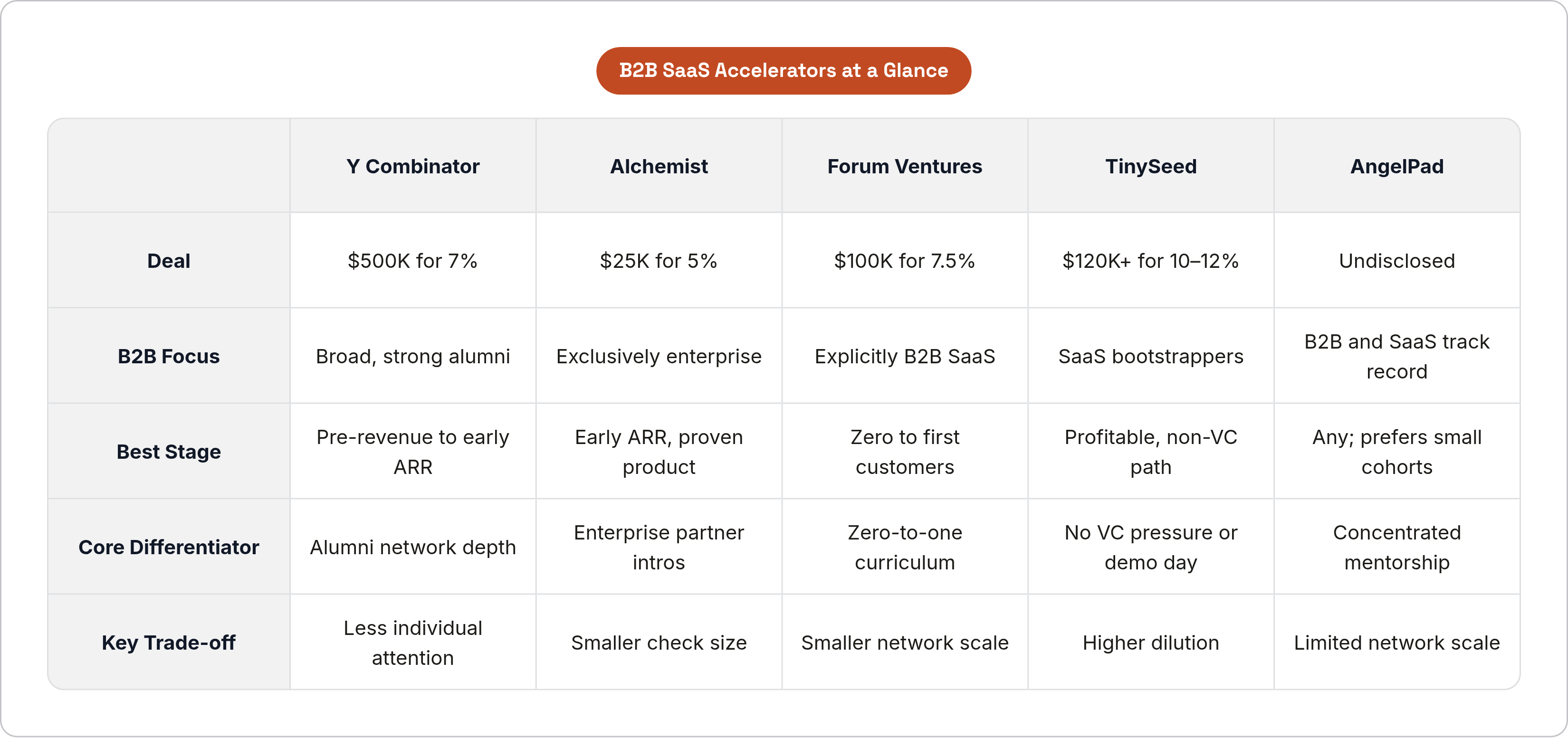
YC is the default for a reason, and the reason is not brand prestige. The current deal is $500K for 7% equity, a big jump from earlier terms that reflects how much the YC stamp has appreciated. Acceptance is extremely competitive. Roughly 1.5 to 2% of applicants make it in from a pool of more than 20,000 per batch.
Here is the part that is easy to underestimate: the alumni network is the actual product. The largest concentration of successfully exited B2B founders of any single program lives inside that network. Peer learning during the batch is immediate. The warm introductions keep coming for decades afterward. Demo Day draws more institutional VC capital into one room than any other single event in the industry, making it the most concentrated source of Series A deal flow in the ecosystem.
The structure itself is simple. Two batches per year. Weekly dinners, office hours with partners, access to a founder network that keeps growing whether you are actively engaged with it or not.
The honest trade-off: a batch of around 240 companies means individual attention is thinner than at a boutique program. Founders who are not self-directed will extract less from it. YC rewards people who know how to go find the value inside a resource-rich environment. If you need tighter structure and more direct guidance to stay focused, a smaller program will probably serve you better. That is not a criticism. It is just a different operating style, and knowing which one you are saves you a lot of frustration.
Alchemist Accelerator: the only program built exclusively for enterprise revenue models
Alchemist does one thing. It is the only major accelerator focused exclusively on startups whose revenue comes from enterprises rather than consumers. That shapes the entire curriculum, the mentor roster, and who shows up to the events. It is not a positioning line on a website. You feel it in practice.
The deal is $25K for 5% equity. The check size is smaller than YC by a significant margin, but so is the cap table dilution. The value proposition here is not capital. It is network access and enterprise go-to-market skill-building.
The curriculum emphasizes enterprise sales, distribution strategy, and the specific challenge of selling to large organizations that move slowly, involve multiple stakeholders, and buy very differently from how individual users do. Those are exactly the skills most B2B SaaS founders are missing when they show up with a working product and no clear path to a signed contract. The program provides direct introductions to major enterprise partners including Salesforce, SAP, and Cisco. For a founder who needs design partners or pilot customers more urgently than another investor conversation, that access is real and it matters.
If you are still searching for product-market fit, you will probably get more from YC or Forum Ventures first. Come back to something like Alchemist once the problem shifts from "what should I build" to "how do I get enterprises to actually buy it."
Forum Ventures, Dreamit, and Startup Wise Guys: programs with deliberate B2B SaaS focus
Forum Ventures (formerly Acceleprise)
Forum Ventures explicitly positions itself as a zero-to-one program for B2B SaaS. It operates as an accelerator, a VC fund, and a startup studio simultaneously, which means it deploys capital beyond the accelerator batch itself. The deal is $100K for 7.5% equity.
Programs run in New York, San Francisco, and Toronto. That geography matters if you are not based in the Bay Area and do not want to relocate. The mentor network is genuinely strong for early B2B SaaS. More importantly, the program is actually structured around the problem of going from nothing to your first real paying customers. That sounds obvious. Most programs are not built around it, even when they claim to be.
Dreamit Ventures
Dreamit focuses on specific B2B sectors: cybersecurity, healthtech, and enterprise IT. Its distinguishing feature is running investor introductions and corporate pilot programs at the same time. That matters because a lot of B2B founders hit a maddening sequencing problem where they need customers to fundraise and need funding to get customers. Dreamit at least tries to run both tracks in parallel rather than pretending one solves the other.
If you are building in a regulated or security-sensitive vertical, industry relationships unlock deals that cold outreach simply will not. That is where Dreamit earns its place on this list.
Startup Wise Guys
Startup Wise Guys is Europe's most experienced B2B startup accelerator. Funding ranges from $100K to $500K depending on cohort and stage.
The core advantage is geographic. If you are a European founder or targeting European enterprise buyers, this program offers network and market access that U.S.-centric programs cannot replicate. The programs that sound more impressive on a list will not get you in front of the buyers you actually need. Fit matters more than brand recognition at this stage, and for a specific founder situation, the fit here is real.
Techstars, 500 Global, and AngelPad: broad programs that can work well with the right vertical filter
Techstars
Techstars has a large global footprint with vertical and city-specific cohorts. Some of those cohorts are well-aligned with SaaS and B2B software. Others are not. The 13-week structured format, with dedicated mentors throughout, suits founders who want intensive and personalized guidance on go-to-market (GTM) mechanics.
The key is to evaluate the specific Techstars program, not the brand. The mentor roster and cohort composition of a given vertical track matter more than the parent name on the website. A Techstars program in the right vertical with the right mentor network is a genuinely different experience from a generalist cohort. Do your homework on the specific track before you apply.
500 Global (formerly 500 Startups)
500 Global is one of the most active early-stage investors in the world. Its curriculum emphasizes distribution and customer acquisition, which makes it especially useful for technically strong teams who have built something good but cannot figure out how to turn it into a repeatable revenue engine. That is a more common problem than people admit, and it is worth respecting as a real gap.
The trade-off is that the program is not B2B-specific. The large alumni base is genuinely valuable for network effects, but founders need to self-select into the right tracks and take ownership of making the experience relevant to their own model. Nobody is going to do that work for you.
AngelPad
AngelPad is small on purpose. Founders get concentrated attention rather than getting lost in a large cohort. Its alumni include Pipedrive, DroneDeploy, and Periscope Data, which gives it a quietly strong B2B and SaaS track record that does not get the attention it deserves. Some rankings place it alongside YC at the top of U.S. accelerator lists, which tends to surprise people who have only heard of it in passing.
If the idea of being in a batch of 240 companies sounds more exhausting than exciting, AngelPad is worth a serious look. It is built for founders who prioritize depth of mentorship over network scale and are comfortable operating in a less structured, high-trust environment.
TinySeed and the non-dilutive options for founders who want to stay independent
TinySeed
TinySeed calls itself the first accelerator designed for SaaS bootstrappers. That is not a throwaway tagline. It tells you exactly who the program is built for: founders building profitable, sustainable SaaS businesses who are not chasing venture scale and are not interested in pretending otherwise.
The deal starts at $120K plus $60K per co-founder in exchange for 10 to 12% equity. That is higher dilution than most programs on this list. The structure reflects a different trajectory entirely. There is no VC pressure to grow at all costs, no demo day engineered to maximize your next raise, and no unspoken expectation that you are optimizing for an acquisition or IPO.
There are a lot of founders quietly building in this direction who do not realize there is a program designed specifically for them. If that description fits you, TinySeed is not a consolation prize. It is the right call.
Microsoft for Startups and Google for Startups
Both are free. Neither takes equity. That alone makes them worth knowing about.
The primary value is not mentorship or cohort dynamics. It is cloud credits, enterprise sales channels, and distribution access through platforms that B2B buyers already use every day. Microsoft for Startups is especially relevant for B2B SaaS companies selling into enterprises already operating in the Microsoft ecosystem, including those running Azure, Microsoft 365, or Teams as core infrastructure. That is a lot of enterprises.
These work best as complements to a traditional accelerator, not replacements. Do not choose between them and a cohort-based program. Stack them on top and get the infrastructure savings while you go through whatever else you have chosen.
How to match the right program to where your company actually is
No single program is universally right. The honest answer is that the best program for you depends almost entirely on where you are right now, not on which name looks best in a LinkedIn bio.
Pre-revenue and still searching for product-market fit? Look at YC or Forum Ventures. Both accept early-stage founders and have curriculum built around the zero-to-one problem.
Have early ARR and need to crack enterprise sales? Alchemist is built for exactly that problem. The corporate partner introductions are the differentiator, and they are real.
Operating in a regulated vertical like cybersecurity, healthtech, or enterprise IT? Dreamit puts the relevant investors and buyers in the room with you. That is the point.
European founder or targeting European enterprise buyers? Startup Wise Guys gives you geographic and network fit that U.S.-centric programs simply cannot offer. Brand recognition matters less than access at this stage.
Bootstrapped and not pursuing VC scale? TinySeed is the only program on this list designed for that trajectory.
Strong product, weak distribution? 500 Global's go-to-market emphasis is the core curriculum. That is exactly what you need.
Regardless of which program you choose, layer Microsoft for Startups or Google for Startups on top. They are not mutually exclusive with anything else on this list, and the credits alone can offset meaningful infrastructure costs.
The evaluation criteria from the opening section do not change regardless of which program you are looking at: enterprise mentorship, SaaS metrics fluency, and GTM networks. Apply those to any program not covered here and you will have a clear picture of fit quickly.
Then make the calls. Find founders from recent cohorts on your own, not the ones the program puts forward. The difference between those two conversations is usually the whole story.