Accelerator vs. Angel Investor Funding for Pre-Seed Startups

The accelerator model looks straightforward from the outside. Fixed-term cohort, usually 10 to 14 weeks, standardized terms, ends with Demo Day. Capital, curriculum, milestone pressure, cohort accountability, and curated investor access, all bundled into one package.
Check sizes vary. Most programs land between $100K and $250K. Y Combinator currently offers $500K per company structured as two instruments: $125K on a post-money SAFE for 7% equity, plus $375K on an uncapped SAFE with an MFN provision. Techstars writes $120K for roughly 6%. 500 Startups offers $150K for roughly 6%.
The capital, though, is almost beside the point. What accelerators are actually selling is a bundle of things that are genuinely hard to assemble on your own.
A deadline, for one. The cohort calendar forces execution in a way that's surprisingly difficult to manufacture without external pressure. Then there's the network: curated access to investors, operators, and peers who've been through the same fire. Intensive, structured feedback on how you tell your story. And for certain programs, the brand alone opens doors that stay closed to cold outreach no matter how polished your deck is.
Demo Day is the delivery mechanism for most of this. It creates a structured moment to get in front of angels and VCs who would never take a cold meeting. That matters more than founders usually realize until they've spent three months sending emails into the void.
Uncapped post-money SAFEs are now the default instrument across most top programs. More on that shortly.
Angels Move Fast, but Finding Them Is Its Own Job
Individual angels typically write checks between $25K and $150K. Micro-VCs (funds under $50M) write initial checks in the $100K to $500K range. The speed advantage over accelerators is real and it's not subtle. Angels decide in days to weeks. Accelerators run on fixed cohort calendars. Miss a batch and you're waiting months.
Fewer stakeholders means faster closes. No committee, no program coordinator, no batch timing constraint. One person decides they believe in you, trust is established, wire hits.
The best angels bring more than a check. Warm introductions to institutional VCs when you're ready for seed. Early credibility on your cap table, because who's already bet on you signals something to the next investor during due diligence. And domain-specific operating experience that's actually relevant to your problem, not generic startup advice dressed up as wisdom.
The catch is access. Unlike VC funds, most angels have no public intake process. You can't apply. You have to be connected. Reliable entry points include accelerator alumni networks, AngelList syndicatesand SPVs, LinkedIn outreach to founders who've exited in your space, and platforms like Signal by NFX or Crunchbase's investor database.
Cold outreach alone rarely works. Pre-seed angel access is largely relationship-brokered, which is either a feature or a frustrating structural reality depending on where you're starting from.
At this stage, angels are betting on team and thesis before traction exists. Personal trust matters more than your pitch deck. That's not a feel-good thing someone tells you at a conference. It's the actual dynamic in the room when the decision is being made.
The SAFE Is the Language Both Sides Speak
Whether you go accelerator or angel, you are almost certainly going to sign a SAFE. Y Combinator introduced the instrument in late 2013 as a cleaner replacement for the convertible note. SAFEs now dominate pre-seed deals. If you're going to play this game, you need to understand what you're signing.
The SAFE is not debt. That distinction matters more than it sounds. No interest rate means money doesn't compound against you while you build, unlike a convertible note. No maturity date means the clock isn't ticking toward forced repayment. No repayment obligation means if the company doesn't raise again, SAFE holders don't get paid back.
The post-money SAFE, introduced by YC in 2018, is now the dominant form. The ownership percentage gets calculated after all SAFE money is counted but before the new priced round closes. The benefit is that founders know their dilution upfront. The risk is that it dilutes founders more aggressively in future rounds than the original version did. That trade-off is worth understanding before you sign, not after.
Valuation caps vary depending on who you are and what you're building. First-time founders on a validated problem typically see caps in the $5M to $8M range. Strong serial founders in B2B SaaS land between $10M and $15M. Hot AI teams right now are seeing caps in the $15M to $25M range, sometimes higher.
Understanding this instrument is table stakes. Both angels and accelerators will hand you one. The differences between a well-negotiated SAFE and a sloppy one compound over time in ways that feel invisible until they suddenly aren't.
Stacking SAFEs Is Where Founders Get Quietly Wrecked
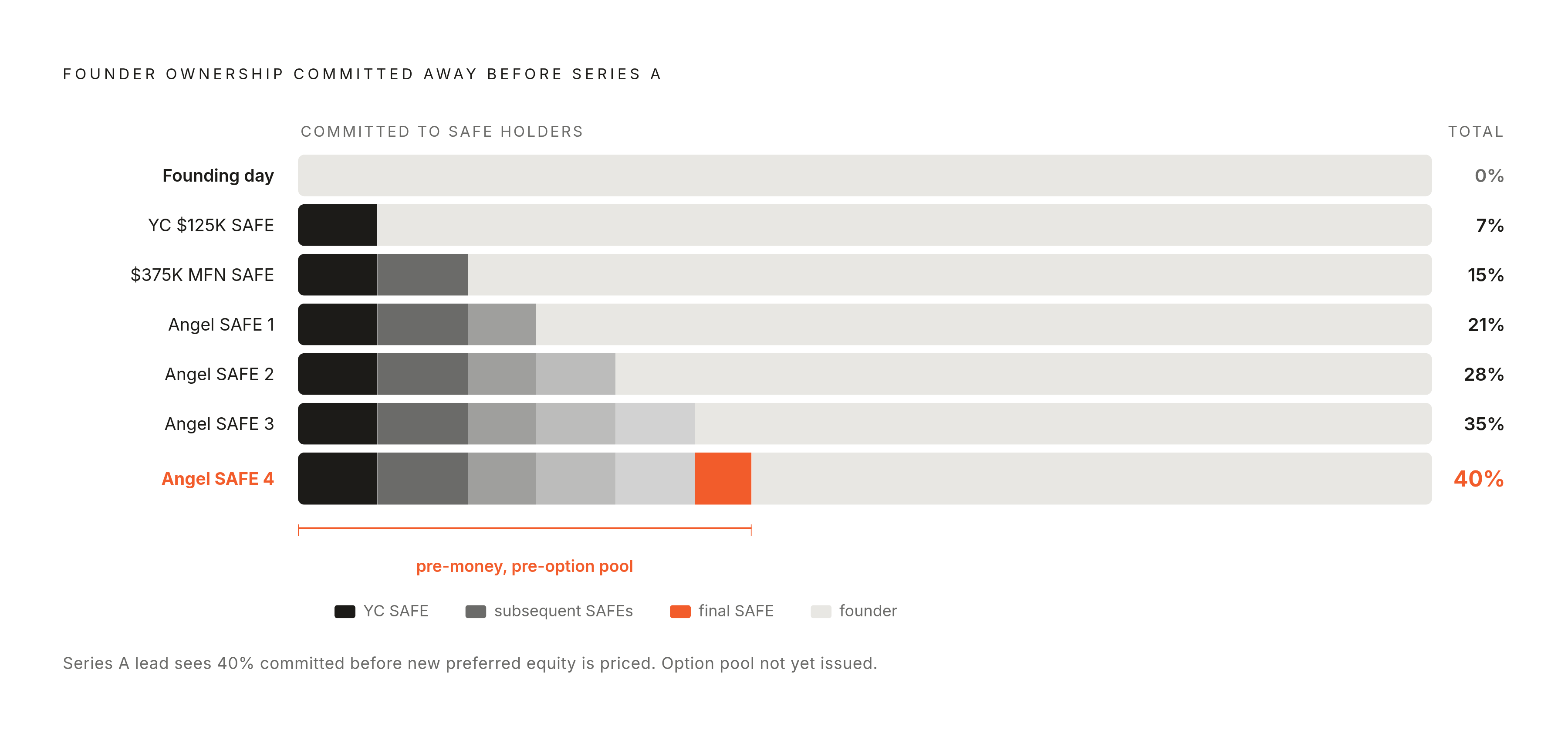
Nobody explains this clearly enough before it's too late. The dilution doesn't show up all at once. It accumulates. You sign one SAFE, then another three months later, then another when runway gets tight. Each one feels manageable in isolation. Then Series A diligence starts and someone runs the math on your cap table and the number is uglier than you expected. Much uglier, sometimes.
Take the YC model. The 7% from the $125K SAFE is fixed and visible. The $375K MFN SAFE, the most-favored-nation provision, converts at a future round. Founders need to model total YC ownership, not just the headline percentage on the term sheet.
Now layer in three or four additional SAFEs signed over 18 months at progressively higher caps. By the time a Series A lead runs their model, somewhere between 35 and 45 percent of the company can already be committed to SAFE holders before new preferred equity is even priced. That happens regularly. It is not a fringe scenario. It's a fairly common one.
This matters directly for the accelerator versus angel decision. An accelerator takes a fixed, upfront equity stake. It's visible and bounded. You know what you're trading before you sign. Multiple angel SAFEs, by contrast, can accumulate quietly across rounds, and the dilution only becomes fully legible when everything converts at a priced round and someone adds it all up at once.
Neither path is inherently more dilutive. It depends on how many instruments you stack, at what caps, and over what timeline before a priced round forces conversion. Plan for 18 months of runway at close. That gives you room to actually hit milestones before raising again, rather than bridging with more SAFEs and making the stack worse.
Model your total ownership at Series A, including any pro-rata rights granted to early SAFE holders. Not just the percentage on the instrument sitting in front of you right now.
The Accelerator Path Has Real Costs That Aren't Equity
Founders fixate on the equity hit. That's fair. But the non-financial costs are real too and they don't show up in the term sheet.
Cohort timing means applying and waiting for the next batch can cost three to six months before capital arrives. If your market window is closing, that delay is genuinely painful. Many intensive programs also require relocation or near-full immersion, which is a real ask for founders with families or teams spread across multiple cities. And if you've already built a company before and you know how to run a sales process, sitting through structured curriculum sessions is overhead, not value.
But here's what accelerators genuinely buy that angels typically can't replicate. Cohort accountability and milestone pressure, which is underrated for founders who need external structure to move fast. Compressed feedback on investor communication, which normally takes much longer to develop on your own. A credentialing signal, because YC, Techstars, and a small handful of others carry brand weight that actually changes how institutional VCs respond. And a warm, dense network of peers at the same stage, which is genuinely hard to build organically and useful for years after the batch ends.
The accelerator bundle makes the most sense for first-time founders who need accountability and pitch scaffolding. It also makes sense for founders entering a new geography or sector where they don't know anyone, and for teams that need the Demo Day moment to access investors they simply couldn't reach otherwise.
The case for skipping it is just as clear in the right circumstances. Speed is critical and your product window is closing. Your funding need is modest and doesn't justify the dilution. You already have the network and credibility the accelerator would provide. Your startup is too early or too late for a specific cohort's thesis.
Before applying anywhere, ask yourself one honest question: are you paying equity for the program, or for the network? If it's the network, make sure that specific program's network actually reaches the investors you'll need at Series A. They are not all the same.
YC Is Its Own Category and Should Be Treated That Way
Y Combinator is not a typical accelerator. It has invested in over 5,600 companies. More than 100 are unicorns. That's not a credential. That's a category of its own, and conflating it with other accelerators leads founders to make genuinely bad comparisons.
The current structure is four batches per year, three months in San Francisco, $500K per company on the SAFE structure described earlier.
The acceptance rate sits around 1.5 to 2 percent from more than 20,000 applicants per batch. That's roughly half the acceptance rate of Harvard. I'm not saying that to be dramatic. I'm saying it because founders sometimes apply to YC the way they approach a backup option, and that's a misread of what you're actually dealing with.
What YC actually evaluates is a short list. Can you explain your idea clearly in one or two sentences? Do you have genuine domain expertise? Are you full-time on this? Is there measurable early progress, active users, a working demo, something real? Can you adapt to feedback without losing your conviction?
YC is open to non-technical founders and international teams. Domain expertise and customer validation can substitute for technical background. Current areas of interest skew toward revenue-focused models, AI applications, international solutions, climate tech, and capital-efficient biotech.
The Bookface alumni network, YC's internal community and deal directory, is consistently cited as one of the most durable benefits after the program ends. It's not just who you meet during the batch. It's ongoing access to a community of people who've actually built things and are generally willing to help each other in concrete ways.
The practical reality is this: YC is worth pursuing seriously if your startup fits its current thesis and you can stomach the selection math. The brand value only materializes if you actually get in. Most people don't, which is not a reason to skip applying. It's just a reason to have a plan that doesn't depend on it.
How to Actually Make the Call
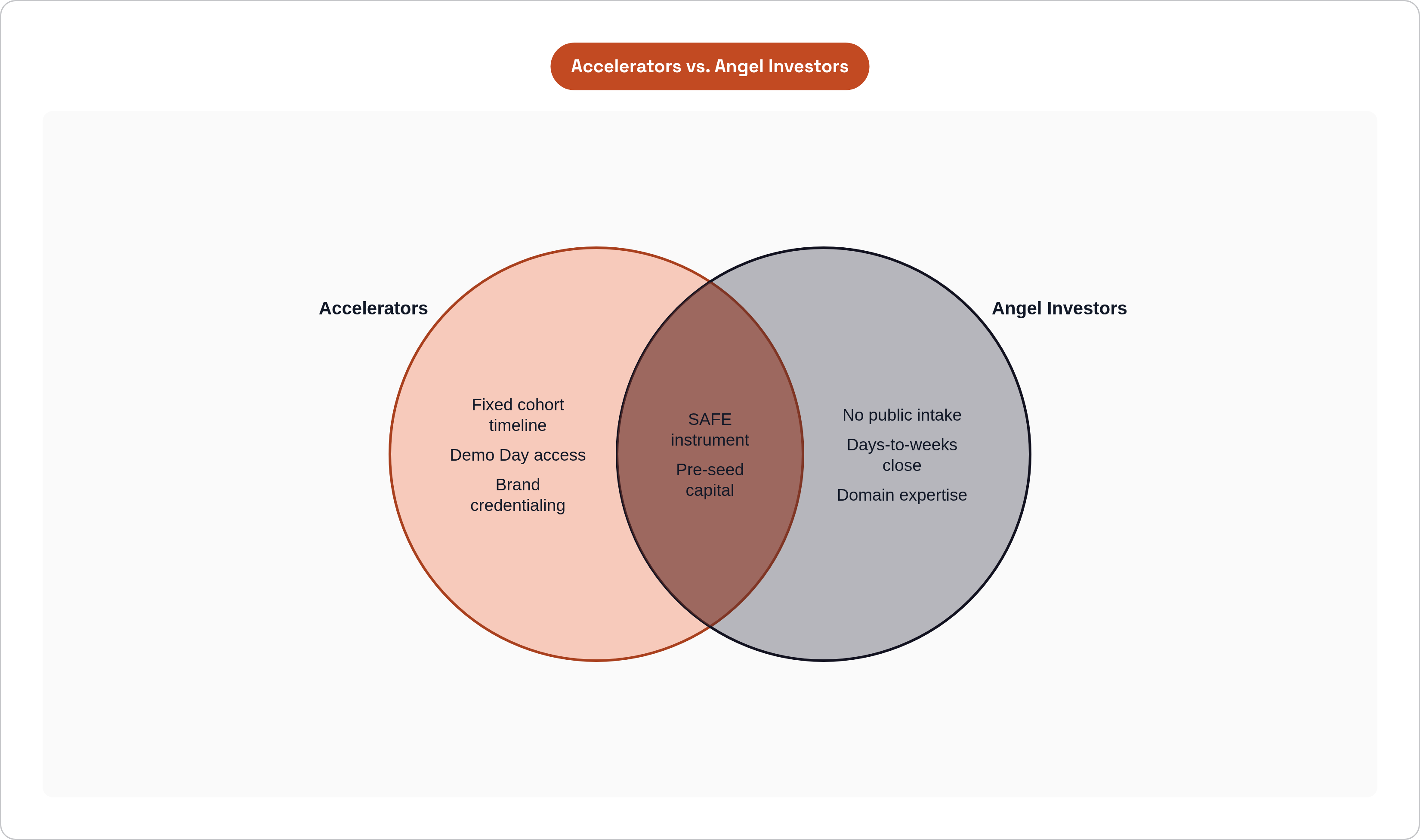
If you're still unsure which path fits your situation, four questions will tell you most of what you need to know.
First, timing. Can you wait for the next cohort, or does your market window require capital in weeks? Second, network gap. Does the accelerator's investor network reach people you genuinely can't access otherwise, or do you already have warm introductions to angels who can close quickly? Third, structure need. Are you the kind of founder who moves faster with external accountability and curriculum, or does that feel like friction that slows you down? Fourth, dilution math. Have you actually modeled what total SAFE stacking looks like at Series A if you take accelerator equity now and add angel rounds later?
The paths aren't mutually exclusive. Plenty of founders raise a small angel round first to hit a milestone, then apply to an accelerator from a stronger position. Others take an accelerator and layer in angels post-Demo Day. Both are valid ways to sequence it.
The non-obvious risk in both paths is the same: taking money from investors whose network, thesis, or reputation doesn't help you reach the next round. Cheap capital that doesn't open the next door is actually expensive when you factor in the opportunity cost.
For first-time founders without an established network, a structured accelerator with genuine brand weight often earns back its equity cost through the doors it opens. For founders who already have that access, angels offer a faster and less dilutive path. The right choice is the one that gets you to the next milestone with the network you'll actually need to raise from there.