AngelPad Accelerator Funding Terms and Cohort Profile
AngelPad's $120K for 7% deal includes common stock alignment and cloud credits worth $300K more.

AngelPad accepts fewer than one in every hundred applicants. From roughly 2,000 applications per cycle, about 15 teams get in. Fifteen. That number is not a rounding error.
Y Combinator, for comparison, takes somewhere between 150 and 200 companies per batch. That's a ten-to-one difference in scale, and it shapes everything about what the experience looks like from the inside. Think of it like the difference between a master class and a lecture hall. Same subject. Completely different dynamic.
Since launching in September 2010, AngelPad has put more than 150 companies into the world. The portfolio leans heavily into:
- Tech, enterprise, and B2B companies
- Software and SaaS
- Sectors spanning Enterprise Applications, Infrastructure, Consumer, Retail, and FinTech
Nearly 10% of all AngelPad portfolio companies have crossed $100 million in valuation. The program has produced four unicorns, and forty-one portfolio companies had exited as of mid-2026.
The small cohort isn't a constraint they're working around. It's the actual product. Deeper partner access, more targeted investor introductions, a tighter alumni network. Those things only survive when the class size is 15, not 150.
AngelPad has held the number-one seed accelerator ranking in the United States from the Seed Accelerator Rankings Project every year since 2015. That project covers more than 160 programs annually, run by researchers at MIT, Brown, and the University of Richmond. It's the closest thing the accelerator world has to an actual scoreboard.
And yet most early-stage founders couldn't tell you what AngelPad offers, what it costs in equity, or whether it's worth applying given the odds. So here's the full picture.
What Actually Gets You In
AngelPad's official line: smart, driven teams targeting large markets with innovative products. Useful, but vague. Here's what that filters down to in practice.
Team comes before idea. AngelPad evaluates who you are before what you're building. Your expertise, your prior startup experience, your track record of actually shipping things. Ideas are cheap. Execution history is not.
You need a technical co-founder. At least one founder has to be building or coding. A fully non-technical founding team doesn't get in. That's not a soft preference; it's a hard filter.
You need to have built something. A prototype at minimum. An MVP, or minimum viable product, with early traction is meaningfully better. "We're still in ideation" will not get you far.
Complementary founding teams win. AngelPad's own founders, Thomas Korte and Carine Magescas, are the model here. Korte is product and vision; Magescas handles strategy, investor relations, and negotiation. They're not describing complementary dynamics as an abstract virtue. They've been running a partnership built on it for over a decade. A founding team without complementary skills is like a pair of scissors with two left blades — technically a tool, but not one that cuts cleanly.
Korte came from Google, where he was the company's first International Product Manager. He was involved in launching AdWords, Google Maps, and Google Shopping across Europe starting in 2002, and he holds two patents still embedded in Google's search ranking algorithm and ads monetization. Magescas brings a background in marketing, project management, and strategic partnerships across multiple startups.
When those two tell you they prioritize complementary co-founder dynamics, it's worth taking literally.
The Core Investment: $120,000 for 7%, and Why the Structure Matters
The headline terms are simple enough. AngelPad invests $120,000 for approximately 7% equity. But the way that 7% is structured is where things get interesting.
It breaks into two pieces:
- 5% in common stock
- Roughly 2% via the $120,000 cash investment
Most financial investors take preferred stock. Preferred stock comes with protections: liquidation preferences, conversion rights, and other provisions that put the investor ahead of founders when things get complicated. AngelPad takes common stock instead. Same class of shares founders and employees hold.
So if you get diluted in a down round, AngelPad gets diluted too. If the company wins, everyone wins together. There's no preferred-stock cushion quietly protecting their position while yours erodes. It's a structural choice, and it carries real legal weight.
AngelPad calls this "Your Success is our Success," which sounds like a tagline but is actually just a description of how the cap table works.
Beyond the $120,000 in cash, AngelPad also provides access to more than $300,000 in cloud credits from AWS, Google, and Digital Ocean. For an early-stage company burning runway on infrastructure, that gap between $120K and $420K in real resources closes faster than you'd expect.
AngelPad is currently operating on its third fund, a $50 million vehicle.
Pro-Rata Rights: The Term Most Founders Skim and Shouldn't
Pro-rata rights give an early investor the option to participate in future funding rounds at the same valuation as new investors, so they can maintain their ownership percentage as you raise more capital. Standard stuff. But there are two very different versions of this right, and the difference matters enormously.
Standard pro-rata: Normal. Expected. If AngelPad holds 7%, they can invest enough in your Series A to stay at 7%. That's fair.
Super pro-rata: AngelPad calls this "dangerous and unacceptable." Super pro-rata gives an early investor the right to purchase more than their current ownership in future rounds. Holding 7%? They demand to acquire 12%, 15%, or more in the next round.
The problem is structural. If an early investor can crowd out new capital by exercising super pro-rata rights, serious Series A investors will walk before the conversation gets very far. AngelPad's framing is blunt: "the right to make a larger investment should be earned, not demanded." Super pro-rata is the fine print that eats your future — one clause that can turn a promising fundraise into a negotiation no serious investor wants to join.
Before you sign any accelerator term sheet, figure out which version of pro-rata is in it. The difference between the two can determine whether your next fundraise runs smoothly or starts life as a mess.
One extra data point worth having: typical 2024 to 2025 seed-stage post-money SAFEs have included valuation caps in the $4 to $8 million range and discounts in the 15 to 20% range. Those numbers give you a baseline for whether any accelerator's conversion terms are market-rate or quietly aggressive.
What Ten Weeks Actually Looks Like
AngelPad describes the program as approximately ten weeks per cohort, though some of its own materials say "three intense months." Either way, it's short and concentrated, not long and gradual.
The curriculum focuses on four things:
- Finding product-market fit
- Defining and validating a target market
- Acquiring first customers (AngelPad uses 100 paying customers as an explicit milestone)
- Fundraising mechanics and investor communication
The mentorship model is deliberately anti-drive-by. AngelPad doesn't want mentors who show up for one coffee meeting and disappear. They want mentors embedded in the daily process as teams iterate. You try something. It doesn't work. You change it. You try again. Mentors are there for that cycle, not just the kickoff.
Then there's Demo Day. Or what used to be Demo Day. In 2018, AngelPad scrapped the traditional public format entirely and replaced it with pre-arranged, one-on-one meetings between startups and VCs on the same day, paired based on actual fit and relevance. Founders reported 20-plus investor meetings in a single day. Feedback from both founders and investors was described as "overwhelmingly positive."
AngelPad looked at a standard industry event, decided it was better at generating buzz than generating outcomes, and changed it. That instinct runs through most of how they operate.
The Outcomes That Justify the Selectivity
AngelPad portfolio companies have collectively raised over $2.2 billion. Average funding per company exceeds $14 million.
The notable exits:
- Postmates. Acquired by Uber for $2.65 billion.
- Vungle. Acquired by Blackstone for a reported $750 million.
- MoPub. Acquired by Twitter in 2013 for $350 million. At the time, the largest exit of any accelerator-launched company.
- Pipedrive. A majority stake sold to Vista Equity Partners in 2020, nearly nine years after the company launched at AngelPad's 2011 Demo Day.
- Earlier acquisitions by Groupon, Yahoo, and Apple round out the list.
Zum achieved unicorn status in 2024, eight years after AngelPad's initial investment. Eight years. These aren't quick flips. They're long bets on teams who can keep executing over years, which makes sense coming from a program that only takes 15 teams at a time and doesn't appear to be in any rush.
Carine Magescas was nominated for Angel Investor of the Year at TechCrunch's 10th Annual Crunchies Awards in 2017. For a program that deliberately avoids the spotlight, the recognition tracks.
How AngelPad Stacks Up Against the Programs You're Actually Comparing It To
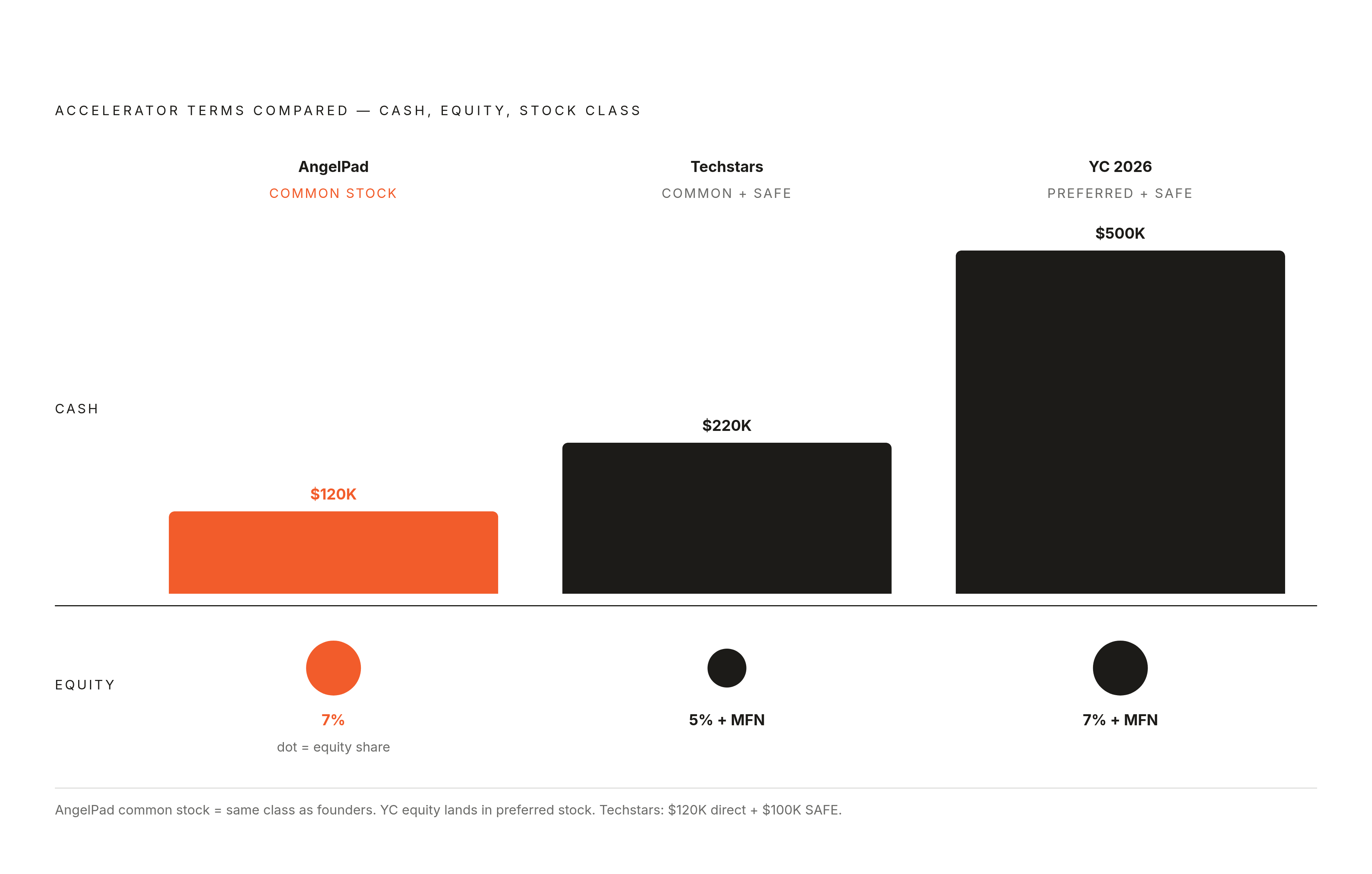
Here's the comparison most founders want:
| Program | Investment | Equity | Structure | Cohort Size | |---|---|---|---|---| | AngelPad | $120K | ~7% | 5% common stock + ~2% from cash | ~15 companies | | YC (2026) | $500K total | 7% + uncapped MFN SAFE | $125K post-money SAFE (preferred) + $375K uncapped MFN SAFE | 150–200 companies | | Techstars | $220K total | 5% common + uncapped MFN SAFE | $20K for 5% common + $200K uncapped MFN SAFE | Varies by program |
The number that jumps out is YC's $500K versus AngelPad's $120K. More capital is real, especially for hardware or infrastructure-heavy products. But YC's equity lands in preferred stock; AngelPad's is in common. One program is structurally aligned with you. The other is not, and the equity dilution compounds over time.
YC's scale is also its main tradeoff. A network of thousands of alumni is genuinely powerful. But personalized coaching from two experienced operators who are working through the messy middle of iteration with you? That only exists when the cohort is 15.
The acceptance rate also cuts off a certain kind of thinking early. AngelPad is not a backup plan. Applying without a working prototype, a technical co-founder, and at least some early evidence of demand will go the way it does for the 99-plus percent who don't get in.
What no comparison table can answer is which program fits where you actually are right now. How much capital do you genuinely need at this stage? How much equity can you give at seed without creating problems for later rounds? Do you need broad network exposure or focused, intensive mentorship? The answer depends entirely on your situation, and AngelPad's answer to all of it has been consistent for fifteen years: keep the cohort small, stay aligned with founders, and don't run a program that looks good on a press release if it doesn't actually work.