How Accelerator Demo Days Actually Work
Founders often mistake press attention for investor interest at Demo Day.

Y Combinator runs the most-watched Demo Day in the world, so it's worth understanding how it actually works before you spend three months preparing for it.
The audience runs roughly 1,500 investors and media at full scale, though the December 2025 event drew around 700 in person. It's invite-only, and getting a seat isn't automatic even if you're a well-known investor. YC president Garry Tan has been explicit about the bar: decision-making investors who have put at least $50,000 into YC companies within the last two years. That filter exists because the room is already bought in on the asset class, specifically early-stage venture. You're not convincing anyone that early-stage startups are worth betting on. You're competing for attention from people who are actively trying to find the next one.
The format runs two days. Every company in the batch presents. Each slot is one to two minutes. By the time you've settled into your seat, someone's entire company has been described, validated, and mentally filed away.
A structural change worth knowing: starting with the Fall 2024 cohort, YC moved from two large batches per year to four smaller ones. Winter, Spring, Summer, Fall, each roughly half the size of the old mega-batches. YC also introduced an Alumni Demo Day for the Fall 2024 batch as a kind of dress rehearsal. Alum Avni Patel Thompson described it as "a beautiful pay-it-forward for alums to come back and support the current batch." That's an accurate read. It's also just smart program design.
The batch composition has shifted sharply. The Summer 2025 batch was 88% AI-native companies. YC has started framing AI as infrastructure rather than a category, which tells you something about how they're thinking about the next decade. About 84% of all YC-funded companies are B2B, a trend that's held across recent batches. If you're building consumer, you're there, but you're in the minority.
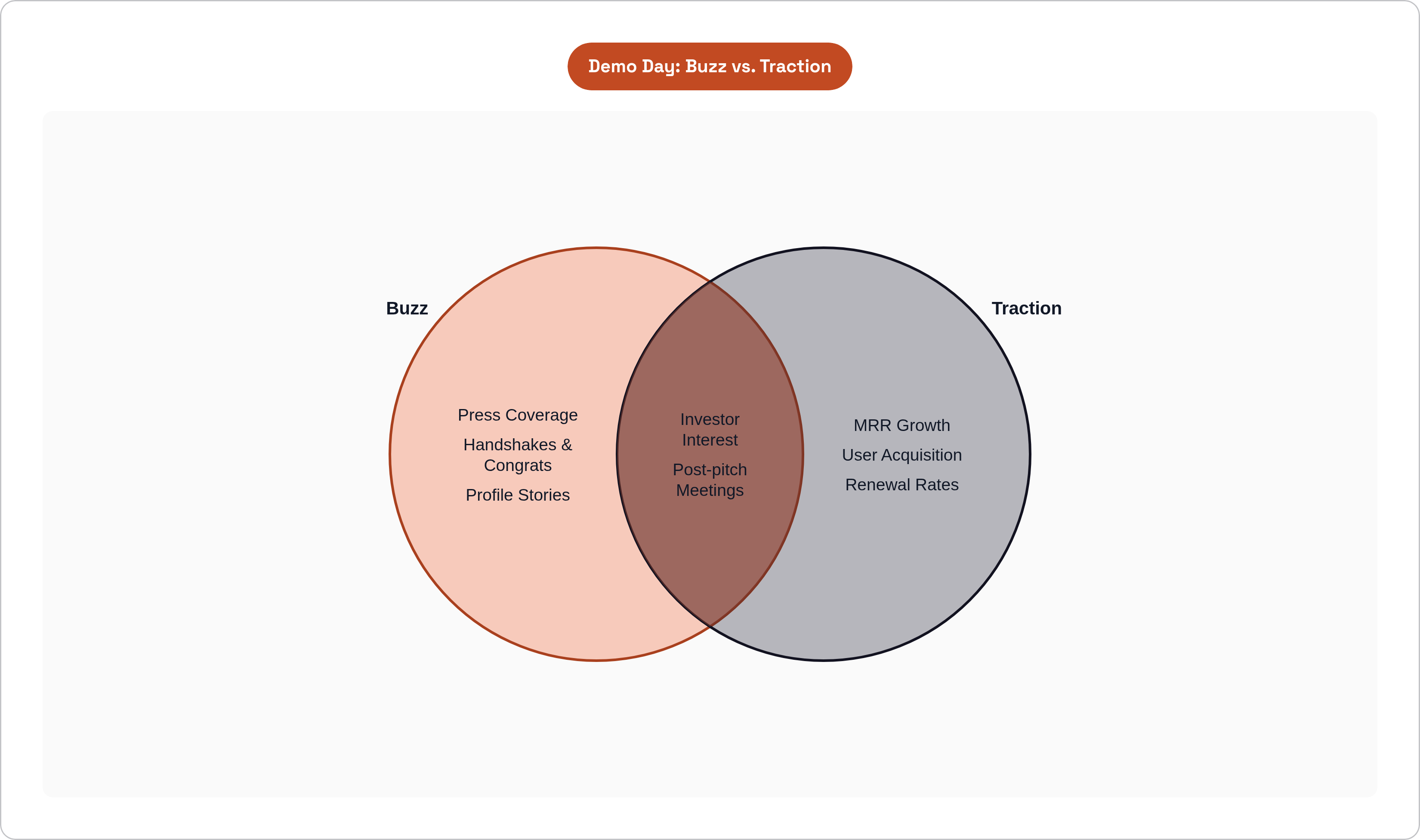
One more thing about the room: it's not just investors. Press and ecosystem players are in there too. Demo Day functions as a PR event as much as a fundraising one. That doesn't change how you should pitch, but it does explain why buzz gets mistaken for traction. Someone writing a profile of your company and someone wiring you money are two completely different outcomes. In the glow right after a good pitch, with people coming up to shake your hand and ask follow-up questions, it is genuinely easy to confuse the two. Think of buzz as sunlight and traction as rain — both feel good, but only one grows the crop.
What a Strong Demo Day Pitch Actually Contains
The structure of a Demo Day pitch is different from a standard investor meeting, and the difference matters because order is doing a lot of work when you have almost no time.
Here's the sequence that works:
- What you do (one sentence, plain English)
- The problem (with a number attached)
- Your solution (brief, specific, no buzzwords)
- Traction (your strongest metric, not buried at the end)
- Business model (one line)
- Market size (one number)
- Team
Three minutes. Six slides at most. If you can't get there in three minutes, that's actually useful diagnostic information. It usually means the thinking hasn't been pressure-tested enough yet.
The first 15 seconds carry most of the weight. Investors watching their twelfth pitch in a row will mentally move on if they can't place you immediately. You're not being judged harshly. You're just competing with fatigue and a full room. A weak opening is like arriving late to a first date — you can recover, but you're already behind.
The traction slide is the one that actually moves people. Not the origin story, not the problem narrative. Numbers. The kinds of metrics that make investors walk over after a pitch: $50K monthly recurring revenue (MRR) growing 20% month over month, 100,000 users acquired in three months with zero paid spend, a 90% customer renewal rate. YC coaches companies toward 10% week-over-week growth during the batch because that's the shape of chart investors are scanning for as a proxy for product-market fit. A clean growth line across the 10 to 12 weeks of the program is the minimum credible signal.
"We're growing" is not a number. Show the line.
The ask is where founders go vague, and vagueness costs meetings. State the amount you're raising and what it will accomplish. Typical YC Demo Day raises run from $1M to $3M in SAFEs in the days immediately after. Strong traction with competitive interest can push that to $3M to $10M or more. Most YC companies enter the post-Demo Day raise with YC's $500K already in the bank, which takes some pressure off and lets you negotiate without the clock feeling quite so loud.
Every slide is either earning a meeting request in the next 48 hours or it isn't. That's a genuinely useful frame to carry into the room.
Why Serious Investors Often Reach Founders Before Demo Day
The best investors don't wait for Demo Day. They track companies through the batch and try to get in front of the strongest ones before the post-event scramble. This is standard practice, not some insider secret.
Which means Demo Day ends up serving two very different investor populations at the same time. Investors already in dialogue use it as a signal-amplifier and a deadline-setter. It confirms their conviction and creates urgency. Investors who weren't tracking the company encounter it cold, and the pitch has to earn a first meeting from scratch in under two minutes. Those are completely different jobs, and building a pitch that works for both simultaneously is genuinely hard. Most pitches don't pull it off.
For the top companies in each batch, the post-Demo Day window compresses fast. Hundreds of investment offers within 48 hours is a documented reality at the top of each cohort. Investors who don't have a decision-making process ready before Demo Day miss those deals. By the time they've scheduled an internal call to discuss it, someone else has already signed.
The implication for founders is pretty direct: Demo Day is not the start of your fundraising process. It's a forcing function that accelerates a process that should already be underway. If you're meeting investors for the first time on Demo Day, you're behind. Not fatally behind, but behind.
The SAFE as the Standard Post-Demo Day Funding Instrument
Y Combinator invented the SAFE (Simple Agreement for Future Equity) in 2013 as an alternative to convertible notes. The core differences from a convertible note: no interest accruing, no maturity date hanging over you, and significantly less paperwork. It's simpler, faster, and more founder-friendly than a note, which is why it spread.
SAFEs made up 90% of all pre-seed deals on Carta in Q1 2025. At seed, 64% of all rounds over a recent 12-month period were SAFEs. YC has been pushing the instrument hard for over a decade, and the market followed.
The shift to post-money SAFEs is the specific thing worth understanding. In Q3 2024, 87% of all SAFEs issued were post-money, up from 43% at the start of the 2020s. YC updating its standard templates drove a lot of that shift. Post-money SAFEs give both sides a clearer picture of dilution at the time of signing, rather than leaving it as a variable to be calculated later when the math gets complicated and everyone's already tired of the process.
YC's own deal structure: $125K on a post-money SAFE for 7% equity, plus $375K on an uncapped MFN SAFE. Typical valuation caps at pre-seed run from around $4M to $15M. At seed, more commonly $10M to $30M.
Here's what founders underestimate. Repeated rounds of uncapped or low-cap SAFEs produce more dilution than expected when those instruments eventually convert, compressing your cap table faster than the headline numbers suggest. It's a known issue as the SAFE ecosystem has matured, and the cap table math can get genuinely messy. Understand it before term sheets arrive, not while you're reading them for the first time with a deadline attached.
What Happens in the 48 Hours After Demo Day (And Why Most Deals Are Won or Lost There)
Demo Day ends. The fundraising work starts immediately. This is where a lot of founders drop the ball, and honestly, it makes sense why. The event is exhausting. A good pitch creates this weird afterglow where you feel like the momentum will just carry itself forward. It won't.
Founders who arrive without a follow-up process already built lose deals the event surfaced. Here's what a functional post-Demo Day process actually looks like:
- Categorize every contact before the day ends. Warm lead, cold introduction, press inquiry. Know what you have while you still remember the conversations.
- Send follow-up emails within 24 hours. The context an investor had during your pitch degrades fast. Get back in front of them while you're still in their head.
- Use a simple CRM or shared tracker to manage your investor pipeline so co-founders aren't duplicating threads or quietly letting things fall through. A spreadsheet works fine. The tool matters less than the habit.
- Set a meeting target for the first week. The raise either has momentum or it doesn't, and securing a lead investor in that first week is usually what determines which one you're in.
The meeting is not the close. But without the meeting, there's no close. Everything flows through that one bottleneck, which is why the 48-hour window is where most deals are actually decided.
For investors, the parallel risk is real: showing up to Demo Day without a ready decision-making process means losing access to the top deals in the batch. Which is exactly why serious investors arrive with pre-formed conviction, not an open mind.
What the YC Application and Batch Experience Teach Founders Before They Ever Pitch
By the time a founder walks onto that Demo Day stage, they've already been through a serious filter. That part is easy to overlook from the outside.
YC's Summer 2025 acceptance rate was approximately 0.6%, the lowest in the program's history, implying application volume above 25,000 for that batch alone. Since 2005, YC has funded approximately 5,668 unique companies. The combined portfolio valuation exceeds $600 billion, with more than 100 companies valued above $1 billion.
What YC actually selects for, in rough priority order:
- Evidence you can build something people want (real users, real usage)
- A market that is genuinely large or growing fast
- A founding team with unusual skill or insight
About 40% of accepted companies in each batch are at the idea stage with no revenue. Traction matters less than most founders assume at the application stage. Clarity matters more. Most applications fail not because the idea is bad, but because the founder can't explain clearly what they're building, who it's for, and why they're the right person to build it.
The batch itself is three months, in person at YC's San Francisco campus. Weekly dinners, office hours, and each company is paired with a dedicated YC General Partner who is themselves a successful founder. That last part matters more than it looks on paper. The feedback isn't theoretical. It comes from people who've actually been through it, which changes the quality of the advice in ways that are genuinely hard to describe until you've experienced both kinds.
The 10% week-over-week growth target exists because it produces the chart investors respond to on Demo Day. That's the logic. The batch isn't separate from Demo Day prep. It is Demo Day prep. Everything the program does for three months is pointed at that two-minute window, and founders who internalize that use the time differently than the ones who treat the batch and the pitch as two separate things happening in sequence.
Reapplication is also worth knowing about. A meaningful share of accepted companies were rejected in a prior batch. YC explicitly wants to see momentum between applications. Getting in on the second or third try, having built something real in the meantime, isn't a consolation story. It's often a better signal than getting in on the first application with nothing to show yet. The program is betting on trajectory, not just starting position. YC doesn't just fund where you are — it funds where you're going.