Project Plan Templates for Early-Stage Startups
Stop building features and focus on answering one customer question.

This is the definition that shapes everything else, so get it right now and save yourself weeks of pain later.
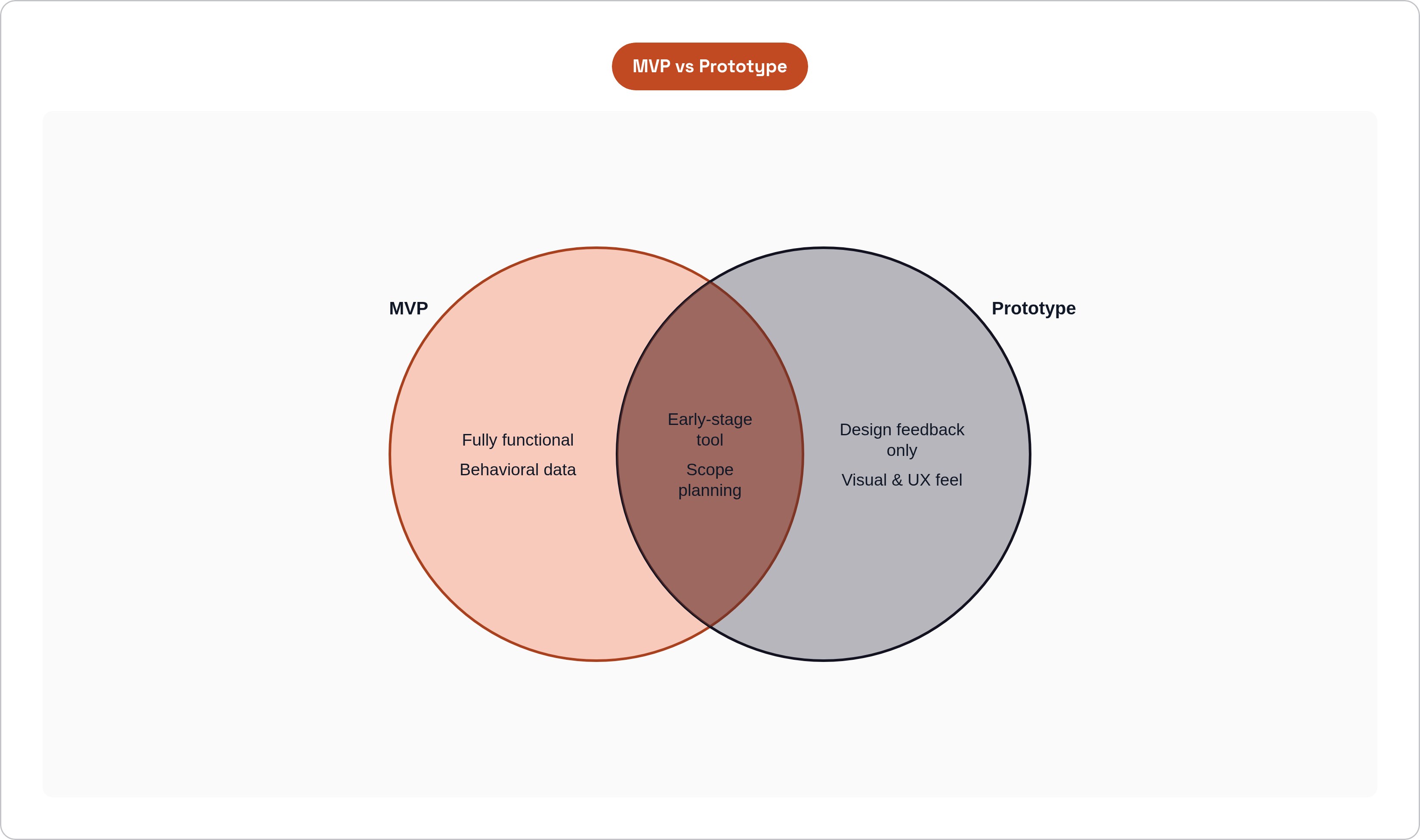
An MVP is not a stripped-down version of a finished product. It's a learning instrument — think of it as a fishing line, not a fishing boat. Built to answer one specific question about the market. That's it.
Airbnb's first version was three air mattresses and a basic website. Zappos validated shoe e-commerce by photographing shoes at local stores before they held a single unit of inventory. Neither team built a platform. Both teams built just enough to test whether anyone actually wanted the thing. These are what people call concierge MVPs. You manually deliver a service to test demand before building any systems around it.
There's also a distinction founders miss constantly, and it costs them badly when they do.
- A prototype tests how something looks and feels. Non-functional. Design-level feedback only.
- An MVP is fully functional. Real users interact with it. The output is behavioral data.
Founders build a project plan around a prototype timeline, then wonder why they're behind when real development kicks off. Those are two different scopes. Treating them as one is how you lose your first month.
The thing that should stop you cold: the most common MVP failure isn't a bad idea or a weak market. It's building too many features. Solving three problems adequately instead of one problem exceptionally well. Every time.
So the implication for your project plan is direct. The template must enforce a scope boundary — not just list features, but tie everything back to the single question the MVP is designed to answer. Everything else is derived from that question, or it doesn't belong in the build.
Feature Prioritization Gives the Template Its Spine
Without a prioritization framework, every section of your template is negotiable. And everything negotiable will expand under pressure. That's not a personality problem. It's just how building works.
The practical standard for early-stage teams is the MoSCoW framework. Simple. Highly effective.
- Must-have: Without this, the MVP cannot be tested at all.
- Should-have: Important, but the MVP ships without it if the timeline demands it.
- Could-have: Nice-to-have. Cut these first.
- Won't-have: Explicitly parked. Not rejected, just out of scope for this build.
The Won't-have column is as important as the Must-have column. It makes scope refusals defensible. When someone wants to add a feature mid-build, the conversation starts from "this was a deliberate Won't-have" rather than "should we add this?" That's a completely different conversation, and the distinction saves relationships.
If you have early user signal, the Kano model is worth knowing too. It distinguishes between baseline expectations, performance features, and delighters. Useful when you have interview data but need to rank across multiple dimensions.
The output of prioritization isn't a feature list. It's a boundary. A written constraint that every subsequent section of the project plan gets held against.
The Templates That Actually Fit a Startup
Most project management templates were built for teams with stable requirements, known stakeholders, and predictable delivery cycles. None of that describes a pre-launch startup. Using the wrong template doesn't just waste time — it creates false confidence that something is organized when it isn't.
Here are the ones worth knowing, and what each is actually optimized for.
Lean canvas (pre-template). Not a project plan, but the input that should come before one. Forces clarity on the problem, the customer segment, and the value proposition before scope is ever set. Do this first, even if it takes one afternoon.
Sprint-based plan (2-week cycles). Maps directly to agile development. Each sprint has a defined goal, a small backlog of Must-have tasks, and a review checkpoint. Scope stays tight because work that doesn't fit the sprint goal gets deferred, not added.
Milestone roadmap. Five to seven named milestones from kickoff to first user. Works well for solo founders or two-person teams who need a shared map, not a task manager. Each milestone has an owner, a definition of done, and a date.
MoSCoW scope doc plus timeline grid. Pairs the prioritization framework with a week-by-week execution grid. The most flexible format for teams that don't have a formal development process yet and need something they'll actually use.
Lightweight RACI chart. Only earns its overhead once a co-founder or early hire is in the picture. Clarifies who is Responsible, Accountable, Consulted, and Informed for each workstream. More on this in a bit.
No single template fits every startup. The right choice depends on team size, whether there's a technical co-founder, and whether requirements are fixed or still getting figured out. What all effective MVP-stage templates share: a visible scope boundary, named owners, and a mechanism for surfacing slippage before it becomes a real delay.
Six Phases, One Honest Plan
The six-phase structure that actually holds up for MVP development runs like this: Discovery, Feature Prioritization, User Journey Mapping, Technical Planning, Launch Strategy, Continuous Iteration. Here's what each phase needs from the project plan — and where teams tend to drop the ball.
Discovery. Document the one question the MVP is designed to answer. Capture the riskiest assumption. Name the target user. This section almost never gets written down. It almost always causes problems later because of that.
Feature Prioritization. The MoSCoW or Kano output lives here. The plan locks against this section, and additions require explicit renegotiation — not a Slack message, not a verbal agreement, actual renegotiation.
User Journey Mapping. Walk the primary user path end-to-end. Identify the one moment the MVP must nail. Prototype before you build. This is where you find the expensive gaps before they're expensive.
Technical Planning. Define the stack, third-party integrations, and any custom backend requirements. These are the variables that push an 8-week build to 16. Name them explicitly and early. Founders underestimate this phase more than any other.
Launch Strategy. Even a soft launch to ten users needs a plan. Who are they? How will you reach them? What data will you collect? Teams that get into an active feedback loop within 30 days of launch are dramatically more likely to find product-market fit. That's not a coincidence — it's the compounding effect of iterating while the signal is fresh.
Continuous Iteration. The plan doesn't end at launch. Build in a feedback loop: weekly review, a mechanism to reprioritize, and a decision rule for what counts as a signal worth acting on versus noise worth ignoring.
A lean MVP with a single platform and minimal features can ship in 8 to 10 weeks. Custom backend logic, third-party integrations, or multiple user roles push that to 12 to 16. A founder looking at the document on week six should be able to tell immediately where the team is and what the next real decision point is. If the plan doesn't make that visible, the plan isn't doing its job.
A Weekly Habit Beats a Perfect Document
A project plan is a point-in-time document. Reality starts diverging from it within days — sometimes hours. The plan's actual value comes from the process of updating it, not from how good it looked when you first wrote it.
Weekly check-ins do two things. They catch drift early, before a two-day slip compounds into a two-week delay. And they force a conscious decision about scope rather than letting the build quietly expand by default.
Here's a structure that works for the weekly review:
- What was completed against last week's milestone or sprint goal
- What was left incomplete, and why
- Whether the reason is a one-time obstacle or a signal the plan itself needs to change
- One decision about next week: adjust scope, adjust timeline, or hold the line
The temptation is to read slippage as a motivation problem. It's almost always a scope or dependency problem that a weekly review would have caught earlier and cheaper.
For co-founding teams, the weekly review also functions as an alignment ritual. The single most common co-founder friction point isn't money or equity — it's divergent assumptions about what's being built and by when. A ten-minute Monday check-in surfaces that before it becomes a real fight.
Progress tracking doesn't require software. A shared document, reviewed every Monday, is enough at this stage. The habit is what matters, not the platform you track it on.
Scope Creep Doesn't Knock. It Lets Itself In.
Scope creep at the MVP stage almost never comes from bad intentions. It comes from a founder's completely natural instinct to solve the problem more completely once they're deep in the build. You've been staring at the thing for six weeks. Of course you can see ten more things worth fixing. That instinct is actually a sign you care. It's also how MVPs die.
The common entry points are worth knowing by name so you recognize them when they show up.
- A user interview surfaces a related problem, and the founder adds a feature before validating whether it belongs in the core use case.
- A co-founder or early hire has a strong opinion about something that was explicitly parked in the Could-have or Won't-have column.
- A competitor ships something, and the team pivots toward feature parity instead of staying focused on the original MVP goal.
- A technical decision opens up new possibilities that weren't in the original scope, and suddenly the build is bigger than it was last week with no one having made a deliberate choice about that.
The MoSCoW scope document is a written record of decisions already made. When pressure to add something arises, the conversation begins from "we already decided this was out of scope" rather than reopening a negotiation from scratch. That's not a bureaucratic move. It's just using your past judgment to protect your future timeline.
Sprint-based plans block scope creep structurally. Work that doesn't fit the current sprint goal goes into the backlog, not the active sprint. The question shifts from "yes or no?" to "which sprint?" That shift sounds small and is actually enormous for team dynamics.
The right response to a new user signal is to document it and bring it to the next weekly review. Acting on it immediately is how reactive building accelerates scope creep into something that derails a launch.
Two Founders, One Plan, No Assumptions
Most early-stage startups are built by two-person founding teams — often one technical, one business-focused. Failory's 2025 data found that roughly three out of four unicorns were co-founded. The split is natural. It plays to different strengths. It also creates invisible coordination gaps that the project plan needs to close.
"Natural" doesn't mean "documented." A technical/business divide has an obvious workstream division built into it, but obvious and explicit are different things. The plan should make the division explicit.
- Technical workstream: features, stack decisions, sprint tasks
- Business workstream: user interviews, launch prep, early distribution, fundraising groundwork
- Shared: weekly review, scope decisions, milestone definitions
The RACI chart earns its overhead once there are two people because the cost of an unresolved assumption about ownership is high when there are only two people available to fix the fallout.
Co-founder coordination failures almost always look like execution problems on the surface. Missed deadlines, misaligned builds, features that don't connect. But underneath, they're usually planning problems — like an iceberg: the visible delay is small, but the hidden mass of unresolved assumptions underneath is what sinks the ship. No shared definition of done. No explicit owner for a workstream. No agreed mechanism for resolving a scope disagreement before it becomes personal.
The project plan also functions as a co-founder alignment document in a very practical way. A founder who can point to a written milestone definition and say "we agreed on this" has a much easier conversation than one who's relying on memory and goodwill.
And if you're still looking for a co-founder: a clear, structured MVP plan is a useful recruiting tool. It signals execution ability. It makes early conversations concrete rather than abstract. People want to join a build that feels real, and a solid plan makes it feel real.
Pick the Right Template for the Actual Stage You're In
The wrong template is worse than no template. A complex Gantt chart for a two-person pre-launch team adds overhead without adding clarity. Here's a simple decision guide that's actually based on team stage, not wishful thinking.
Pre-idea to first prototype. Lean canvas plus a simple milestone doc with five named checkpoints. No sprint structure needed yet. Keep it on one page if you can.
Prototype to MVP build, solo founder. MoSCoW scope doc plus a week-by-week timeline grid. Weekly self-review against the grid, even if it feels awkward to do it alone.
MVP build, two-person team with one technical founder. Sprint-based plan with 2-week cycles, plus a lightweight RACI for workstream ownership. Shared weekly review, non-negotiable.
MVP to first users. Milestone roadmap with explicit launch criteria plus a feedback collection plan. This is where the Continuous Iteration phase activates and the plan stops being a build document and starts being a learning document.
A few customization principles that hold regardless of which template you use:
- Add a scope boundary section. A Won't-have list with names and dates attached so there's no ambiguity about when the decision was made.
- Write every milestone's definition of done before the milestone begins, not after it's missed.
- Build in a weekly review slot from day one. It takes ten minutes and catches problems that otherwise take two weeks to surface and another two to fix.
The goal is the lightest structure that keeps scope tight, timelines honest, and progress visible. Not the most comprehensive plan imaginable. A template the team actually uses every week beats an elaborate one that gets updated once and then silently ignored while the build goes sideways.


