Entrepreneurial Operating System for Startup Teams
EOS works best for scaling companies, but early teams should steal three components.

EOS was not built for a two-person startup. Gino Wickman designed it, published Traction in 2011, and the system has since been adopted by tens of thousands of privately held companies. Almost all of them had something in common: an existing leadership team, somewhere between 10 and 250 employees, and a product or service that already worked. In other words, they had already figured out what they were building. EOS helped them figure out how to scale it.
That context matters. Because if you pick up Traction as a two-person founding team and try to implement the whole thing, you will spend real time on a 10-year target for a company that hasn't shipped yet, document processes that don't exist, and schedule quarterly off-sites for a team that sits three feet apart. That's not a framework problem. That's a mismatch problem. Trying to run EOS at the wrong stage is like wearing a suit of armor to a sprint — technically protection, completely the wrong gear.
Here's the actual thesis: EOS contains about six components, and roughly half of them are immediately useful to an early founding team. The other half are overhead you shouldn't carry yet. Knowing which is which is the whole game.
How the six EOS components map onto startup realities, one by one
EOS is not a software product. It's an operating framework built around six components: Vision, People, Data, Issues, Process, and Traction. Each one solves a specific dysfunction. Not all of them are your dysfunction right now.
Vision. The V/TO.
The Vision/Traction Organizer is a two-page document. It covers your core values, core focus, a 10-year target, a 3-year picture, a 1-year plan, and your quarterly Rocks. The idea is to get the whole leadership team aligned on where you're going and how you're getting there.
For a pre-product startup, the 10-year target and 3-year picture are mostly creative writing. Useful for alignment, sure. But extrapolating from zero traction is guesswork dressed up as strategy. Don't let it eat more than an hour of your time right now.
The quarterly Rocks, though. Those are immediately useful. More on them in a moment.
People. Right people, right seats.
EOS replaces the traditional org chart with an Accountability Chart. Each seat on it has three to five explicit accountabilities and a single named owner.
There's also the GWC filter: does this person Get it, Want it, and have the Capacity to do it? It's a clean lens for evaluating whether someone actually fits the role they're in, not just whether they're technically qualified.
For co-founders, the Accountability Chart is the most underrated tool in the whole system. Most early co-founder friction doesn't come from bad values. It comes from unspoken assumptions about who owns what. Drawing even a simple chart — you own product and engineering, I own vision and fundraising — surfaces the assumptions before they become arguments.
Data. The Scorecard.
EOS asks every team to track five to fifteen weekly numbers. Not monthly revenue. Weekly leading indicators. Things that tell you whether the business is healthy before the lagging numbers catch up.
For a pre-product team, those numbers look different than they do for a company with customers. User interviews completed. Prototypes reviewed. Landing page conversion. But the discipline is identical. Pick numbers, assign owners, check them every week.
Issues. The Issues List and IDS.
IDS stands for Identify, Discuss, Solve. It's a structured method for clearing the Issues List in every meeting. The insight behind it is almost embarrassingly simple: most teams surface problems but never actually resolve them. They discuss endlessly, table the hard ones, and revisit the same issues for months.
IDS fixes that. You identify the real issue (not the symptom), discuss it long enough to understand it, and solve it before the meeting ends. This requires no infrastructure. Just discipline.
Process. Core Processes.
EOS asks companies to document their six to ten core processes so everyone follows them the same way. Sales, operations, onboarding, HR.
For a pre-product startup, this is mostly irrelevant. You don't have repeatable processes yet. You have experiments. Documenting them prematurely creates the illusion of a working business before one actually exists.
The one exception: if you're running a Concierge MVP and manually delivering a service to validate demand, rough process notes help you figure out what eventually gets automated. That's useful. But it's different from formal EOS process documentation.
Traction. Rocks and the Meeting Pulse.
The Traction component is about converting vision into execution through a structured meeting cadence. Annual planning sessions, quarterly reviews, weekly L10 meetings, and daily huddles where needed.
The weekly L10 is the crown jewel. Ninety minutes, fixed agenda, same time every week. It's the most immediately portable element of EOS for a small team, and the one that replaces the most dysfunction fastest.
Where EOS fits best in the startup lifecycle — and where it doesn't yet
The honest answer is that EOS was built for the scaling stage. Post-product-market fit, team growing past ten people, execution becoming the constraint. That's the target customer.
But different pieces of EOS earn their overhead at different points.
Pre-product (idea through MVP): The full system is premature. What's worth doing: Rocks, Scorecard discipline, IDS in meetings, and an Accountability Chart to clarify co-founder ownership. What's not worth doing yet: Core Processes, the long-range V/TO planning, and a formal Meeting Pulse beyond a simple weekly sync.
Post-launch, early traction (product is live, first users, team of three to eight): The L10 meeting starts earning its overhead here. Once you have a Scorecard with retention, activation, and conversion numbers in it, the meeting has real substance. The Accountability Chart also becomes critical as you add your first non-founder hires. Ambiguity about ownership is the source of most early management failure.
Scaling (Series A territory, team of ten or more): This is the stage EOS was built for. Core Processes documentation matters now because customer support, onboarding, and sales motions need consistency across a growing team. The People component's Right People, Right Seats analysis becomes a formal quarterly exercise.
The failure mode to avoid: founders discover EOS at the scaling stage, try to retrofit it onto a team that has never had any operating structure, and face resistance from people who are used to doing things however they want. Installing it earlier at a lighter weight is easier than installing it fully later.
The Rocks and Scorecard as the entry point for most founding teams
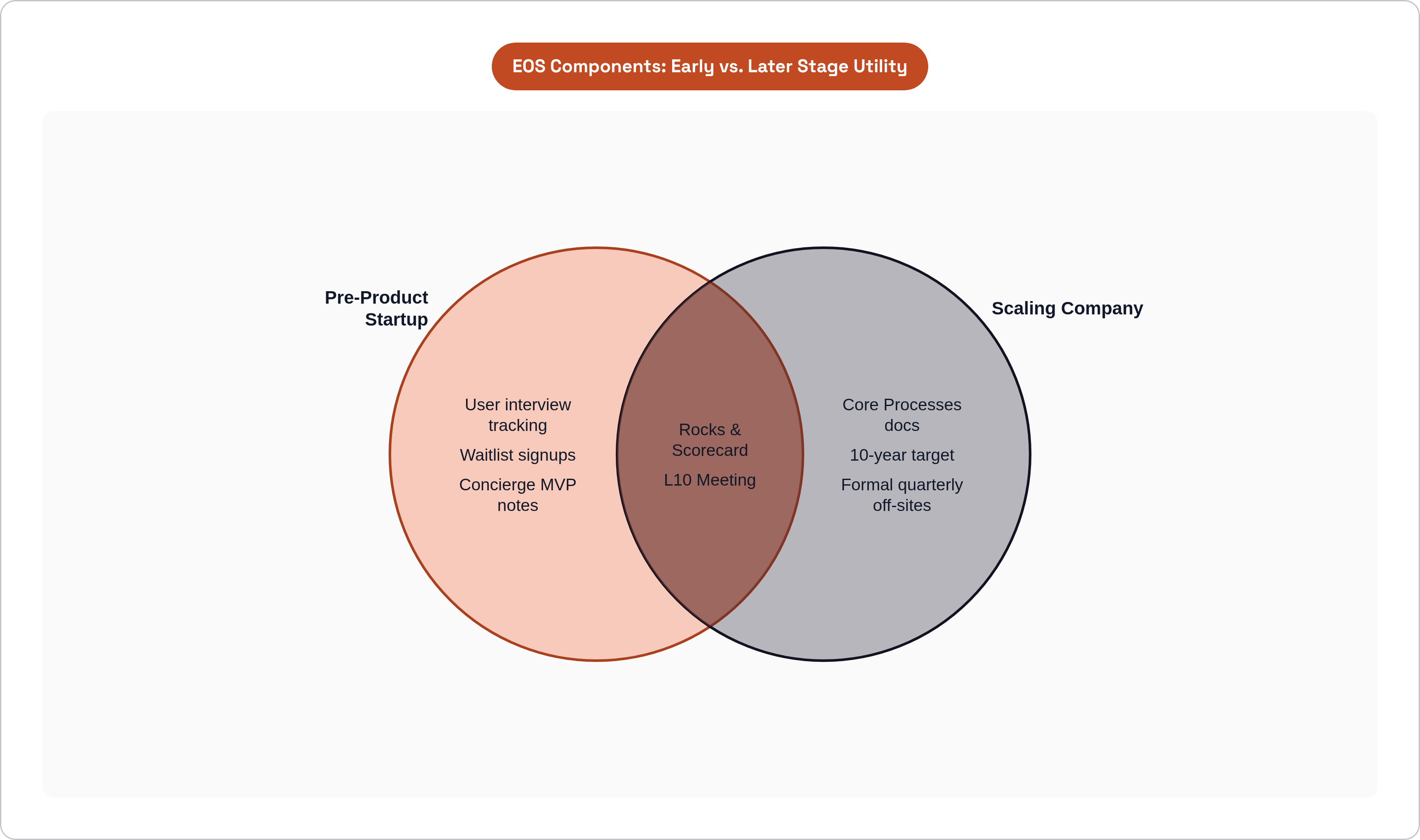
These two tools do more per hour invested than anything else in EOS for an early-stage team.
Rocks
Rocks are 90-day priorities. You set three to seven per quarter. Each one has a single owner. At the end of the quarter, each Rock is either done or not done. Binary. No partial credit.
The 90-day timeframe is deliberate. Long enough to accomplish something meaningful. Short enough to stay relevant given how fast startup context shifts.
The discipline that matters most: each Rock has one owner. Not "the founding team." Not "we'll both work on it." One person. That's the move that makes accountability real.
At the pre-product stage, Rocks might look like: ship MVP by week ten, complete twenty user interviews, hit one hundred signups on the waitlist. Concrete. Binary. Owned.
Scorecard
Five to fifteen weekly numbers, each with an owner and a weekly goal. The numbers tell you whether you're healthy right now, not three months ago when the last revenue report came in.
For a pre-launch team: interviews scheduled this week, prototypes reviewed, landing page conversion rate. For a post-launch team: activation rate, week-one retention, support tickets resolved, cost per acquisition on this week's experiment.
The Scorecard keeps early founders honest in a specific way. Without it, it's easy to rationalize drift. You had a good conversation with a potential user, so you feel like things are moving. The Scorecard doesn't care about the conversation. It cares whether you hit the number.
How they work together
Rocks set the quarterly destination. The Scorecard confirms you're moving toward it every week. Together they replace the informal "how do you think it's going?" check-in with something that can surface problems while there's still time to fix them.
How the People component addresses the co-founder ownership problem
CB Insights has published research identifying co-founder conflict as one of the top reasons startups fail. The breakdown usually isn't about values or vision at the highest level. It's about unspoken assumptions. Who owns the product roadmap? Who makes the final call on a hire? Who gets to commit the engineering timeline?
The Accountability Chart is the EOS answer. Each seat on the chart has three to five explicit accountabilities, a single named owner, and gets reviewed quarterly.
For a two-person founding team, even the simplest version of this is powerful. CEO seat: vision, fundraising, hiring. CTO seat: product, engineering, infrastructure. That level of explicitness prevents most early friction before it has a chance to calcify.
There's a real-world version of this principle in how Airbnb's founders divided responsibility early. Chesky owned vision, Gebbia owned design, Blecharczyk owned technology. The role definition happened at the founding stage. Not after conflict emerged. That's the move.
The GWC filter (Get it, Want it, Capacity to do it) is more useful for evaluating early hires than for evaluating co-founders. But it does surface one honest question about co-founders: does each person genuinely want the seat they're in, or are they filling a gap because nobody else is available? Those are very different situations, and the Accountability Chart makes you look at them directly.
One other thing worth knowing: EOS's own guidance suggests that leadership teams above four people start creating friction in the system. A two- to three-person founding team is actually the ideal size for EOS's People tools to operate cleanly. You're not too small for this component. You're the right size for it.
The L10 meeting as a weekly operating rhythm for small teams
The L10 is ninety minutes. Fixed agenda. Same time every week. Here's how it runs:
- Segue (5 min): One personal best, one professional best. Resets the room, gets people out of their heads.
- Scorecard review (5 min): Go through each number, each owner. Call out anything off-track. No problem-solving here yet.
- Rock review (5 min): Is each Rock on track or off track. Binary. No discussion in this segment.
- Customer and employee headlines (5 min): Good news or bad news. Surface things worth putting on the Issues List.
- To-do list (5 min): Review last week's 7-day to-dos. Done or not done.
- Issues List and IDS (60 min): The heart of the meeting. Prioritize the top three issues and IDS each one to resolution.
- Conclude (5 min): Recap to-dos, note any messages to cascade to the wider team, rate the meeting one to ten.
For a two-person founding team, the full ninety-minute format probably runs shorter. The segue and conclude compress naturally. The Scorecard and Rock reviews go faster with fewer people. You'll likely land somewhere around sixty minutes.
The non-negotiable element is the Issues List. It gets IDS'd to resolution every single week. Not tabled. Not "let's circle back on this next month." Resolved.
What the L10 replaces is worth naming explicitly. It replaces the long, agenda-free founder sync that covers everything and resolves nothing. It replaces the async Slack thread where decisions get made informally and nobody is entirely sure what was actually decided. Both of those are forms of dysfunction that feel fine until they're not.
The rating at the end (each person scores the meeting one to ten, average gets reported) is a small accountability signal that earns its thirty seconds. If your meetings consistently score below seven, the meeting isn't working and you have to fix it. That's a useful forcing function.
Where EOS creates overhead a startup shouldn't carry yet
There are real places where EOS asks for time and structure that an early team doesn't have and shouldn't build yet.
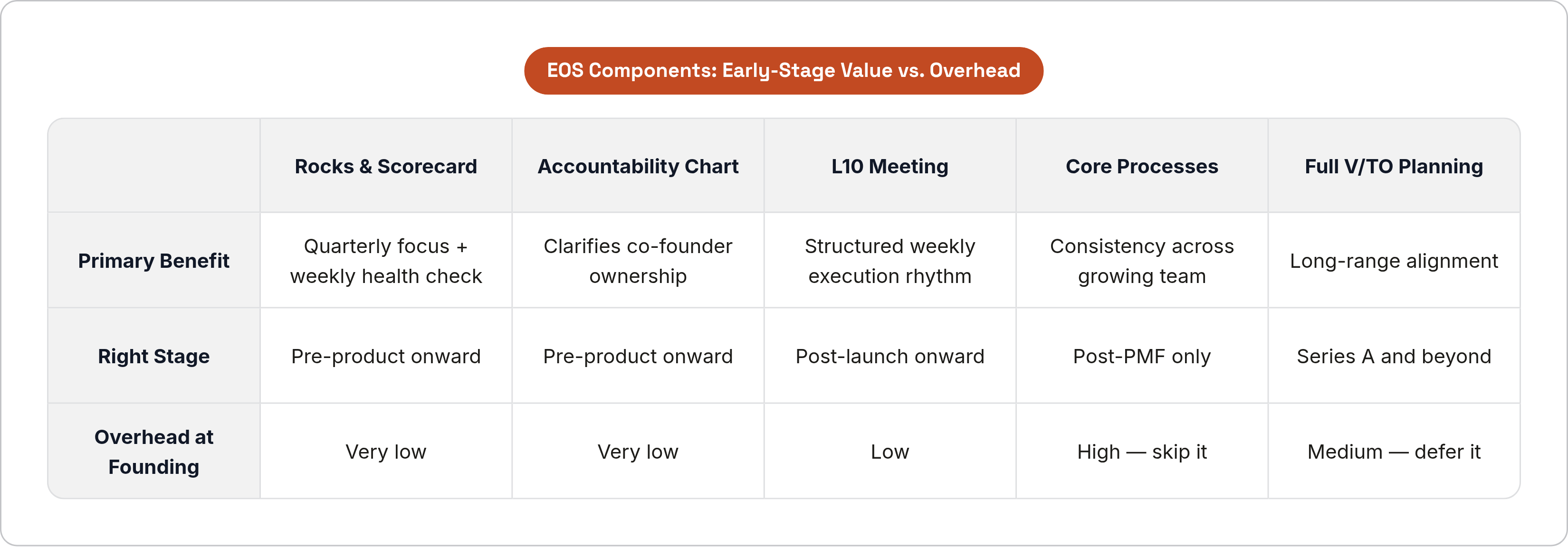
Core Processes documentation is the biggest one. EOS asks companies to identify and document their six to ten core processes so every person runs them the same way. A pre-product startup doesn't have repeatable processes. It has experiments. Documenting them before they've been validated creates the illusion of a working business. Skip this until you've found product-market fit and are actually training new people on a consistent motion.
The full V/TO long-range planning (10-year target, 3-year picture) is worth a few hours of founder conversation for alignment purposes. It's not worth treating as a serious planning exercise when you haven't launched yet. Do the quarterly Rocks and the 1-year plan. Defer the longer horizons until you have traction data to extrapolate from.
Hiring a certified EOS Implementer costs real money. It also presupposes a leadership team large enough that an outside facilitator adds value over what the team can do itself. This isn't the right entry point before Series A. The self-implementation path using Traction and the free tools at EOSWorldwide.com is the right call for early teams.
Formal quarterly off-sites with full-day sessions are appropriate at ten or more people. At two to three, they're overhead dressed up as rigor.
The underlying principle is worth stating clearly: EOS presents itself as a complete system, but it's modular in practice. Founders who pick up the high-ROI tools first (Rocks, Scorecard, L10, Accountability Chart) and add complexity as the team grows are using it correctly. The goal isn't to implement EOS. The goal is to build a company that works.
Putting a minimal EOS stack together for a founding team of two or three
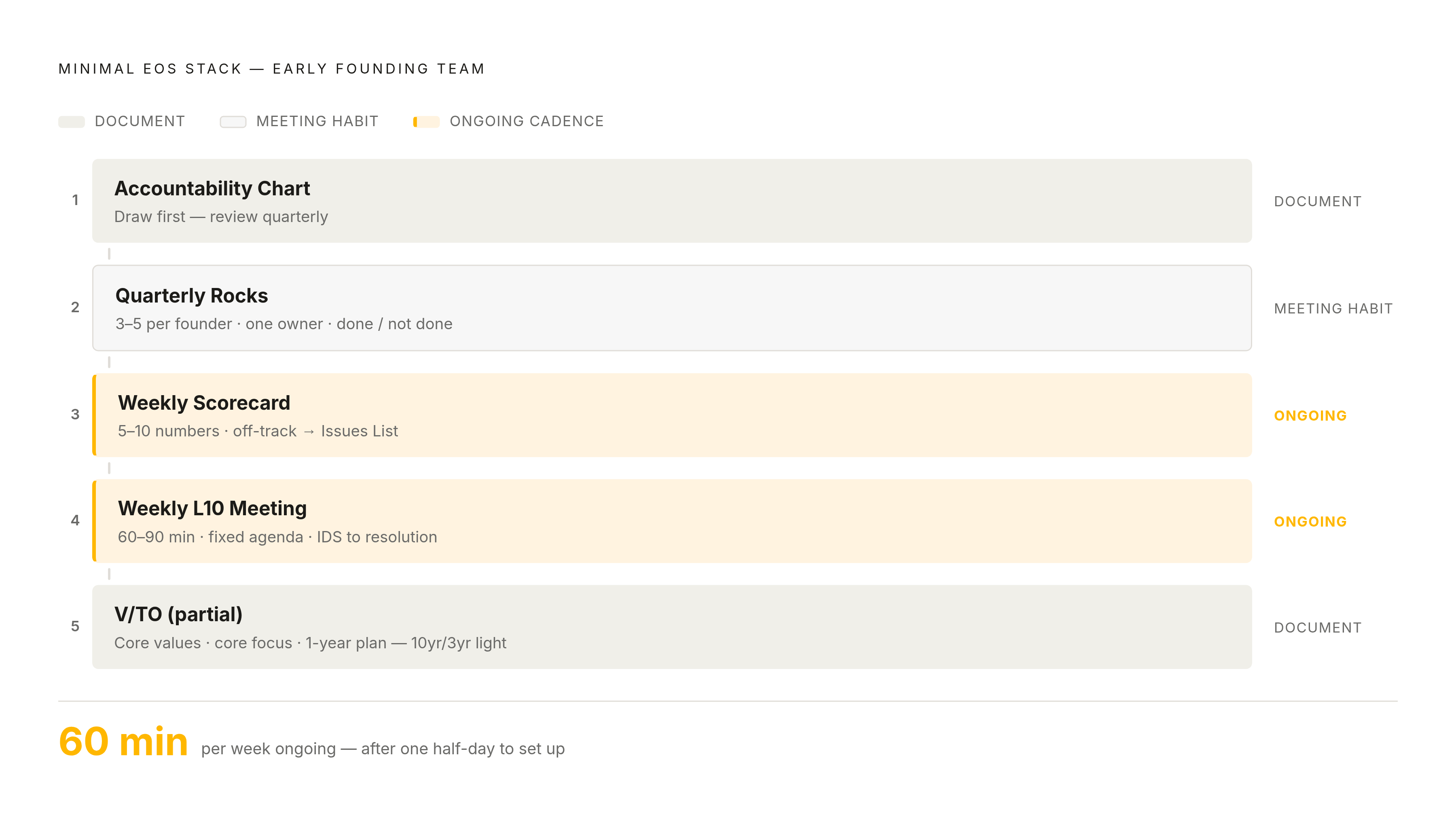
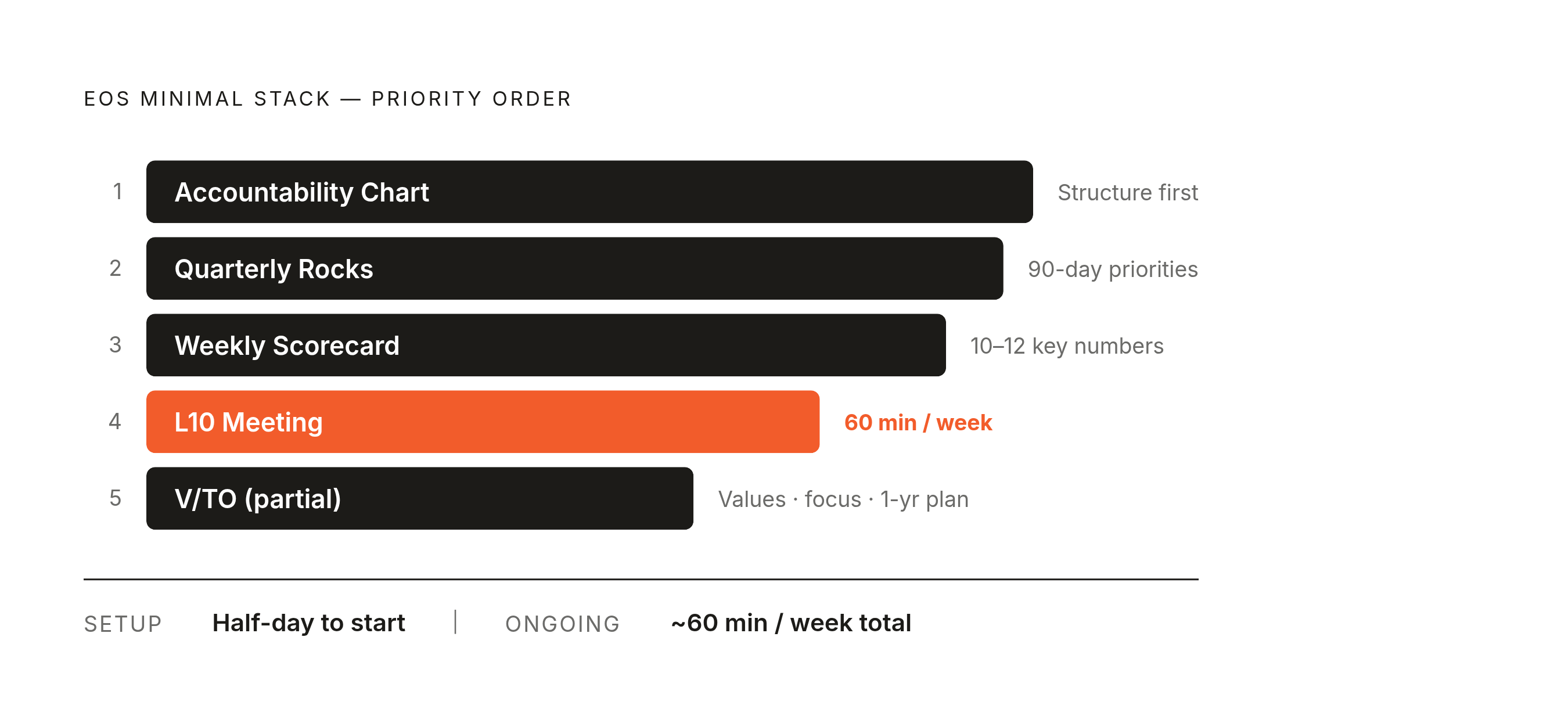
Here's what the actual minimal stack looks like. No fluff, no overhead.
Accountability Chart. Draw it before anything else. Even if it's just two seats. Write down the three to five things each person explicitly owns. Review it once a quarter and update it as roles shift.
Quarterly Rocks. At the start of each quarter, each founder names three to five Rocks. Each Rock has one owner. At the end of the quarter, each Rock is done or not done. That's it.
Weekly Scorecard. Pick five to ten numbers. Assign each one to a person. Review them every week. When a number is off-track, put it on the Issues List.
Weekly L10 meeting. Same time every week. Sixty to ninety minutes. Follow the agenda. IDS everything on the Issues List to resolution before the meeting ends.
V/TO (partial). Fill out the core values, core focus, 1-year plan, and quarterly Rocks sections. Leave the 10-year and 3-year sections light until you have traction. Update the 1-year plan every quarter.
That's the stack. Five elements. Three of them are meeting structures or habits. Two of them are documents you maintain over time. The total implementation overhead to get started is one half-day to draw the Accountability Chart and V/TO skeleton, and about sixty minutes per week from that point forward.
EOS wasn't built for a two-person founding team. But these five pieces were always going to be useful for one. The rest can wait until you've earned the complexity.


