Payroll Tools for Startups Hiring First Employees
Payroll mistakes can cost startups their runway—here's how to avoid the biggest traps when hiring.

Here's a number that should give you pause: according to Alight's 2024 Company Payroll Complexity Report, 53% of surveyed companies had incurred payroll penalties in the prior five years due to non-compliance. Not a fringe problem. The majority.
For an enterprise, a penalty is a line item. For a startup, it can be a runway event.
IRS late deposit penalties escalate fast. A deposit that is just 16 days late on $50,000 in quarterly payroll taxes costs $5,000 in penalties alone, before interest. The penalty structure is designed to punish delay. There is no grace period that softens the blow when you are late and broke.
The other cost founders underestimate is employee trust. A 2025 survey found that 44% of employees have noticed a payroll error at some point, and 50% will start looking for a new job after just two of them. When your entire team is two or three people, losing one because of a fixable administrative mistake is not just painful. It can be unrecoverable.
The upside of getting this right with software is real. Automated payroll processing can reduce errors by up to 50% and cut processing time by around 25%. Those are not small margins for a founder who is also the CEO, the head of sales, and occasionally the person rebooting the router.
88% of small businesses say payroll tax laws are too complex to manage on their own. That is an accurate read of the situation, not a failure of intelligence.
The Classification Decision Happens Before the First Paycheck
Every founder needs to answer one question before running payroll: is this person an employee or an independent contractor?
This is not a stylistic choice. It is not a budget preference. And it is definitely not determined by what your contract says.
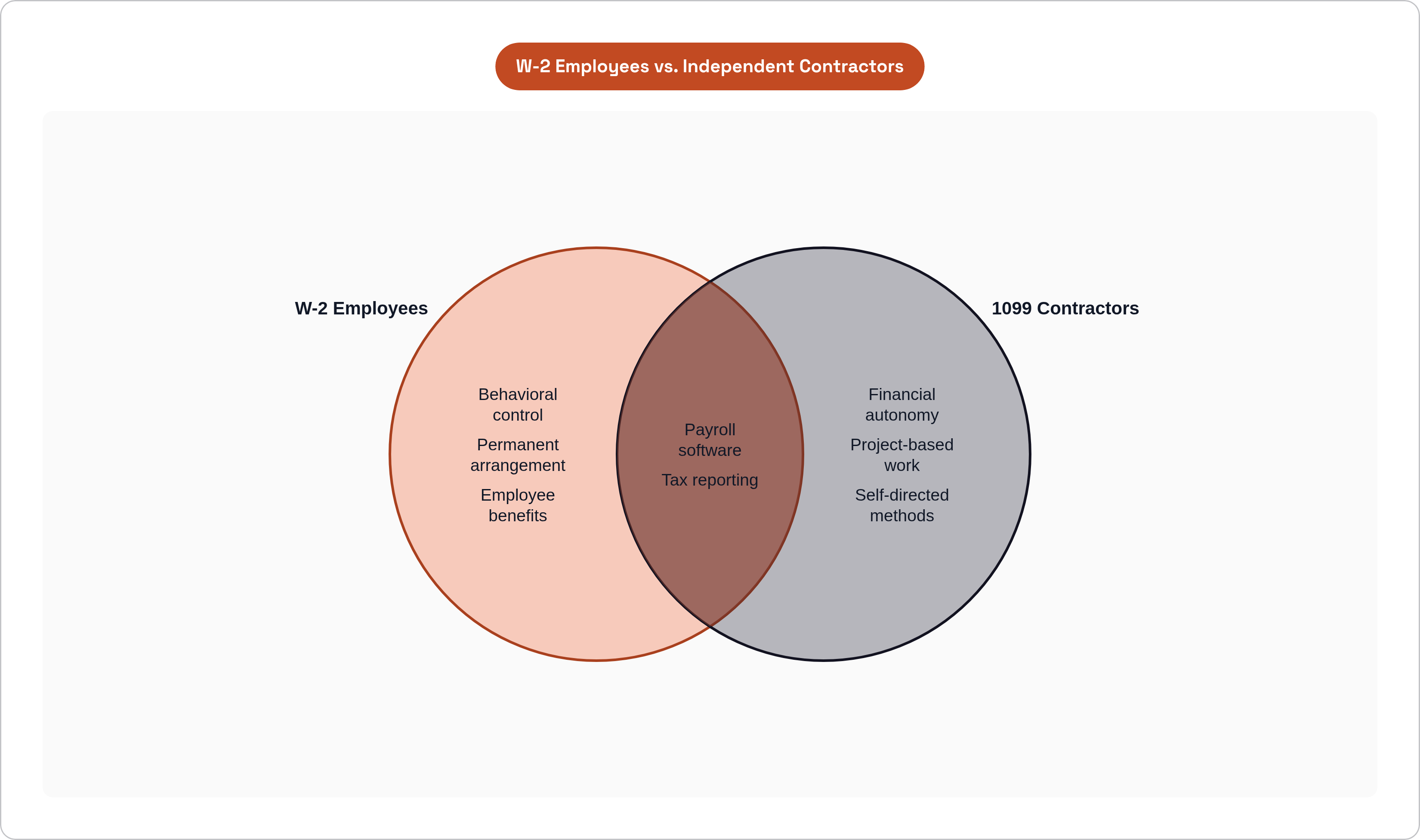
The IRS applies a multi-factor test that looks at three things:
- Behavioral control. Do you control how the work gets done?
- Financial control. Do you control the business aspects of the worker's job?
- Nature of the relationship. Is there a permanent arrangement? Are there employee-type benefits?
The IRS will look past whatever the contract says and examine the actual working relationship. Founders confidently hand someone a 1099 because their lawyer drafted an "independent contractor agreement," and then discover the IRS disagreed with that framing entirely. It happens more than you'd think, and the fallout is significant.
Worker misclassification penalties can reach 100% of unpaid taxes, plus interest. For a pre-revenue startup, that is a survival-level event.
When in doubt, classify as employee. If you are relying on contractor arrangements for core work, talk to an employment attorney before you commit to that structure.
Most payroll tools handle both W-2 and 1099 workflows, so that part is easy enough. But the software will run whatever classification you feed it. The judgment call is yours.
Hiring One Remote Employee in Another State Is Basically a New Compliance Universe
A single employee in another state triggers employment tax nexus, also called payroll tax nexus, in that state. That typically means registering with the state within 15 to 20 days of first wages paid. From there, that state has its own withholding requirements, its own unemployment tax (SUTA), its own minimum wage, and its own filing deadlines. None of it automatically aligns with your home state.
And the regulatory environment keeps moving. As of January 1, 2026:
- 19 states are raising minimum wages
- Three new paid family and medical leave programs are launching
- Pay transparency laws are now active in 17 states
Multi-state payroll compliance is not a static checklist. The rules shift, deadlines vary, and the cost of missing a registration in a state where you have one employee is not proportional to the size of that team. The fine does not care that you only have three people.
This is where your choice of payroll tool has the most immediate practical consequences. Spreadsheets and manual processes break down fastest when state lines are involved. Multi-state capability should not be a premium feature you evaluate later. It should be a baseline requirement before you post a remote job listing.
If there is any chance you are hiring out of state in the next 12 months, treat it as certain when evaluating tools.
The 2026 W-2 Changes Are Already Your Problem
The One Big Beautiful Bill Act, signed in July 2025, introduced new W-2 reporting requirements that apply to 2026 W-2s. Two changes matter most for early-stage startups.
First, employers must separately track and report the premium portion of overtime compensation in a new Box 12 code. Only the "half" in time-and-a-half qualifies. If you have hourly or non-exempt employees, your payroll system needs to be categorizing this correctly from the first 2026 pay period. Not eventually. From the first one.
Second, startups with tipped employees must report qualified tips in Box 12 (Code TP) and a new Treasury Tipped Occupation Code in Box 14b.
Good payroll software will handle this automatically. But "automatically" only works if the vendor has already built for it. When you are evaluating tools right now, ask directly whether 2026 OBBBA compliance is on the roadmap. Any vendor worth trusting should answer that without hesitation. If they fumble the question, that tells you something.
The tracking needs to start from your first 2026 payroll run, which means the setup decision is happening now, whether or not it feels urgent.
The R&D Payroll Tax Credit That Most Technical Founders Are Leaving on the Table
This one catches a lot of founders off guard, so let me be direct about it.
If your startup has less than $5 million in gross receipts and no more than five years of gross receipts history, you qualify as a Qualified Small Business for Section 41 R&D tax credit purposes. That means you can use the R&D tax credit to offset payroll taxes, up to $500,000 per year as of January 2023.
The same legislation that introduced the 2026 W-2 changes, the OBBBA, also permanently restored immediate expensing for domestic R&D costs. Engineering salaries, cloud infrastructure, and contractor costs are now fully deductible in the year they are incurred. This reverses the mandatory amortization period that was in place from 2022 through 2024.
If your startup was expensing R&D during that window, you can amend returns to reclaim those deductions. But you need to act by July 6, 2026.
The practical magnitude here is real. A startup spending $600,000 annually on engineering and cloud costs can recover $40,000 to $60,000 per year in payroll taxes. That is actual runway without dilution.
Here is the part that bites founders in year two or three: claiming this credit requires accurate, categorized payroll records from day one. Sloppy payroll records from year one create a cost you feel much later, usually right when you are trying to close a funding round and someone asks for clean financials. By then, fixing it cleanly is mostly not an option.
What to Actually Look for in a Payroll Tool Before You Hire
Evaluate these features before the first hire, not after you realize one of them is missing.
- Automatic tax filings across all required jurisdictions. Federal (Form 941, FUTA), state, and local. You should not be manually remitting withholding.
- Multi-state support from day one. Even if your first hire is local, this matters if remote hiring is possible in the next year.
- Employee self-service and onboarding flows. W-4 collection, direct deposit setup, and new hire reporting to state directories should happen without you managing paper forms.
- Integration with your accounting software. If you are running QuickBooks or Xero, your payroll tool should connect cleanly. Double data entry is where errors breed.
- Support for both W-2 and 1099 in the same platform. Most early startups use a mix. Your tool should handle both without requiring a workaround.
- Transparent per-employee pricing. Model the cost at five and ten employees, not just one. The jump can be significant.
- OBBBA 2026 readiness. Ask the vendor directly. Any tool worth using should be able to answer this without stalling.
The Tools That Are Actually Built for the First-Hire Moment
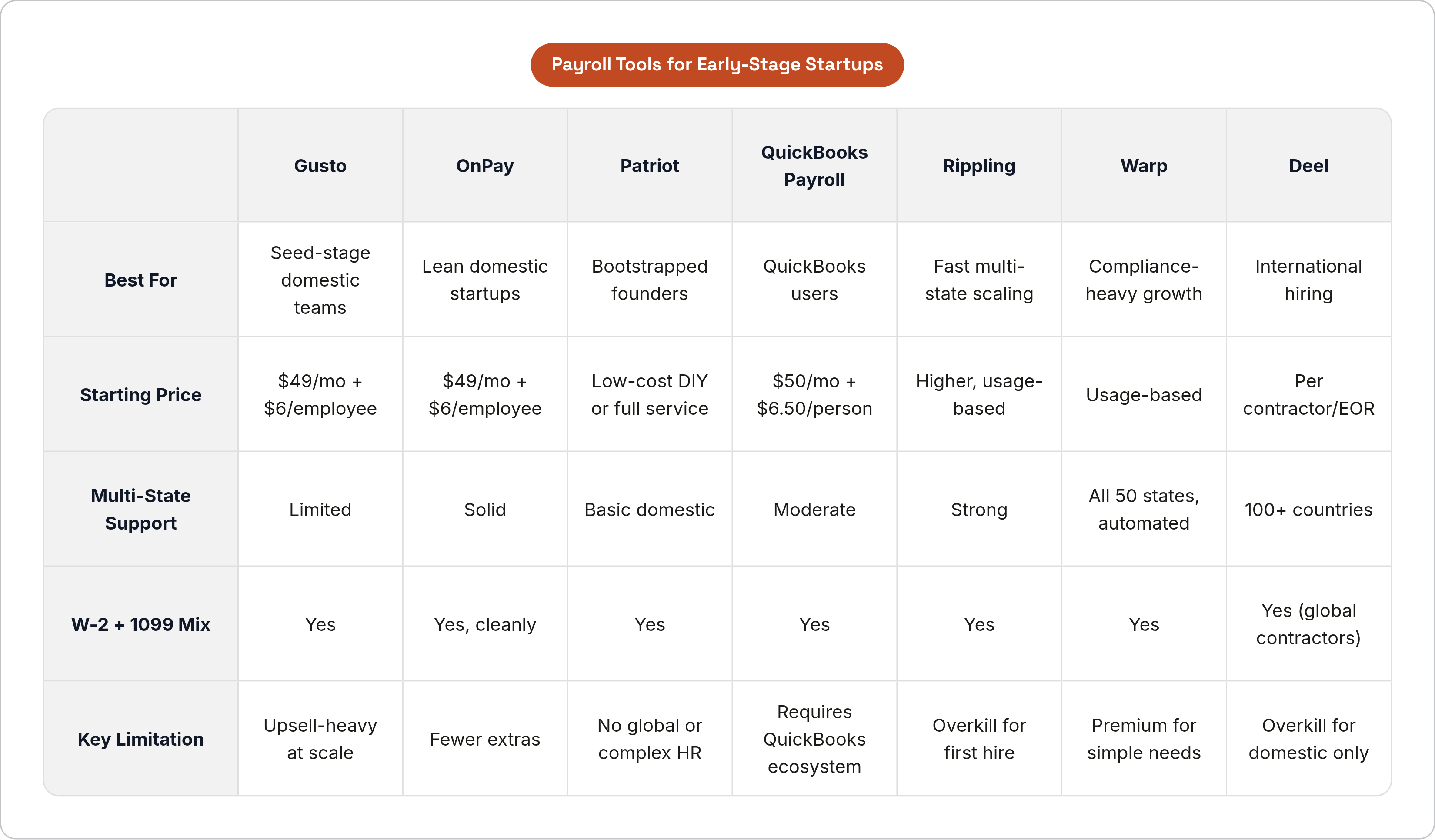
Not all payroll tools are the same. The ones built for enterprise HR are not necessarily the right choice when you are trying to run your first payroll and also close a sales deal by Thursday.
Gusto is the most common first choice for early-stage domestic startups, and the reputation is mostly earned. The Simple plan runs $49 per month plus $6 per employee. It handles federal and state tax filings automatically, the onboarding flow is good, and benefits administration is built in. The limitations show up if you scale internationally or need complex HR workflows. For a seed-stage team of two to ten people, it works.
OnPay matches Gusto's pricing ($49 per month plus $6 per employee) and is a smart pick for lean domestic startups that want reliability without a lot of extras. It handles multi-state payroll well and supports mixed W-2 and 1099 teams cleanly. Less flashy than Gusto, more reliable in some edge cases. Some founders switch from Gusto to OnPay simply because they got tired of the upsells, which says something about both products.
Patriot Payroll is the budget option for bootstrapped founders. The Basic plan is the DIY filing version. The Full Service plan handles filings for you. Simple, affordable, and right for straightforward domestic payroll. Not built for global hiring or complex HR.
QuickBooks Payroll is the natural fit for startups already running their books in QuickBooks Online. The integration reduces reconciliation work significantly. It starts at $50 per month plus $6.50 per person. If you are already in the QuickBooks ecosystem, this removes more friction than switching to a standalone tool. If you are not in that ecosystem, it is less compelling.
Rippling is built for startups that expect to scale fast, across states or internationally. Payroll, HR, and IT live in one platform. There are hundreds of integrations. Payroll processes in 90 seconds. It is more platform than a first-hire-only operation needs, and priced accordingly. Worth considering when multi-state growth is imminent rather than hypothetical.
Warp is an AI-native platform that monitors more than 10,000 tax jurisdictions and auto-handles registrations and filings in all 50 states. Average employee onboarding is around 10 minutes. Purpose-built for compliance-heavy or fast-scaling startups, and a strong choice if multi-state complexity is already in play rather than just on the roadmap.
Deel is the right call when international hiring is part of the plan from day one. It covers employer-of-record (EOR) and payroll in more than 100 countries and handles instant payments in more than 200 currencies. Overkill for a purely domestic first hire. Exactly right when your first employee is abroad.
Square Payroll is built for retail, hospitality, and service businesses with hourly or tipped employees. If you are running a Square POS, the payroll integration is genuinely useful. If you are a tech startup, this is probably not your tool.
ADP Run brings enterprise-grade compliance depth and multi-state reliability. Strong fit for regulated industries or complex situations. Also more infrastructure than most seed-stage startups need, and priced to match.
The Right Tool Depends on Where You Actually Are Right Now
Start with one clarifying question: are you hiring domestically only, or is remote or international hiring likely in the next 12 months? That answer narrows the field fast.
- Bootstrapped founder, one or two domestic W-2 employees: Patriot or OnPay. Low cost, handles the essentials, no unnecessary complexity.
- Seed-stage startup, domestic growth expected, want payroll and benefits in one place: Gusto is the default starting point. Most founders who use it are satisfied at this stage.
- Already running your finances in QuickBooks: QuickBooks Payroll removes the most integration friction. Stay in the ecosystem.
- Remote-first team, hiring across state lines, or planning to: Rippling or Warp. The automated jurisdiction handling is worth the higher cost given what it costs to get multi-state compliance wrong.
- Hiring internationally from the first hire: Deel. No domestic tool is built for what Deel handles.
One more thing worth saying clearly: switching payroll providers mid-year is painful. Employees notice it. Filings get complicated. Integrations break. The data migration is annoying in ways that are hard to describe until you are three hours into a support call trying to reconcile Q2 tax deposits across two platforms.
Make a careful choice before the first payroll runs. The right tool is far easier to appreciate before you have discovered the hard way what your current one cannot do.