Startup Accounting Software Beyond QuickBooks

Most founders think their accounting problem is a software problem. It isn't; it's a stage problem.
QuickBooks isn't bad software. It's just software built for a different kind of business. A steady-revenue, paper-check-era, reconcile-once-a-month kind of business. The assumptions baked into its architecture made perfect sense decades ago; they make a lot less sense when your payment processor, corporate card, and bank feed are all updating in real time and you need to know your runway before your next board call.
The real issue is velocity. Legacy ledger tools were designed for businesses that move slowly. Startups don't. And when you try to pour a high-velocity financial stream into a system built for slower water, things break. Visibility breaks. Timing breaks. Your ability to answer the one question that actually matters. How much cash do we have, and how long does it last?
That question doesn't live in a traditional general ledger at all. Burn rate and runway have to be reconstructed by hand, in spreadsheets, from exported data. That's not a minor inconvenience; cash-flow failure is one of the leading causes of startup death. Not product failure. Market presence alone isn't enough either. Running out of money without seeing it coming. Founders flying blind on real-time cash are like pilots navigating by stars they can't see — the ones most exposed to that outcome.
So the question isn't "should I use QuickBooks?" The question is: what does your startup actually need right now, based on where it actually is?
How Accounting Needs Shift as a Startup Moves Through Stages
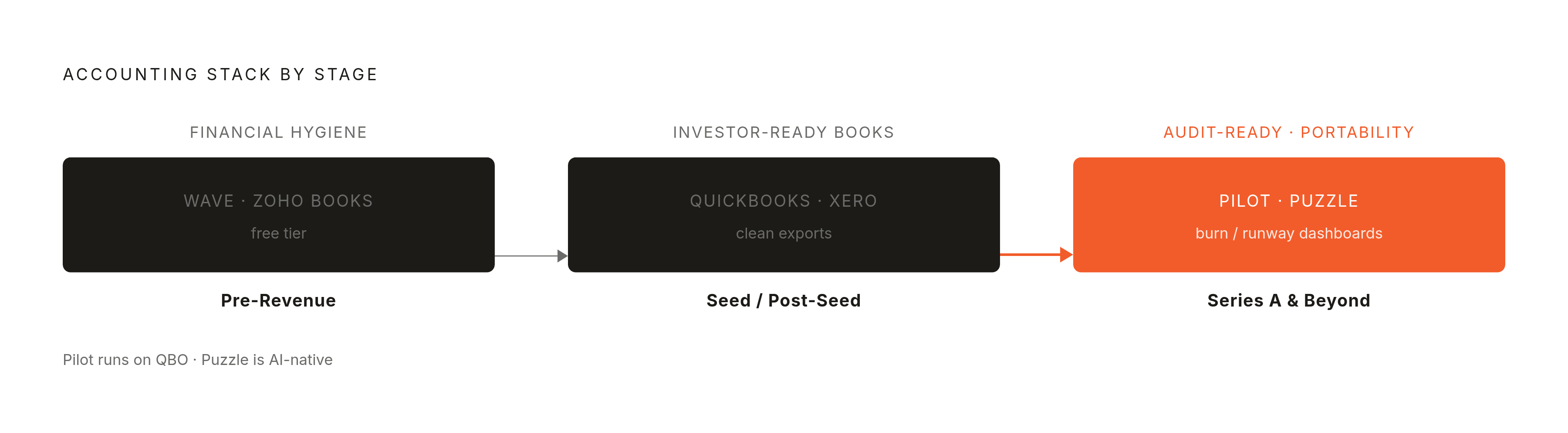
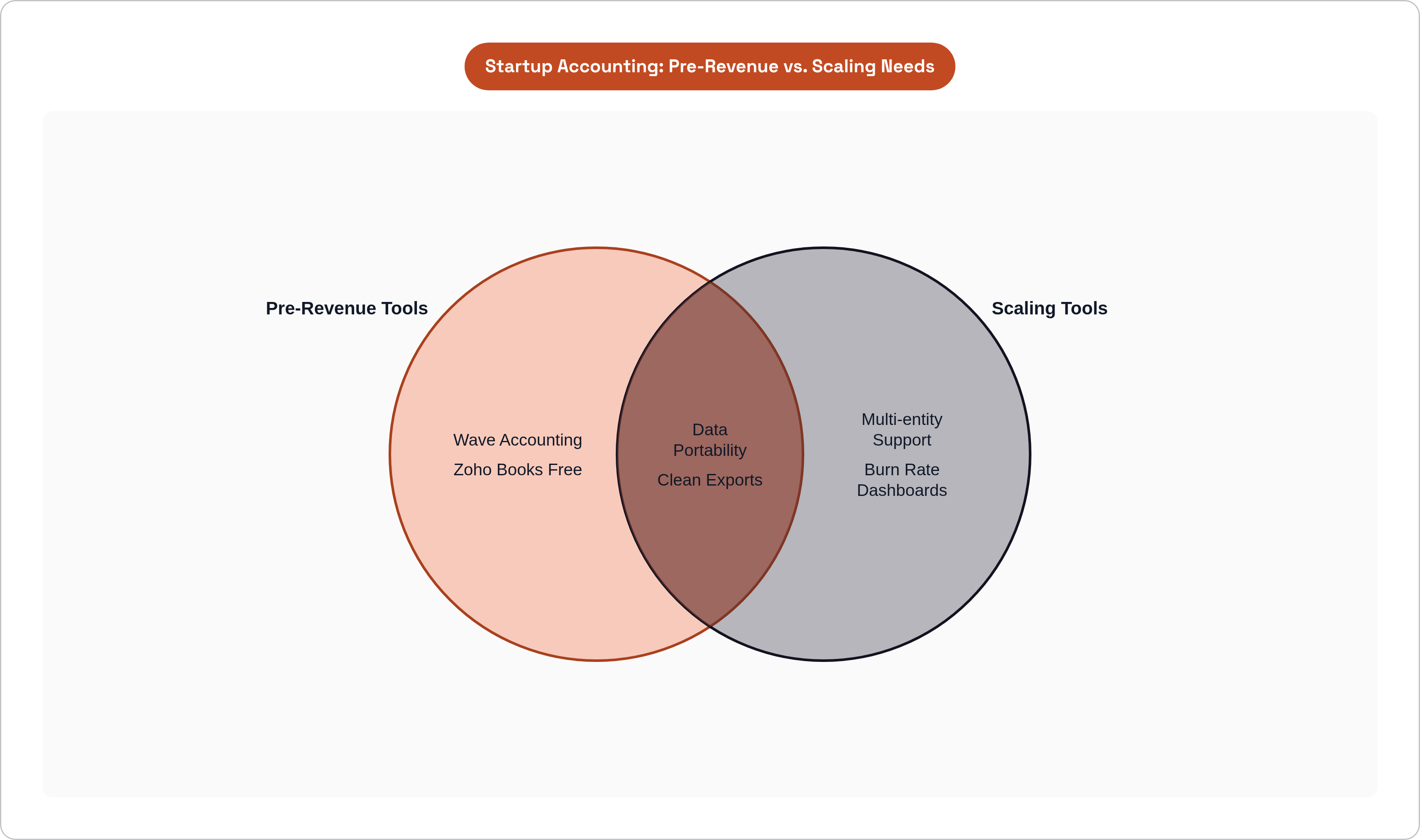
There are three genuinely different phases, and they require genuinely different tools.
Pre-revenue. You need to track spending, maybe invoice a few clients, and build basic financial hygiene. You do not need accrual accounting. Multi-entity support is equally unnecessary at this stage. Investor reporting can wait as well. Anyone selling you those features at this stage is selling you something you can't use yet — it's like giving a seedling a full-grown tree's worth of water.
Post-seed. Now things get real. Investor updates, monthly closes, burn and runway visibility. These stop being nice-to-haves and become actual obligations. Clean books matter for the first time, because other people are looking at them.
Scaling (Series A and beyond). Audit-readiness. Data-room quality exports. Multi-currency or multi-entity support if your business has gone international. And critically, no proprietary lock-in that complicates diligence when a prospective investor's lawyers come calling.
The mistake most founders make is choosing a tool for where they want to be, not where they are. They're pre-revenue and they're setting up accrual accounting because they heard that's what serious companies do. Or they're post-funding and still running books in a free tool they set up as a side project, and they show up to a Series A with a P&L that no investor can parse.
The opposite mistake is staying too long on a minimal tool. Migrating messy books under investor scrutiny is a nightmare; migrating clean books on your own timeline is just an afternoon.
Here's a useful signal to watch for: the moment you stop wanting to do your own bookkeeping isn't a personal failing. It's a stage signal; it's the right moment to reconsider your stack.
Use this section as a diagnostic. Every tool described below maps to a phase. Find your phase first.
Free Tools That Cover the Pre-Revenue Phase Without Overcomplicating It
The best free accounting tool for a pre-revenue startup is the one you'll actually use. Full stop.
Wave is genuinely free at its core. Not a freemium trial. Not "free for 30 days." The core accounting and invoicing features cost nothing. Wave makes money on payment processing and payroll add-ons, which means the free tier is stable; it exists because it serves a business model, not as bait.
What Wave lacks: accrual accounting, burn-rate dashboards, investor-ready reporting. It's not designed to grow with you past early stage. That's fine. It's not trying to.
Zoho Books has a free tier worth knowing about, especially if you're already using other Zoho tools. It's a reasonable pre-revenue option with slightly more structure than Wave.
The honest limitation of both: they create a migration moment. At some point, you will outgrow them. And migrating messy books is always harder than migrating clean ones. The practical guidance here is simple. Use free tools to learn financial hygiene. Track every dollar in and out. Reconcile regularly. Treat the eventual migration as a planned event you'll execute when the time is right, not a crisis you'll manage when a deadline forces your hand.
Free tools are how you build the habits. They're not a long-term strategy.
Cloud-Native Platforms Built for Startups That Are Starting to Raise
At seed stage, two names dominate this conversation: QuickBooks Online and Xero. There's a reason for that, and it's not marketing.
QuickBooks Online isn't categorically wrong at seed stage. Accountants know it. Banks expect it. It integrates with the common tools. It exports cleanly. Its ceiling is real, but you don't immediately hit it at seed. Current pricing (as of mid-2025, after a price increase) runs from about $38 per month for Simple Start up to $275 per month for Advanced. Older comparisons often cite stale numbers, so verify current pricing directly before budgeting.
Xero is the more startup-native alternative. It was built cloud-native from day one. Not a desktop product retrofitted for the web. That architectural difference shows up in how it handles integrations. Xero has an open API and a marketplace of hundreds of third-party integrations, which makes it a better fit for teams assembling a modern fintech stack. Multi-currency support is built in, not bolted on. The interface is widely regarded as cleaner and more intuitive for non-finance founders doing their own books.
The practical decision between QBO and Xero at seed often comes down to one question: who is your CPA? Many accountants have a strong preference and will simply do better work in the tool they know. Ask before you choose.
Both platforms matter for a specific investor concern. Research across hundreds of startups consistently surfaces the same top diligence question at Series A: does the data export cleanly into a diligence pack? QuickBooks and Xero are the two names that satisfy that question. Proprietary formats don't.
What the Bench Collapse Revealed About Picking Managed Bookkeeping Services
In December 2024, Bench Accounting abruptly shut down. One of the largest managed bookkeeping services in the market, mid-shutdown, was acquired by Employer.com. Former customers spent weeks locked out of their accounts, dealing with incomplete data exports and books stranded in a proprietary format.
This wasn't a small thing. Bench ran its bookkeeping in its own system. When the company failed, founders couldn't simply hand their data to another provider. The books weren't portable. The months of work that had gone into those closes, those reconciliations, those investor-ready reports; all of it was stuck — like a library that burns down and takes every book with it.
The structural lesson is clear. Any managed bookkeeping provider must use an industry-standard general ledger underneath. QuickBooks Online or Xero. If the provider fails or the relationship ends, you need to be able to walk your books out the door. If the service runs a proprietary ledger, that's an inconvenience on the surface but a trap in practice.
This isn't a hypothetical risk anymore. Bench made it a real, recent, well-documented data point; it belongs in every serious evaluation of any managed service. Ask explicitly. What ledger system do you use? What happens to my data if I cancel? If the answers are vague, walk away.
Pilot as the Managed Bookkeeping Answer for VC-Backed Startups That Have Moved Past DIY
Pilot's model is straightforward. Real human bookkeepers handle your monthly close, run your accruals, and produce investor-ready financials. The books live in QuickBooks Online. So when you eventually outgrow Pilot, or if Pilot ever had its own Bench moment, you can pick up and leave with your data intact.
That portability is the product differentiator as much as anything else.
Pilot starts around several hundred dollars per month, which immediately tells you who it's for. This is a post-funding decision. It's not designed for pre-revenue founders; the math doesn't work until the volume of financial activity and the cost of a founder's time justify the monthly spend.
For founders at seed or beyond, the trade-off is time. The hours that would otherwise go to reconciling transactions, categorizing expenses, and preparing reports for investor updates come back to you. These aren't hours you were spending on accounting because you love accounting; they're hours you were spending because someone had to, and you were the only person available.
Pilot shows up consistently in Series A diligence conversations alongside QBO and Xero. Investors recognize it as producing trustworthy, exportable books; that recognition has real value at the moment you need it most.
Who Pilot is a poor fit for: pre-revenue founders, early bootstrapped teams with low transaction volume, anyone for whom $499 a month is a significant burn-line item without clear justification. Start with the free tools. Migrate to Pilot when the time and money math actually works in your favor.
AI-Native Accounting Tools and What "Automating the Close" Actually Means in Practice
There's a meaningful difference between accounting software that added an AI feature and accounting software built around machine learning from the ground up. That difference matters more than it sounds.
Traditional tools use rules-based matching. You tell the system that transactions from a certain vendor go in a certain category, and it follows that rule until you change it. AI-native platforms like Puzzle use machine learning categorization. The system learns from patterns. In vendor claims, transaction categorization approaches near-full automation; the practical result is a dramatically shorter time to a clean close. Less manual review, fewer uncategorized transactions sitting in a queue.
The startup-specific piece is bigger than just speed. Burn rate and runway are absent from a traditional general ledger as native fields. They don't exist there. Founders using legacy tools compute them manually from exported data, usually in a spreadsheet, usually right before a board meeting. AI-native platforms surface these metrics natively in dashboards; you open the tool and you see your runway. That's a different relationship with your financial data — the difference between reading yesterday's weather report and looking out the window.
Puzzle is specifically built for startups and positions itself on real-time financial health visibility, not waiting for an accountant to produce a month-end report.
Honest caveats, because they matter:
- AI-native tools are newer. The category has less track record than QBO or Xero when it comes to surviving Series A diligence scrutiny.
- Verify that your CPA or future controller can work fluently in the platform, or that the data exports to standard formats.
- Automation accuracy claims in vendor materials should be weighed against independent reviews. The category is still maturing.
Best fit here is a VC-backed founder who wants burn and runway visibility baked into the product, not reconstructed from a spreadsheet, and who is comfortable being a relatively early adopter of a newer category.
The One Accounting Decision That Affects Every Other Tool Choice: Data Portability
At Series A, investors and their lawyers will request a data room. Clean financials, reconciled books, exportable cap table. The accounting software choice you made 18 months earlier determines how painful that moment is.
The portability test is simple. Can your books be exported into a standard format. CSV, a QBO file, handed to a new accountant in a tool they already know. Without re-keying years of transactions?
Tools that pass: QuickBooks Online, Xero, Pilot (because it runs QBO underneath).
Tools that require explicit scrutiny before you sign up: any managed service or AI-native platform running a proprietary ledger. Ask the question directly. What format does my data export in? If I leave tomorrow, can a new accountant pick this up without a re-import project?
Bench is the concrete warning. Founders who chose a managed service with a proprietary ledger learned at the worst possible moment that their books weren't theirs to take; that lesson has a price tag, and it's not just money. It's time, during a period when time is the scarcest resource a founder has.
This criterion applies at every stage, not just post-funding. Even a free tool used at pre-revenue should export cleanly before you migrate to a paid platform; building the discipline early means you never end up trapped later.
Matching the Right Tool to Where Your Startup Actually Is Right Now
Here's the short version.
Pre-revenue or side project: Wave or Zoho Books free tier. Minimize cost. Build financial hygiene. Plan the migration before it becomes urgent.
Seed-stage with a CPA: QuickBooks Online or Xero. Ask your accountant which they prefer. Prioritize clean exports over features you don't need yet.
International operations or multi-currency from day one: Xero. Its native multi-currency support makes it the stronger default at this stage.
Post-seed, done with DIY books: Pilot. Managed service built on QBO. Portability preserved. Monthly close handled. Time returned to the founder.
VC-backed and want burn/runway in a dashboard, not a spreadsheet: Puzzle. With the caveat that you verify CPA compatibility and data export formats before committing.
The accounting software decision is not permanent. But switching mid-diligence is expensive in the worst possible way; making the right choice one stage early is far cheaper than a re-import project while investors are waiting on your data room.
One last thing. The software is infrastructure. The discipline is knowing your numbers. Whatever tool you use, treat the monthly financial close as a non-negotiable habit. Not because an investor told you to, but because the founders who know their numbers at all times are the ones who see problems coming. And in a startup, seeing a problem coming is often the difference between solving it and being ended by it.