Startup Incubators vs. Accelerators for First-Time Founders
First-time founders often pick accelerators when incubators would serve them better.

Accelerators have better marketing. That's really the whole explanation.
YC. Techstars. Names like those carry weight you can feel. Demo days, investor intros, press coverage, famous alumni. From the outside, getting into one looks like a cheat code. So founders apply. Not because the fit is right, but because the brand is magnetic. Completely understandable. Still a mistake.
Here's what the mismatch actually looks like in practice:
Join an accelerator too early and you're handing over equity at the lowest valuation your company will ever have. The program assumes you have traction. You don't. The curriculum sprints past you. You exit with less momentum than you had going in, plus a permanent equity haircut you'll carry through every future fundraise.
Stay in an incubator too long and the flexibility that protected you at the idea stage quietly becomes the thing that stalls you. No urgency, no capital, no forcing function to push you from "concept I'm excited about" to "thing a customer will pay for." The open timeline stops being an asset and starts being an excuse you didn't realize you were making.
First-time founders get a compounding version of this problem. Repeat founders have a calibration point. They know what "ready" actually feels like because they've been there. First-timers are guessing, which isn't a character flaw, it's just the position they're in. And if you're a solo founder on top of that, there's an additional wrinkle: some programs expect a team on arrival, others exist specifically to help you build one before you go anywhere else. Knowing which is which before you apply matters more than most people realize.
The cost of picking wrong isn't symbolic. It's wasted runway, diluted equity, and months you could have spent building.
What "Stage" Actually Means, and the Honest Question Founders Need to Answer First
Stage is not a vibe. It is not how ambitious you are. It is a factual description of what your company has right now, today.
Three rough buckets:
- Idea stage. Problem identified. No product. No customers. Possibly no co-founder.
- Early build stage. MVP exists or is in progress. Some user conversations have happened. Team is forming.
- Growth-ready stage. Product is in real users' hands. There's actual signal of demand. You have a full-time team and can commit entirely to a program for three to six months.
The single most useful question you can ask yourself: do you need space or speed?
Space means time to validate the problem, the freedom to pivot without a cohort clock running, and a low-pressure environment to run experiments without someone asking you to justify them every two weeks. Speed means structured milestones, investor deadlines, and peer pressure to ship. Speed is only useful when you have something to ship. Applying to an accelerator in search of space is like hiring a personal trainer to figure out what sport you want to play.
A few secondary questions that sharpen the picture:
- Do you have a co-founder? Some accelerators rarely back solo founders. Some programs exist specifically to help you find one first.
- Can you go full-time for three to six months? Applying with a side-project mindset produces side-project results. The programs are built for people who show up entirely.
- Have you talked to real potential users yet? Not friends who said "that sounds cool." Actual strangers with the problem you're solving. If the answer is no, that's a strong signal you're not accelerator-ready.
CB Insights' analysis of startup failure post-mortems consistently puts "no market need" at the top of the list. Not bad execution. Not bad founders. The market simply didn't want the thing. Founders who skip validation and jump straight into growth programs are essentially using the program to accelerate toward that outcome faster.
What Incubators Are Actually Good For. And What They Can't Give You.
Incubators get undersold because they're not glamorous. No demo day. No famous alumni network dropping into office hours. No equity check landing in your bank account. From the outside, the value proposition feels fuzzy, especially when you're comparing it to the cinematic version of what an accelerator looks like.
But for the right founder at the right moment, an incubator is exactly the right call.
They're well-suited for:
- Founders still inside a university ecosystem who need a bridge to the real world
- Founders validating whether a problem is real before committing to a product direction
- Founders who need affordable workspace and peer community more than they need capital
- Founders still looking for a technical co-founder or a first team member
What a well-run incubator actually provides is access to mentors without a program clock forcing every conversation into a deliverable. You can talk to a domain expert about the problem you're solving without having to justify it in terms of your week-eight milestone. That's genuinely valuable when you're still figuring out what you're building. There's also the peer community. The psychological value of being around other founders at similar stages, people who understand the particular weirdness of what you're doing, is hard to quantify and easy to dismiss until you've experienced the alternative, which is doing it completely alone. University-affiliated programs often layer on research access, lab infrastructure, and IP support that would otherwise take years to access independently. A 2018 study in the Journal of Business Venturing found incubated startups reported stronger business model development and higher survival rates. The slow-build environment has a real track record, even if it doesn't generate splashy press.
What incubators cannot give you is urgency. The same flexibility that protects idea-stage founders can let early-build founders drift for months with nothing to show for it. They also can't give you meaningful capital. Workspace and mentorship are the offer. Not investment. And there's no built-in mechanism for the kind of structured investor exposure that a demo day creates. If you need a clear path to a funding round on a defined timeline, the incubator model wasn't designed for that.
Station F in Paris is a useful contrast here. It functions less like a classic incubator and more like a startup city: hundreds of companies co-located with VCs and corporate partners, creating ambient exposure to capital rather than a curated curriculum. It shows how far the incubator category has stretched from its original form, and why reading the label isn't enough. You still have to read the structure.
The honest ceiling on incubators: they're designed to help founders develop. Not to produce investor-ready companies on a schedule. That's not a flaw. That's the design. Know that going in.
What Accelerators Are Actually Good For. And the Equity Cost of Joining One Wrong.
The accelerator model is built around one core assumption: there is something to accelerate.
The curriculum, the cohort accountability, the demo day pressure. All of it assumes a product in users' hands and a team that can execute under compression. When those conditions are met, accelerators can move a company faster than almost anything else available. The network, the investor access, the peer pressure. They compound each other in ways that are genuinely hard to replicate on your own, and the credibility that comes with a recognized program name changes how investors, press, and recruits treat you. That effect is real and it kicks in immediately.
What the best accelerators deliver beyond that:
- Curriculum from practitioners who have actually built and funded companies, not theoretical instruction from people who studied companies
- A cohort of peers at a similar stage, which creates accountability and shared problem-solving and professional relationships that often outlast the program by a decade
- A structured path to investor meetings that would otherwise take years of cold outreach and conference networking to build
The equity cost, though, is concrete and permanent. Equity exchanged at program entry is exchanged at the earliest and typically lowest valuation the company will ever have. YC's current terms are $500K for 7%. Techstars runs around $220K for 5%. That stake compounds through every future dilution round. Founders who join too early give up equity for a program they weren't positioned to use, and they carry that cost permanently. There's no getting it back.
The right posture is to treat the equity cost as real money. Because it is. Apply when you can show up with evidence of demand, not just a pitch about demand you expect to find.
IndieBio is a useful boundary case here. It's built specifically for founders solving scientific problems that require lab access. The program provides infrastructure that would otherwise be prohibitively expensive to assemble independently, wet lab space, equipment, technical mentorship from people who have actually commercialized science. It illustrates that some accelerators are built for specific stage-and-domain combinations, not just general readiness. Reading a program's specific design tells you more than its category label does.
Building an MVP Before You Apply. And Why the Program You Pick Shapes How You Build It.
An MVP is not a deck. It is not a polished prototype you walk investors through in a demo. It is the minimum product that lets real users do something and tell you whether it matters.
The goal is to test a business assumption with as little build as possible, before committing to scale. Dropbox validated file-sync demand with a demo video before the underlying product was built. Airbnb proved the core concept with three air mattresses and a basic website. Neither required months of engineering. Both generated real signal. That's the frame.
Why MVP approach changes depending on which program you're targeting:
If you're incubator-stage, lean methods fit the environment naturally. Serve a handful of users manually. Drive traffic to a landing page and see if anyone enters their email or, better yet, tries to pay. These approaches fit a flexible, unstructured setting because you have time to run the experiment properly and learn from it before committing to a direction.
If you're accelerator-stage, the MVP should already exist before you apply. The program clock does not leave room to build the thing from scratch. You iterate under pressure. You construct before you apply, not during.
The tooling environment has genuinely shifted here, by the way. AI-assisted development, no-code platforms, and accessible cloud infrastructure have compressed how long it takes to get something in front of real users. Gartner projected that by 2025, the vast majority of new applications would be built using low-code or AI-assisted tools. The barrier to a working MVP is lower than it has ever been, which also means the bar for what "ready to accelerate" looks like has risen accordingly. "I haven't built anything yet" is a harder excuse to make when a solo non-technical founder can ship something functional in a weekend.
The CB Insights finding about no market need is the direct argument for building and testing before entering any program. Validation is not a program deliverable. It is the prerequisite.
Practical bottom line: if you can't show any signal of user interest before applying, an accelerator is likely premature. Use the pre-application window to generate that signal, even crudely.
The Co-Founder Question as a Stage-Fit Variable, Not an Afterthought
Solo founder status is not just a personal situation. It's a factor that affects which programs will consider you, how you should use program time, and what you should probably do before you apply anywhere.
Top accelerators rarely back solo founders. The pattern is consistent enough that solo status is a real application risk, not just a soft preference that occasionally comes up in feedback. The reasoning usually comes down to execution capacity and resilience. Startups with co-founders attract more investment and grow faster. The structural advantage is well-documented.
But here's the part that doesn't get said enough: team issues show up in nearly a quarter of startup failure post-mortems, according to CB Insights' 2024 analysis of 483 cases. The problem is often not the absence of a co-founder. It's the wrong co-founder, found too quickly under pressure because a program application was coming up and the founder needed to put someone's name on the form. That is a very specific kind of expensive mistake. Shared strategic vision and complementary skills matter more than friendship, geography, or the fact that someone was available when you needed them to be.
What this means practically:
- If you need a co-founder: choose a program that supports co-founder matching as part of its structure, or invest real time in structured matching before applying anywhere else. Treat it as a milestone, not a line item.
- If you have a co-founder: check whether the team is actually complementary before treating formation as done. Technical plus commercial, or domain plus distribution, is meaningfully different from two people who have the same background and get along well.
- If you're technical and building alone: the decision to find a business co-founder versus stay solo is consequential enough to resolve before you commit to a program track, not during it.
YC's co-founder matching platform is worth knowing about as a practical resource. It's the largest such platform available and free to use independent of applying to a YC batch. Even if you never apply to YC, the platform does what it says.
How to Read a Program's Structure as a Signal of Who It Was Built For
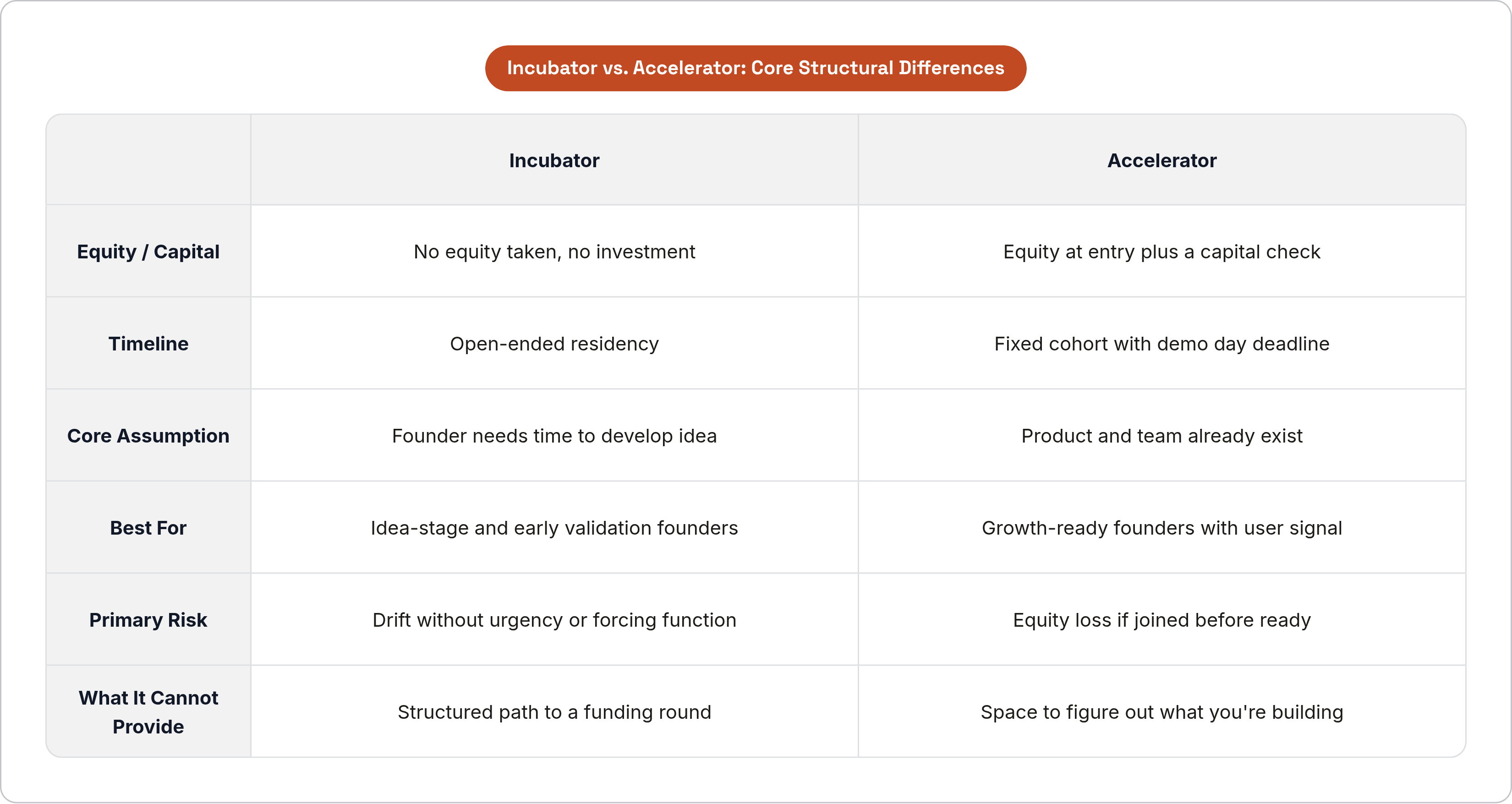
The simplest shortcut in this whole conversation: stop reading a program's marketing copy and start reading its structure. The design tells you more than the tagline does, every time.
Quick signal map:
- Equity taken at entry = accelerator model. Assumes an investable company already exists.
- No equity, no capital = incubator model. Assumes the founder needs development time.
- Cohort with a fixed end date and demo day = assumes something to demonstrate already exists when you walk in.
- Open-ended residency = assumes the founder needs exploratory time, not a countdown.
Questions worth asking about any program before you apply:
- What do successful alumni look like at the point they entered, not when they graduated?
- Does the curriculum assume you have users, or does it help you find them?
- Is there a co-founder matching component, or is a team assumed on arrival?
- What actually happens to companies that enter underprepared? Do they get support or do they fall behind the cohort and quietly fade out?
That last question is the one programs won't answer directly on their websites. You have to ask alumni. The answer tells you a lot about whether the program was built for founders like you or for founders a stage ahead of you who you're hoping to catch up to.
One more thing worth saying plainly: these programs are not mutually exclusive. Many founders use an incubator to reach MVP and early validation, then apply to an accelerator. That is a legitimate and common path. It's not a failure to skip the accelerator directly. It's sequencing done right. The founders who get the most out of these programs are almost never the ones with the most impressive pitches going in. They're the ones who were honest about what they actually had, picked the room that matched it, and showed up ready to use it.