How to Apply to Y Combinator for the First Time
Reapplication is normal at YC—most founders who get in applied multiple times.

The 0.6% acceptance rate for Summer 2025 is the lowest on record. Worth pausing on that number, but not for the reason you might think.
It is not that YC quietly raised the bar. The volume inflated the denominator: YC now runs four batches per year, and tens of thousands of teams apply each cycle. The signal partners are actually looking for has been remarkably consistent since Paul Graham, Jessica Livingston, Robert Morris, and Trevor Blackwell started this in 2005. What changed is how clearly you need to demonstrate that signal in writing, in under two minutes, to someone who has seen 20,000 applications before yours.
The 1.5 to 2% acceptance rate you have probably seen cited online is from the two-batch era. That era ended. Cohort sizes now sit somewhere between 140 and 200 companies per cycle.
Here is something most first-timers do not know: reapplication is the normal path. Not a consolation prize. The normal path. Brian Chesky and the Airbnb team were rejected. The Stripe team was rejected. Most founders who eventually get in applied two or three times. YC partners track reapplications closely. Progress between rounds is itself a signal.
So write your first application like it counts, because it does. But a rejection is not a verdict. It is closer to a repair list — think of it as a map where X marks the spot you still need to reach.
One thing to understand upfront about the deal itself. YC puts in $500,000 total: $125,000 for 7% equity via a post-money SAFE, plus $375,000 on an uncapped SAFE with most-favored-nation provisions that converts at the terms of your next round. The three-month batch includes weekly dinners, office hours, a direct Slack channel with a dedicated General Partner who hand-selects their group each batch, and Demo Day at the end. Over 5,600 companies funded. Combined valuation north of $600 billion. More than 100 unicorns. YC-backed companies hit Series A at 45%, versus a 33% baseline. More than half are still operating after ten years, compared to roughly 30% of startups broadly. That context explains why the application is genuinely competitive, which is the only reason any of this matters.
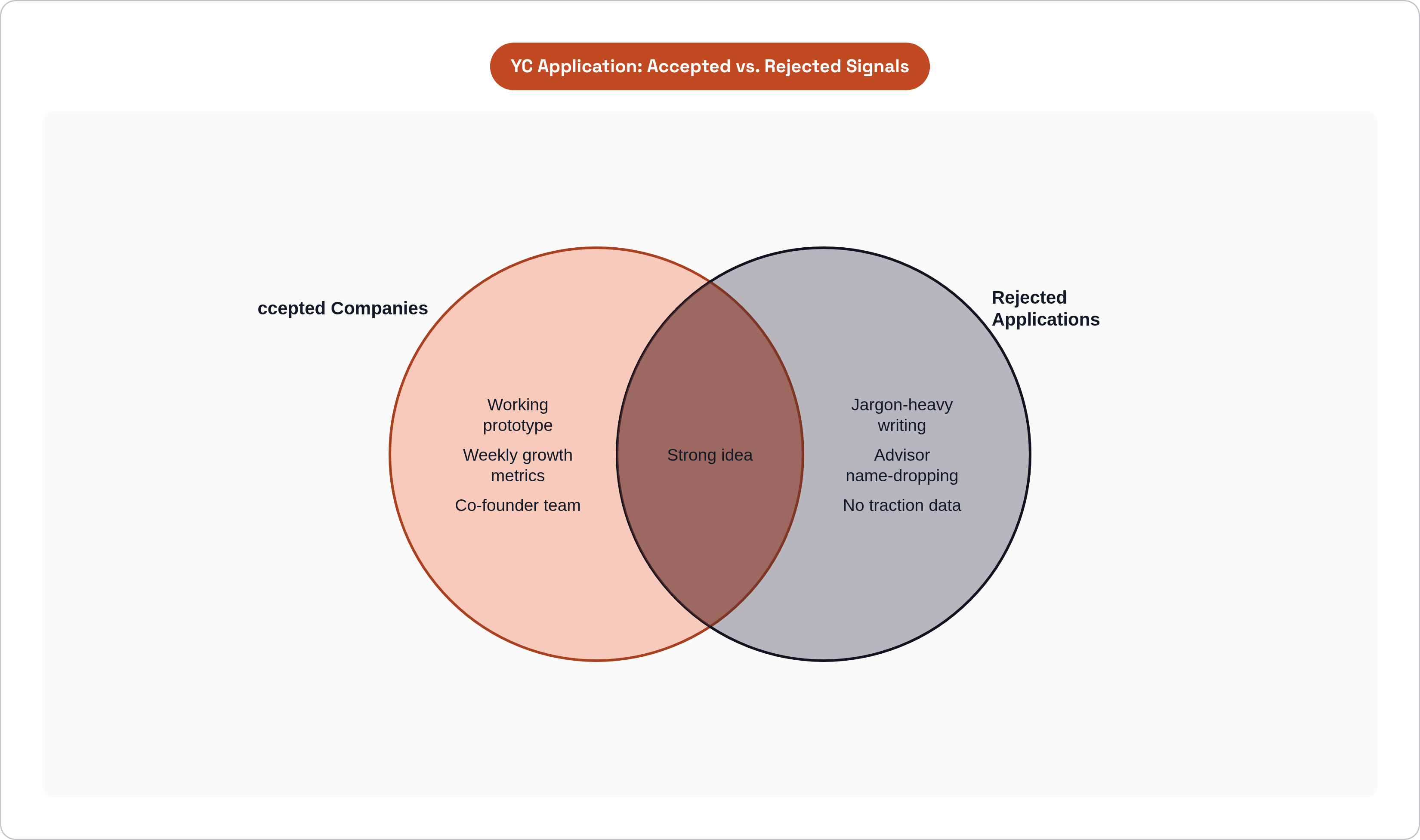
Who YC Funds and What Kinds of Companies Dominate Recent Batches
B2B companies make up the overwhelming majority of recent batches. Consumer startups are a shrinking slice. Back in 2005, about one in three YC companies was consumer-facing. Today it is closer to one in seven.
The Summer 2025 batch was 88% AI-native. That is not a trend signal. That is YC telling you how they think about AI: not as a vertical, not as a feature, but as default infrastructure. If you are building with AI, you are not in some special subcategory. You are just in the regular category now.
On stage and revenue:
- Roughly 40% of accepted companies have zero revenue at the time of application
- About 85% have a working prototype or live product
- Idea-only applications do get accepted, but only when founders bring something else: a prior exit, deep technical credentials, or serious domain expertise that makes the idea credible without a product
Having a working prototype, weekly revenue growth, or a strong technical co-founder improves your odds. Not because YC has a formal product requirement, but because those things answer questions partners are already asking before they get to your application.
Solo founders are roughly 10 to 15% of each batch. They get in. But the bar is higher, because partners need to see evidence that one person can carry the workload of two before any hiring happens.
Know your company type, your stage, and which signals you can actually demonstrate before you write a single word of the application. That self-assessment is where you start.
The Five Things YC Partners Actually Weigh When Reading Applications
YC has been fairly open about this, which is genuinely useful. Here is the weighting, per YC itself:
- The founders. Can they build? Can they sell?
- Evidence of doing. Code shipped. Users acquired. Revenue earned.
- Why this team for this problem. Domain expertise, relevant history, full-time commitment.
- Market size and timing. Is this a real opportunity, and does now make sense?
- Clarity of thought. Can you describe what you do in one or two plain sentences?
That last one deserves more attention than it usually gets. Clarity of thought is not about polish. It is about whether you understand your own business well enough to explain it without hiding behind jargon. Three paragraphs and a glossary is also a signal. Just not the one you want to send.
Other things that consistently read as strong:
- Domain expertise. Do you know your market and competitors better than anyone who might be reading your application?
- Commitment. Full-time or a credible plan to be soon?
- Growth framing. YC's internal benchmark is 5 to 7% week-over-week. Founders who frame traction in weekly terms read differently than founders who present numbers in whatever aggregate is most flattering. Even $500 a month growing 20% week-over-week is a compelling story. The rate is what matters, not the absolute number.
The thing tying all of this together is execution. Have you made measurable progress? Can you adapt? Partners are not looking for a perfect business. They are looking for founders who move when things are uncertain — the ones who treat a dead end not as a wall, but as a detour sign.
The Single Most Important Question on the Application and How to Answer It
The question is: "Please tell us in one or two sentences about something impressive that each founder has built or achieved."
YC calls it deliberately open-ended. Academic achievement qualifies. Highly-regarded software qualifies. Paying your own way through college after leaving home at sixteen qualifies. The category does not matter. The magnitude does.
The mistake most first-timers make is treating this like a pitch. They name-drop advisors. They reference carefully constructed market-size arguments. They write in the voice of a Series B press release. Partners have read thousands of applications. That register reads as noise. It does not signal ambition. It signals discomfort telling a plain story about what you have actually done.
What works instead:
- Write it as you would explain it to a smart friend who has no stake in whether you sound impressive
- If you cannot get there in two sentences without leaning on adjectives, it needs more work
- Specificity is credibility. "We grew from zero to 400 weekly active users in six weeks" beats "we are gaining strong early traction" every single time, without exception
This principle runs through the whole application. Concrete beats vague. Specific beats general. A plain sentence about a real thing beats an enthusiastic sentence about an abstraction — the way a single lit match beats a speech about fire.
How to Approach the Other High-Weight Application Questions
The full application covers five areas: company information, founder details, progress metrics, startup idea exposition, and an optional video.
Idea description. One to two sentences. Needing more than that is not a sign that your idea is complex. It is a sign that you do not yet have full clarity on what you are building.
Progress and traction. Use weekly metrics. Monthly and quarterly numbers are not what YC tracks internally, and founders who use them signal that they are tracking the wrong things. Pre-revenue? Describe user engagement, retention, or qualitative evidence that people actually want what you are building. Do not inflate numbers. Manufactured precision does not help your case — partners have seen every version of this.
Why this team. This is where domain expertise and prior relevant work go. Not your bio. Not your LinkedIn summary. The question being asked is why you specifically are the right people to solve this specific problem. Answer that question directly.
The optional video. Treat it as required. A format that works:
- Ten seconds: who you are and what your company does
- Twenty seconds: the problem and your solution
- Twenty seconds: traction
- Ten seconds: a close
Production value is irrelevant. Film it on a laptop. What matters is that you sound like you mean it, and that all co-founders appear on screen if you have them. Authenticity over aesthetics.
One pattern worth avoiding: the application is not a pitch deck. No advisor slides. No TAM funnel graphics. No vision paragraphs carefully phrased to prove you read every Paul Graham essay. You probably did read them. That is fine. Just do not write like you did.
What to Have Built Before You Submit
The practical bar is a working prototype or live product. About 85% of accepted teams have one when they apply. That is not a coincidence.
An MVP does not need to be a full product. It needs to test the core assumption behind your business. Nothing more.
Two examples that are worth actually internalizing rather than just nodding at:
Airbnb's first version was three air mattresses and a simple website. The assumption being tested was that strangers would pay to sleep in someone else's home. Everything else came after proving that one thing.
Dropbox's first version was a video demonstrating sync before the product fully existed. It validated demand without the full codebase. What needed to be real was the proof that people wanted it, not the software itself.
If you are still figuring out what to build, the concierge MVP approach is worth knowing. You manually deliver the service to early users before automating anything. It gets you real user feedback and a real story to tell in the application, and both of those things matter.
On feature prioritization: identify the one or two things that are genuinely the core of your product. Build those. Everything else waits.
If you have nothing built, the question becomes whether your track record substitutes. A prior exit, technical depth, or deep industry expertise can make an idea credible without a prototype. But that is a high bar, and it is not the path most first-timers are actually on.
The goal before applying is to have something real enough to generate a weekly growth number, even a small one.
Co-Founder Decisions That Affect the Application
YC's stated position is direct: one-person startups are tough, and founders are more likely to succeed with a co-founder. YC runs a free co-founder matching platform that has facilitated over 100,000 matches. If you are still looking, that is where to start before you apply.
Solo founders do get in, but the bar is higher. Partners need to see evidence that you can ship product and recruit without someone alongside you.
On equity splits, this comes up in the application and it matters more than most first-timers expect.
According to Carta's 2024 data, 45.9% of two-person founding teams now divide equity equally, up from 31.5% in 2015. Michael Seibel has cautioned against large unequal splits. Assigning significantly more value to one founder can hurt morale and plant the seeds of conflict that surface later at the worst possible moments. Equal splits have their own risk too: teams that default to 50/50 without actually having the conversation are more likely to experience founder dissatisfaction down the line.
The split should come from an honest conversation, not a default. Partners can tell the difference between a team that thought it through and a team that split equity the way you might split a restaurant check.
On vesting: four-year schedules are standard and expected. If your team does not have a vesting agreement in place, sort that before you submit. Its absence raises questions you do not want raised.
For first-timers still figuring out the co-founding team: applying before the team is right is usually worse than waiting. Use the matching platform. Get the team right. Then apply.
What Happens After You Submit — The Interview and What Follows
YC interviews are ten minutes long. Two or three YC partners. Fifteen to twenty rapid-fire questions about what you do, who your users are, your traction, your revenue model, and why this team is the right one.
These are the same signals the application asked about, now tested under pressure and without the benefit of editing time. The interview is designed to see how founders think when things move fast. It is not designed to give you space for a prepared pitch.
Practicing out loud matters more than rehearsing a deck. Get comfortable saying, in plain language and in under thirty seconds, what you do and why it works. Every co-founder should be able to do the same independently, without contradicting each other.
If you are accepted:
- Weekly check-ins with a dedicated YC General Partner for the three-month batch
- A direct Slack channel with that partner
- Full access to the YC founder network
- Demo Day at the end, pitching to a curated audience of top investors
If you are not accepted:
- Most founders who eventually get in applied two or three times. This is genuinely the normal path.
- Partners track reapplications. The question they are asking on the next read is simple: what changed?
- More traction. Clearer idea. Stronger team signal. Better product. Those are the categories. Pick whichever ones apply and go work on them.
Writing the application forces you to articulate what you are building, why you are the right people to build it, and whether you have actually started. Turns out those three questions are worth answering regardless of whether you get in. Submit anyway.