No-Code Tools for Early-Stage Startups
Discipline matters more than platform features when building a lean MVP.

An MVP is the smallest thing that lets a real user complete the core job and give you real signal. Not a prototype. Not a demo. Not a v1 with most of the features done. Just the minimum required to get a response from a real person doing a real thing.
No-code MVP does not mean "build whatever Bubble lets you build." That is a trap most founders walk right into. The constraint on your MVP should come from your hypothesis, not from a platform's feature list.
The most common mistake is treating the ease of building as permission to add features. It is actually the opposite. Because no-code makes building so fast and frictionless, you have to be more disciplined, not less. Every feature you add is a question you are failing to answer. You end up with a cluttered product and muddled data, and you still do not know if anyone actually wants the core thing.
Think of your MVP like a flashlight, not a chandelier. You are not trying to illuminate the whole room. You are trying to find the door. And honestly, half the time founders are unsure which room they are in yet.
Before you pick any tool, answer two questions:
- What is the single action a user must complete for this to count as a real product?
- What is the fastest way to let them do that and capture their response?
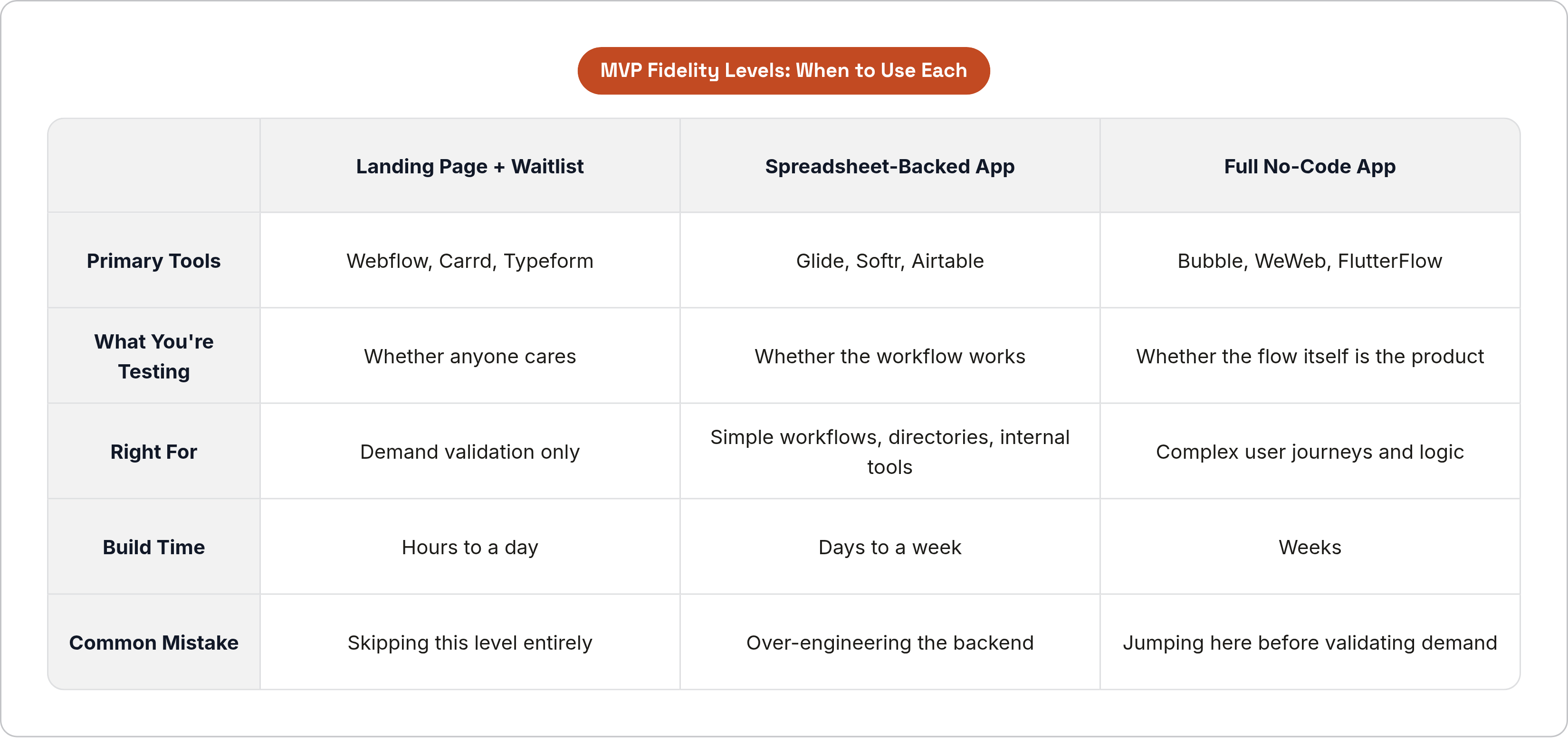
Once you have those answers, you can choose the right level of fidelity. The right level is always the lowest one that gives you a decision-quality answer. Here is what that spectrum looks like:
- Landing page plus a waitlist form. Demand signal only. You are not building a product yet. You are finding out if anyone cares enough to raise their hand.
- Spreadsheet-backed app (Glide, Softr). Gives a small early cohort a real working experience without complex logic. Right for simple workflows, directories, and internal tools.
- Fully interactive no-code app (Bubble, WeWeb). You build this when the workflow itself is the product. When the way users move through the app is what you are testing.
Most founders jump straight to the third option. Most should start at the first.
The Cost and Time Reality That Makes No-Code Viable
Numbers first. The median software developer salary in the U.S. was $133,080 in May 2024, according to the Bureau of Labor Statistics. That is before benefits and tooling. Contract rates start at $50 an hour and run well above $150 an hour for senior engineers. A traditional MVP build takes anywhere from four weeks to nine months depending on complexity and team size.
A no-code MVP takes days to a few weeks for comparable scope. An AI HR tool called Aneta was built on Lovable in one month. A course platform was built on Bubble with GPT-4 integration in under three weeks and pulled in over 100 early users through social channels. Research from Nocode.tech found that startups using no-code tools reduce MVP development costs by up to 85%.
Here is the part that usually gets glossed over, though. Those numbers reflect launch speed, not the total cost of getting to product-market fit. Iteration cycles, migrations, and UX rework are real expenses that tidy cost comparisons leave out. No-code is not cheap forever. It is cheap right now.
And right now is usually when you need it most.
What that means practically: the capital you save on development is capital you can redirect toward user acquisition and iteration. Getting 500 real users costs money. Having those conversations costs time. No-code gives you more runway to do both without burning through your seed check before you have learned anything worth knowing.
Matching Tools to the Job They Actually Do
Tool selection should start with what you are trying to learn, not with what a platform can do. Find the tool that teaches you that thing at the lowest cost. Everything else is a distraction.
Testing Whether Anyone Wants This Before Building Anything
- Webflow or Carrd for a landing page with a clear value proposition and a call to action.
- Typeform for lead capture, waitlist signups, or an early customer survey.
- Google Trends or Exploding Topics to pressure-test demand before you invest in any tool at all.
Dividend Finance used Webflow to launch, capture inquiries, and validate product-market fit before moving to a custom build. The no-code phase helped them attract funding. Nobody looked back at it with embarrassment later.
Building a Working Product for a Small Early Cohort
- Glide or Softr turns a spreadsheet into a real app. Right for simple workflows, internal tools, or directory products.
- Airtable works well as the database layer underneath either of those.
- Adalo is the right call for mobile-first flows that need push notifications or payments. Starts at $36 per month.
When the Workflow Itself Is the Product
- Bubble gives you full web app logic, database management, and advanced workflows. Starts at $29 per month. It has the highest ceiling of any no-code builder for web products.
- WeWeb or Wized plus Webflow for design-sensitive products that need a real backend.
- FlutterFlow for cross-platform mobile where the UI actually matters to the experience.
Going From Sketch to Something Testable Fast
- Uizard converts hand-drawn sketches or text prompts into interactive prototypes. It crossed one million users as of 2025. Designed specifically for non-technical founders who need something a real user can click through before committing to a builder.
Quick pricing reference: Bubble starts at $29 per month, Webflow from $14 per month, Glide from $25 per month. Let the job drive the budget, not the feature list.
The Automation and Data Layer Most Founders Underestimate
A no-code MVP without instrumentation is a guess dressed up as a product. You need to know what users actually do inside the product, not just that they signed up and presumably had a nice time.
Your automation stack does not need to be complicated at the start:
- Zapier connects your tools and triggers actions across the stack. Onboarding emails, Slack notifications when a user completes a key action, data syncing between your form and your CRM. All of it runs without you touching it.
- Airtable works as a lightweight CRM and user tracking database. It is your operational backbone before you need anything more serious.
- Mailchimp or ConvertKit handles email nurture sequences for your waitlist and early users.
The behavioral analytics layer is where most founders underinvest. It is also the layer that actually tells you why users drop off:
- Hotjar gives you heatmaps, session recordings, and form analytics. You can see exactly where users get confused or abandon the flow. Not where you think they get confused. Where they actually do. Those are often not the same place.
- Mixpanel tracks how users move through your product over time. Event-based, so you can see patterns across your whole user base rather than piecing together individual sessions.
Skip these tools and your iteration is guesswork. The whole point of this layer is to convert early user behavior into a clear decision: double down, change the core flow, or stop.
Getting the First Users to a No-Code MVP
No-code removes the build bottleneck. It does not solve distribution. That is a separate, founder-owned problem, and no platform is going to solve it for you. This is the part nobody really wants to hear, and also the part most founders try hardest to avoid thinking about until they have already launched.
Channels that consistently work for early technical and startup audiences:
- Product Hunt has a concentrated early-adopter audience. Strong for B2C products and developer tools.
- Hacker News (Show HN) delivers high-quality feedback and a credibility signal if it lands well.
- Reddit works when you find the specific subreddit where your target user already spends time. Pick one or two communities. Be genuinely helpful before you ever post a link. Spraying five subreddits with the same post is a great way to get ignored everywhere simultaneously.
Before you launch anywhere, do two things:
- Use Exploding Topics or Google Trends to confirm the problem you are solving is growing, not shrinking.
- Set up Typeform or a simple intake form to capture intent from early visitors. Your email list is an asset from day one.
Zapier research found that 90% of no-code users report their company experienced accelerated growth from using no-code tools. That number conflates the tool with the distribution effort, though. The founders who see growth are the ones actively driving users to their product, not the ones who hit publish and waited.
The practical minimum before any broad launch: find 10 specific people who have the problem, put the product in front of them, and pay attention to what they do. Not what they say they will do. What they actually do. A user clicking away in silence tells you more than a user nodding politely on a call.
Where No-Code Tools Break Down and What to Do About It
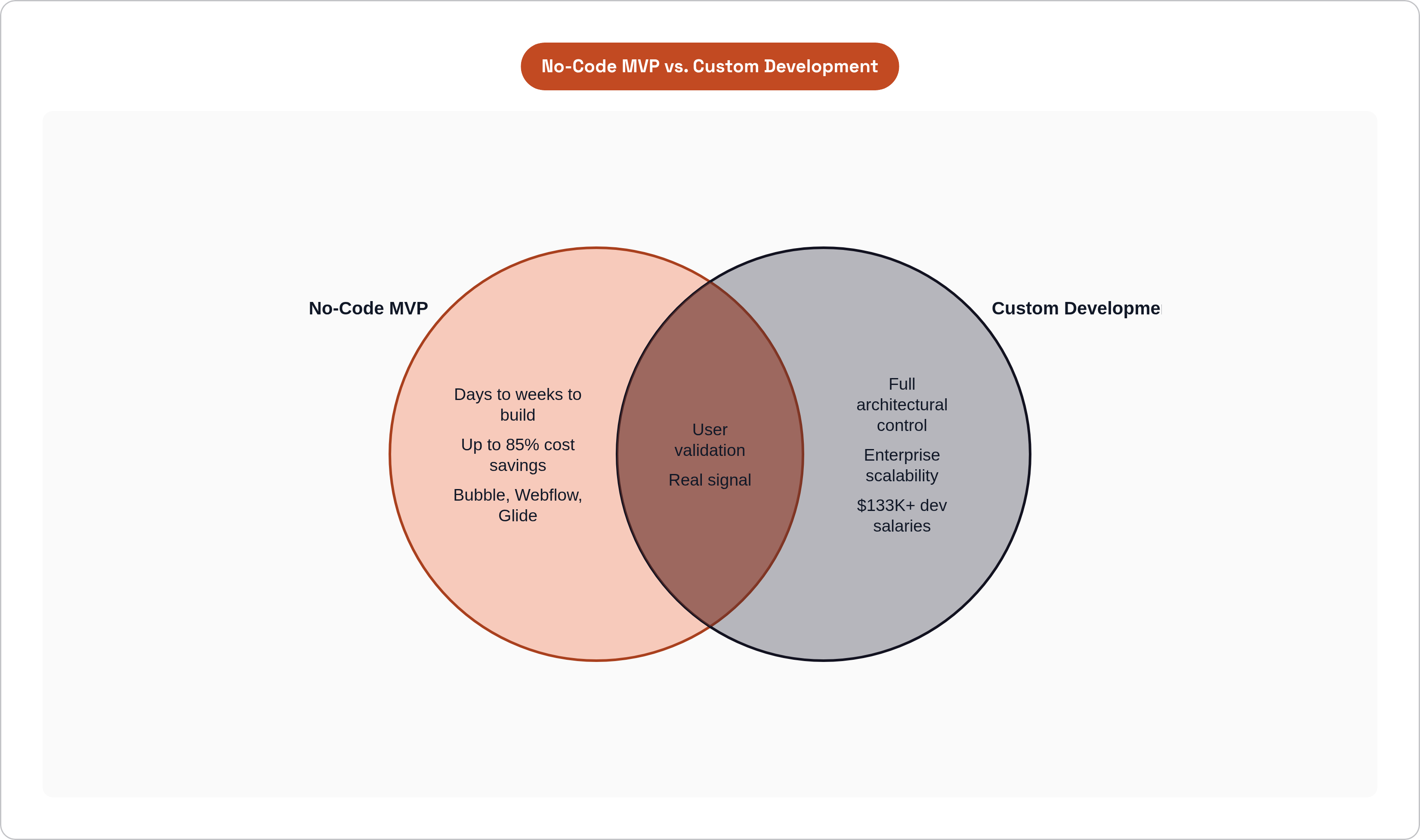
No-code tools have a real ceiling. The question is whether you hit it before or after you have found product-market fit. Most founders do not hit it before. That is actually the whole point of using them.
Common break points:
- Custom behavior the platform cannot express. Edge cases in user flows that need code-level flexibility will eventually show up. At first you work around them. At some point the workarounds stack up and start behaving like their own product, and not in a good way.
- Performance under load. Most no-code platforms are not architected for scale. Query limits, API rate limits, and database size caps become real problems when your user base grows.
- Integration depth. Connecting to a legacy enterprise system or a non-standard API usually requires workarounds that quietly become technical debt. You will not notice until you are deep in it.
- UX polish. Without a designer, no-code interfaces often look inconsistent. Early cohorts will forgive that. Enterprise buyers generally will not.
The common migration pattern goes like this: validate with Glide or Airtable, build more complex workflows on Bubble, move to custom development once product-market fit is proven and the architecture requirements are clear. Dividend Finance did exactly this. Webflow MVP first, then a custom build after initial traction. The no-code phase was part of the strategy, not a mistake they quietly fixed later.
Signs it is time to start planning the migration:
- You are adding workarounds faster than you are adding features.
- Performance complaints start showing up in user feedback.
- Your next hire is blocked by what the platform can and cannot do.
The decision to go no-code at the start should include an honest estimate of how far the tool can take you. Not just how fast it can get you to launch.
How to Use the MVP's Output to Decide What to Build Next
Set your evaluation window before you launch. Four to eight weeks is a reasonable window for most early-stage products. At the end of that window, you make a call based on what you actually saw. Do not extend the window because things are "almost there." Almost there is not signal.
Three outcomes, and what each one means:
- Strong signal. Users return. They refer others. They ask for features you have not built yet. This justifies the next investment, whether that is a deeper no-code build or starting the custom development conversation.
- Weak signal. Low engagement. High drop-off in your Hotjar and Mixpanel data. Before spending more, diagnose first. Is the problem the product, the positioning, or the channel? These are genuinely different problems with different fixes, and treating them the same is how you end up rebuilding the wrong thing entirely.
- No signal. This is actually the fastest, cheapest outcome you can get. Stop. Reframe the hypothesis. Start a new test.
Weekly check-ins against specific goals make the feedback loop real. Founders who track progress each week catch a weak signal early instead of rationalizing it away for two months. It is very easy to convince yourself things are going fine when you are avoiding the numbers. This happens to almost everyone, and being aware of it does not make you immune to it.
What to avoid: raising a pre-seed round to build a custom version of something that has not cleared the validation threshold yet. The no-code MVP exists specifically so that does not happen.
If the signal is strong and the next step is fundraising, the no-code MVP becomes your evidence. User count, retention data, and a live product are what a pre-seed investor wants to see. Not a polished deck about a hypothetical product.
Build the smallest version. Instrument it. Drive users to it. Read the data. Decide. Then do it again with whatever you learned.


