Referral Program Mechanics for Pre-Series A Startups
Optimize K-factor and timing to turn customer trust into measurable referral growth.

A referral program for a pre-Series A startup is an engineering problem. Satisfied customers supply the trust, but timing, rewards, and a low-friction share flow turn that trust into growth. The goal is to build a measurable loop before buying the machinery to scale it.
Why referral programs fail before they start: the gap between willingness and action
Most satisfied customers say they would refer a product, yet most never do. That gap is the useful starting point. A customer can like a product without remembering to recommend it, finding the right link, or knowing what to say. Founders who take silence to mean that customers do not love the product enough keep spending on brand while they still fail to ask for referrals. Love is lovely, but it does not copy a referral link.
Nielsen’s 2021 global study found that the vast majority trust recommendations from people they know above other forms of marketing. The referrer understands both the product and the friend’s needs, which helps qualify the match before acquisition. A healthy early-stage user base has people who can help the business grow as well as people waiting for another discount.
Schmitt, Skiera, and Van den Bulte’s 2011 study in the Journal of Marketing found meaningfully higher customer lifetime value for referred customers against a matched control group. The retention benchmarks that vendors have put together point the same way, but often-repeated claims of much larger lifetime-value multiples do not have the same backing from primary research. Founders earn trust when they make that difference clear.
Paid acquisition makes this gap financially urgent. When acquisition costs put pressure on an early-stage company’s finances, referrals give it another way to grow through the customer relationships it already has. Sustained growth depends on whether those relationships generate enough new customers.
What the K-factor actually measures and why it is the right metric to optimize
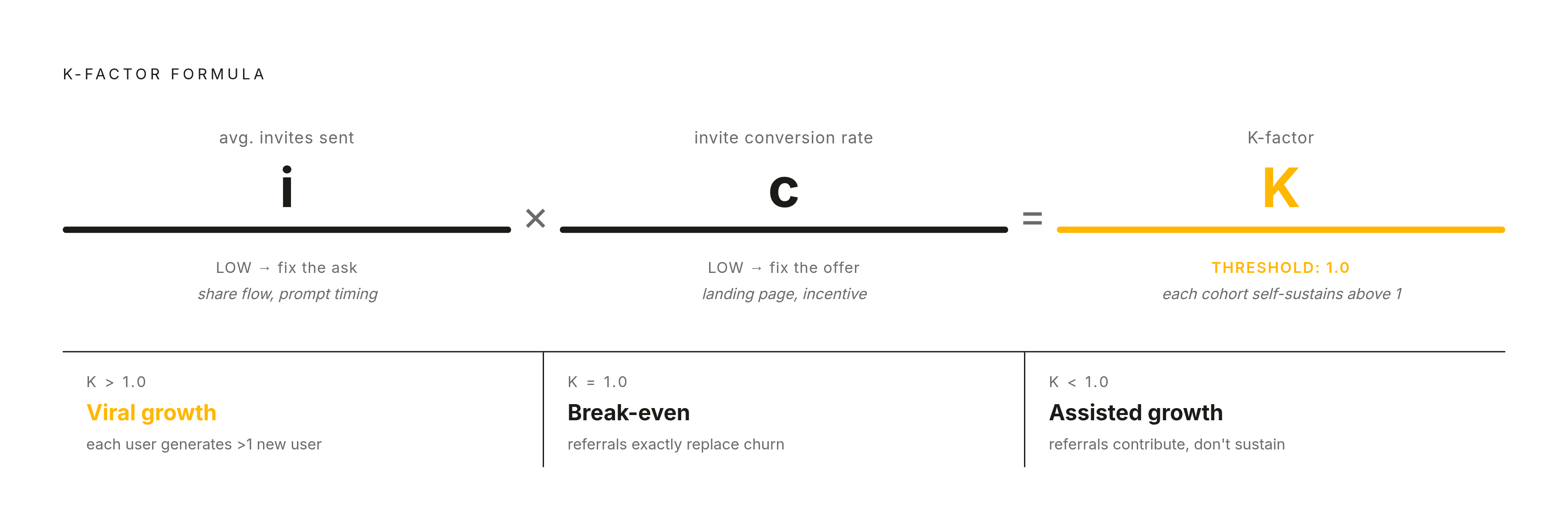
K-factor is the average number of invites each user sends multiplied by the conversion rate of those invites. Above 1.0, each cohort generates more than one new user per existing user through the loop. Below that threshold, referrals still contribute acquisition, but do not sustain growth on their own. A handful of invites that have a low conversion rate gives a small K-factor. More activity is not automatically more growth.
The two components need separate tracking because they expose different faults. Low invite volume points toward the ask or share flow, while low conversion points toward the offer or the referred friend’s landing experience. Improving either component increases the result. Optimizing invite volume alone, however, can fill the pipeline with people interested only in the reward. A busy dashboard can still be an expensive ornament.
Reward disbursement should follow a revenue-generating event so that measured success reflects business outcomes. A K-factor above 1.0 describes user reproduction, while rewards and operating costs need their own financial check.
Even below 1.0, the economics can work. Better conversion and retention among referred customers can shorten SaaS CAC payback, while a meaningful referral share can lower blended CAC. For a pre-Series A company, earlier payback leaves cash available longer before another raise becomes necessary. Once the metric is clear, the first lever to examine is when the invitation appears.
Timing the ask: why the moment of peak satisfaction is the highest-leverage mechanical decision
The highest-leverage design decision is the event that fires the referral ask. When a delivery goes well, a customer leaves a positive review, a support issue is resolved well, or a customer renews, the product’s value is fresh in their mind. At that positive lifecycle moment, it feels easier to share. An ask that comes after a complaint, refund request, or failed delivery sends the opposite signal. A referral prompt should not be the confetti cannon at a customer’s bad afternoon.
Define the trigger before building reward infrastructure. For e-commerce, that could be the first delivery or second purchase. For SaaS, it might be a successful export, an invited teammate, or the first measurable time saving. Founders should ask the first 25–50 activated users when the product delivered on its promise, then instrument that moment. AI can help detect behavioral signals and draft channel-specific asks, with human approval of tone and exclusions, but it cannot replace that definition.
Designing the reward: why two-sided incentives convert better and how to set the right reward value
Two-sided rewards make the referral feel like a gift. When only the advocate benefits, recommending the product can feel socially awkward because the friend is funding someone else’s perk. The advocate can offer the friend a benefit. Symmetry removes a reason not to share.
Dropbox gave both the advocate and the referred friend additional storage, making the reward an extension of the product itself. The currency fit the promise. Service credits serve a similar role in SaaS, while Canopy’s free filters reward customers with something relevant to the device they own.
Reward value needs an economic limit that keeps the combined reward and operating cost below the CAC of the next-best acquisition channel. Within that limit, founders should be as generous as the economics allow. A small reward protects margin only if it still prompts participation. Otherwise, the program has saved money by bringing in nobody.
Tiered rewards can keep active advocates involved, but founders need to be careful about what they learn from launch campaigns. Harry’s used referral milestones in a pre-launch waitlist campaign. Robinhood used visible waitlist positions and let users move up by referring friends. Early access was the prize, and FOMO supplied the push. These cases support choosing the emotional trigger before the reward type.
Simplicity as conversion infrastructure: how program friction destroys participation before the reward even matters
A well-timed offer can still fail if sharing requires unfamiliar tools, another login, or a reward claim process that reads like a minor insurance dispute. Simplicity is a conversion constraint. To test it, founders should complete the flow as a new user, time it, and count the taps. The reward cannot compensate for every obstacle placed before it.
The practical target is a unique link that works across channels without another login. After sharing, the advocate needs to know whether the referral was tracked and when the reward will arrive. Even an email confirmation can provide that visibility. Eligibility also belongs in the flow, since sending the ask to everyone creates noise instead of reaching users who have experienced value.
Notion’s former refer-a-friend program illustrates execution through its combination of credit rewards, a simple share link, and in-product placement. The two-sided program was discontinued in 2020 and replaced by a one-sided affiliate commission program, so it should not be presented as a current template. The useful principle remains that sharing should fit naturally into the product experience.
Building before buying: when to run the program manually and when tooling earns its cost
A manual pilot is the right starting point when there are no proven referral conversions. It lets a founder learn whether people share and whether their friends become paying customers before deciding to pay for automation. Software needs a job before it needs a budget. Once conversions arrive consistently each week and tracking consumes more than a few hours, tooling has a concrete problem to solve.
Pricing deserves attention before the feature tour. With flat monthly fees, the program has a bill even when it converts nobody, while success-based pricing means paying when there is a conversion, payout, or revenue result. Usage-based pricing is a separate model from success-based pricing. The useful comparison is what event creates the bill and whether that event creates value for the startup.
Cello uses tiered monthly pricing based on referral ARR thresholds. Its own page describes a B2B SaaS fit, with native HubSpot, Stripe, and Salesforce integrations and an in-product SDK for embedded referral widgets. Viral Loops, by contrast, is designed for B2C campaigns, waitlists, and giveaways rather than B2B SaaS programs requiring in-product embedding and automated payouts. The supplied pricing material does not establish a clear billing model for Viral Loops, so a price comparison cannot responsibly go further.
ReferralCandy offers Shopify and WooCommerce stores a path to automated links, codes, tracking, and reward disbursement. Yotpo presents its platform as a way to bring tracking, reward fulfillment, and analytics together for e-commerce teams as their operations grow. Neither product’s pricing model is specified in the supplied material. For stores with paying customers and a working referral offer, commerce integrations can address the tracking bottleneck. For a pre-launch SaaS team still locating its aha moment, that bottleneck has not arrived yet.
Fraud, PMF readiness, and the two objections worth taking seriously before launch
Fraud can turn an acquisition budget into a payout scheme for people who never intended to become customers. That objection deserves more than reassurance. Self-referrals and reward gaming weaken the connection between program activity and genuine demand. The response is to manage exposure against the acquisition savings. Controls that repel every possible abuser can also repel legitimate advocates.
The launch guardrails are velocity caps, delayed rewards, and device or IP signals for detecting self-referral. Caps limit how many rewards each advocate can get over a period, while delays hold back payment until the referred customer takes an action that brings in revenue. Fraud protection should be adjusted as the economics become clear, with these controls starting conservatively and loosening over time.
Insufficient product-market fit is the stronger objection because a referral program cannot manufacture a reason to stay. Without a clear, shareable value proposition and satisfied users, it can amplify churn. A small pilot changes the risk. Founders should begin with 25 to 100 qualified advocates rather than the whole user base, and treat the first few months as a learning period.
Qualification needs an operational definition before launch. An advocate should have reached the positive lifecycle moment, completed at least one revenue-generating action, and filed no complaint or refund request in the prior month. Participation, conversion, referred customer lifetime value against cost, and retention then provide the basis for deciding whether to expand. Readiness changes the sequence while evidence remains necessary.
Keeping the program alive: referral metrics on the weekly founder dashboard and ownership structure
A referral program needs one owner responsible for its metrics, iteration, and reward fulfillment. When people share ownership, the work too easily becomes nobody’s Tuesday problem. Referral performance belongs beside revenue and churn on the weekly dashboard. Gustaf Alstromer’s growth curriculum at YC treats acquisition as a system requiring regular attention. Referrals need the same operating rhythm.
For a practical weekly review, first check the participation rate by measuring the share of qualified advocates who complete at least one referral during the period. Weak participation should prompt an inspection of timing and friction before a reflexive reward increase. The second check is K-factor, with invite volume and conversion rate each shown on its own. Low volume directs attention to the ask and share flow, while low conversion directs it toward the reward and landing experience. One headline number cannot diagnose both problems.
The third check compares referred customer lifetime value with rewards and operating costs. Incremental value needs to exceed the cost of producing it. The fourth tracks referred cohort retention at 30, 60, and 90 days against the rest of the user base. Faster churn can be a sign that users came for rewards, that users were poorly qualified, or that the program launched before the product was ready.
Planning for launches should be part of that weekly rhythm too. Kat Manalac’s launch curriculum at YC covers repeated launches across channels, including press, but an inbound spike cannot feed a referral loop that is not ready. The trigger, rewards, and share flow should therefore be in place before a major push, while still waiting for each user’s positive lifecycle moment. For solo founders, an accountability partner can help keep this work from getting pushed aside by other things they need to do. A launch creates attention, but someone still has to run the system afterward.