Early User Retention Strategies for Consumer Startups
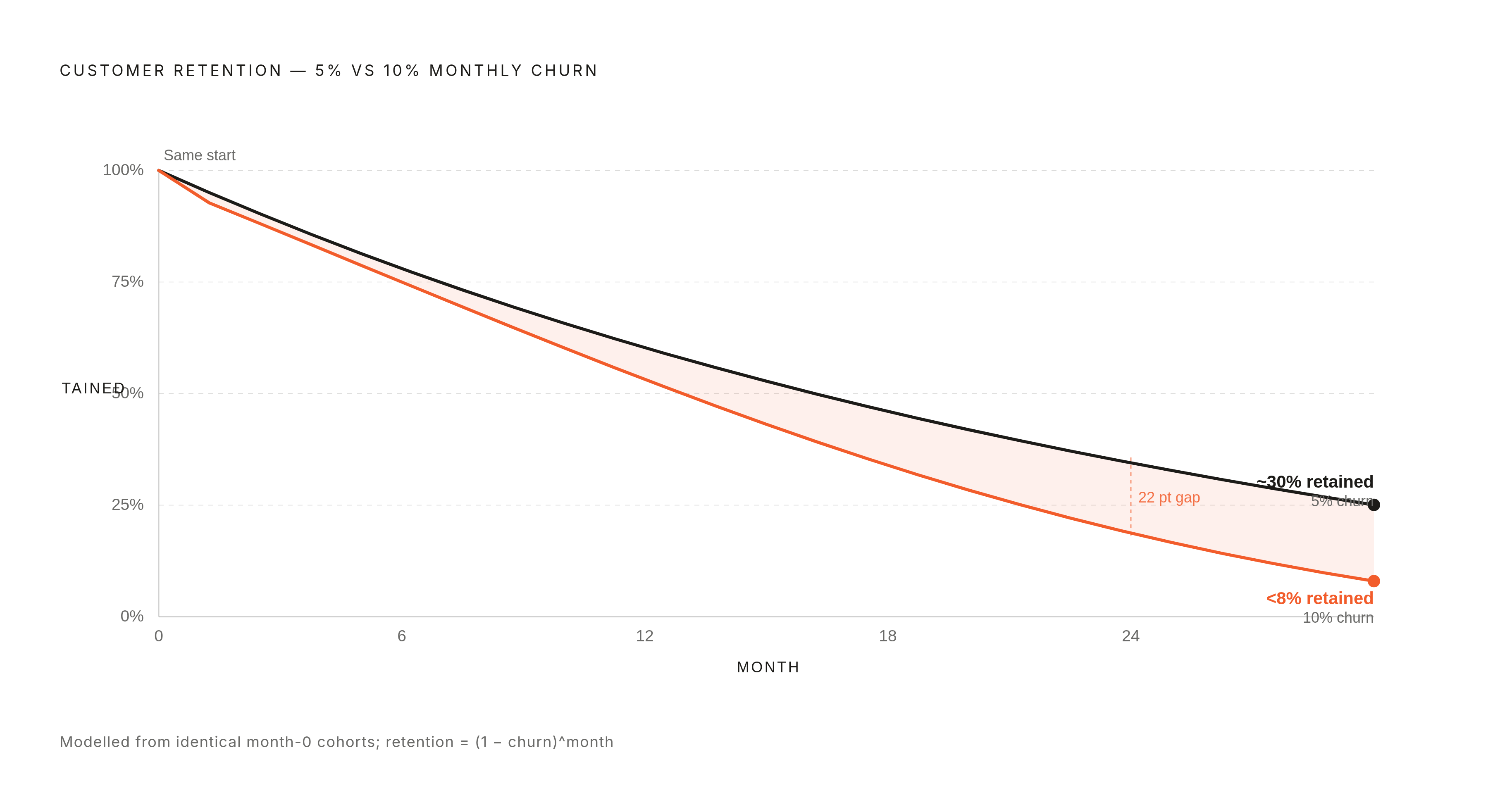
A 5% difference in monthly churn compounds into vastly different businesses within two years.

Growth and retention are two different skills, and most consumer startups only ever build one before the money runs out. Amplitude's 2025 Product Benchmark Report looked at over 2,600 companies and found no meaningful correlation between how well a company acquires users and how well it keeps them. Bet on the wrong one, and the other doesn't just lag. It quietly bankrupts you, one "great acquisition month" at a time.
What the economics of churn actually look like at early scale
A new customer costs somewhere between five and twenty-five times more than keeping one you already have. That gap is too large to file under rounding error, yet founders treat it like a footnote every single quarter.
Run two companies side by side with identical acquisition rates. One churns 5% of customers a month, the other churns 10%. Give it two years, and you're not looking at two similar businesses with slightly different numbers. You're looking at one company with a real customer base compounding underneath it, and another running a treadmill dressed up as a product. Only 18% of companies actually prioritize retention over acquisition, according to Churnkey, even though a 5% bump in retention can lift profits by as much as 95%, per Bain & Company. Most founders are pulling the wrong lever, and the dashboard never says so directly. It just quietly bleeds them for a year before anyone notices.
Average SaaS churn in 2025 sits around 4.1% a month: 3.0% voluntary (people choosing to leave) and 1.1% involuntary (a card expires, a payment fails, something breaks quietly in the background). Compound 4.1% for a year and roughly 40% of the customer base is gone. Push it to a "still not terrible" 5% a month, and the annual loss creeps toward 46%. A single point of monthly churn is the difference between a business and a slow leak, and most founders can't tell you which one they're running.
Strong retention doesn't just save money. It changes what an acquisition dollar is even worth. A user who sticks around for two years is an asset compounding in the background. A user who churns in six weeks was a rental with extra steps, and the rent never covered what it cost to bring them in.
The benchmark that tells you when retention is strong enough to scale
For an early-stage consumer product, the number to hit is 20 to 30% retention at the 30-day mark, measured against actual core product use, before growth spending gets serious. Below that line, paid growth is refilling a bucket with a hole in the bottom. No amount of clever acquisition copy patches a hole.
30-day retention is a proxy, not a finish line, and treating it as the finish line is where most founders go wrong. What matters is whether someone came back to actually use the thing, not whether they opened the app and stared at it for four seconds before closing it again. Login counts are close to useless here. Completing the core action, the one thing the product exists to deliver, is the only number worth watching closely.
For products with a free tier or trial, logo retention (anyone still engaging with the core feature, paying or not) tells you more than revenue retention at this stage. Revenue numbers hide "ghost users," people still paying but no longer opening the app. Ghost users have a habit of churning all at once, months after they've already checked out mentally, and by the time revenue retention notices, the damage happened long ago.
Three checkpoints matter, each one catching a different kind of failure. Day 3 tests whether the habit is forming at all. Day 7 shows whether the first week actually held. Day 30 is the first checkpoint that means anything statistically, worth building a dashboard around.
Define "retained" concretely: a user who completed a specific core action a set number of times inside the window, not "logged in." Crossing 20 to 30% at Day 30 doesn't mean the product is finished or perfect. It means the bucket has stopped leaking fast enough for growth spend to actually pile up instead of evaporating.
Finding the aha moment your product actually delivers
The aha moment is the first time a new user gets the actual value the product exists to deliver. It's an outcome, not a feature tour, and definitely not a cheerful onboarding screen with confetti falling on it. It's the "oh, that's what this does for me" moment, and it either happens fast or it doesn't happen.
Retention gets decided in the first session or two, full stop. A user who never reaches that moment has zero reason to open the app again, and no clever push notification schedule changes that math.
Finding the aha moment takes real investigation, not a guess pulled off the product roadmap. Talk to early users and ask what made them come back, or what moment made the whole thing feel worth their time. Frame it as a job to be done: what task did this user hire the product for, and what does completing that task actually feel like from their side? Then check session-one behavior data for what retained users did that churned users never did. That gap usually points straight at the answer.
Founders tend to define the aha moment from the builder's seat, based on whatever feature they're proudest of, rather than from what user behavior actually shows. Getting this backwards is the single most common mistake in this whole exercise. Netflix and Spotify built retention machines out of personalized recommendations, surfacing value users didn't even know to ask for. Their moment came after "I made an account." It was "this thing gets me," and that's a different product wearing the same signup flow as everyone else.
Once that moment is identified, it stops being a nice insight sitting in a slide deck somewhere. It becomes the target every part of onboarding has to point toward, no exceptions.
Engineering onboarding to route every new user to value before doubt sets in
Onboarding has exactly one job: shrink the gap between "I signed up" and "okay, this is clearly worth my time." Every screen, tooltip, and welcome email either serves that job or gets in its way. There's no third option, and there's no neutral screen sitting quietly in between.
This is Layer 1 retention, getting someone to a real outcome before they've consciously decided whether the product deserves more of their attention. It's the most visible layer, and it has to come first, because nothing built afterward matters if this layer fails.
A few things separate onboarding that works from onboarding that just looks nice in a design mockup. Ask preference questions at signup, not to feed some internal dashboard, but to route each user toward their version of the aha moment faster. Mark small milestones explicitly, with visible confirmations that something real just happened, which anchors the habit before doubt gets a chance to form. Cut every step that doesn't move someone toward the core action, since around 70% of MVP failures come from building too many features, and the same bloat kills onboarding flows for the exact same reason.
Test the flow on real people before launch, not after, when the damage is already done. Something that reads clearly in a design file can confuse an actual stranger within ten seconds, and that gap is the fastest route to a Layer 1 failure nobody notices until the churn numbers show up. Nudges and emails should trigger off behavior, not off a calendar. A user who hasn't hit the core action by Day 2 needs a completely different message than one who's already done it three times, and sending them the same email is a wasted send.
Good onboarding has a simple bar: someone who finishes it should have already had the aha moment, not still be walking toward it.
Building the habit loop that turns one-time use into automatic return
Layer 2 retention runs on switching costs that aren't contracts. They're workflows, routines, integrations. The product becomes annoying to leave because leaving means losing something real, not because a cancellation form is buried three menus deep behind a "wait, are you sure?" screen.
Retention research points to six drivers: habit formation, emotional resonance, perceived value amplification, frequency of engagement, depth of immersion, and astute identification and mitigation of churn triggers. The habit loop covers the first four directly, and it's worth building deliberately rather than hoping it emerges on its own.
A working habit loop needs four pieces. A trigger, external (a notification, an email) or internal (a recurring need the product has trained someone to associate with it). A frictionless action, the core behavior repeated with as few steps in the way as possible. A variable reward, an outcome that feels a little different each time: new recommendations, fresh results, updated content. And an investment: something the user puts in, preferences, history, data, that makes the product more valuable to them and more painful to walk away from.
Feedback loops reinforce all of it. Usage summaries, progress bars, "here's what happened while you were away" emails, these make the value visible instead of assumed, and assumed value is invisible value. Frequency requires deliberate effort to sustain. It's a design decision made or missed. If natural use is infrequent, retention needs deliberate nudges (streaks, reminders, recurring prompts) or a tracking window built for that slower rhythm, instead of pretending a weekly-use product is a daily habit.
Support matters more here than most founders give it credit for. 58% of consumers say they'd switch providers for better customer service, and 78% stay loyal after a good support experience. It's a metric that carries weight beyond a soft, feel-good line tucked into a customer happiness slide. That's habit-layer infrastructure with numbers attached to it.
Reading the signals that predict churn before users decide to leave
Churn almost never happens as a sudden decision. It shows up first as a pattern: a slow drop in how often someone engages, which features they touch, how deep they go into a session before bouncing out.
Watch three specific shifts instead of vanity metrics. A drop in how often the core action gets completed is the earliest and most honest signal available, full stop. A shift from active use to passive scrolling means someone is circling the edges instead of doing the thing that actually matters. And a login with no action at all is the ghost-user pattern: still paying, not really there, invisible right up until they cancel in a wave.
Involuntary churn, that 1.1% slice of the 4.1% average monthly SaaS number, is recoverable. Retry logic on failed payments and proactive dunning emails claw back a real chunk of it before it ever counts as a loss.
Behavioral monitoring tools now let teams flag at-risk users before those users have said a word of complaint. The right move depends entirely on when the drop shows up. An early drop in the first week points to an onboarding gap: the user likely never reached the aha moment, so route them back to it. A drop in the second half of the first month suggests the habit loop broke somewhere, usually friction or a missing value delivery, and it's worth a targeted nudge or direct outreach. When engagement drops without a cancellation, a user may be reassessing whether the product is worth continuing, and a usage summary showing real outcomes can close that gap before they walk.
Catching someone at the exit door with a discount code fixes nothing. Catching the signal early enough to fix the actual problem matters far more than scrambling to save one subscription on its way out the door.
What founders should build, track, and ignore in the first retention sprint
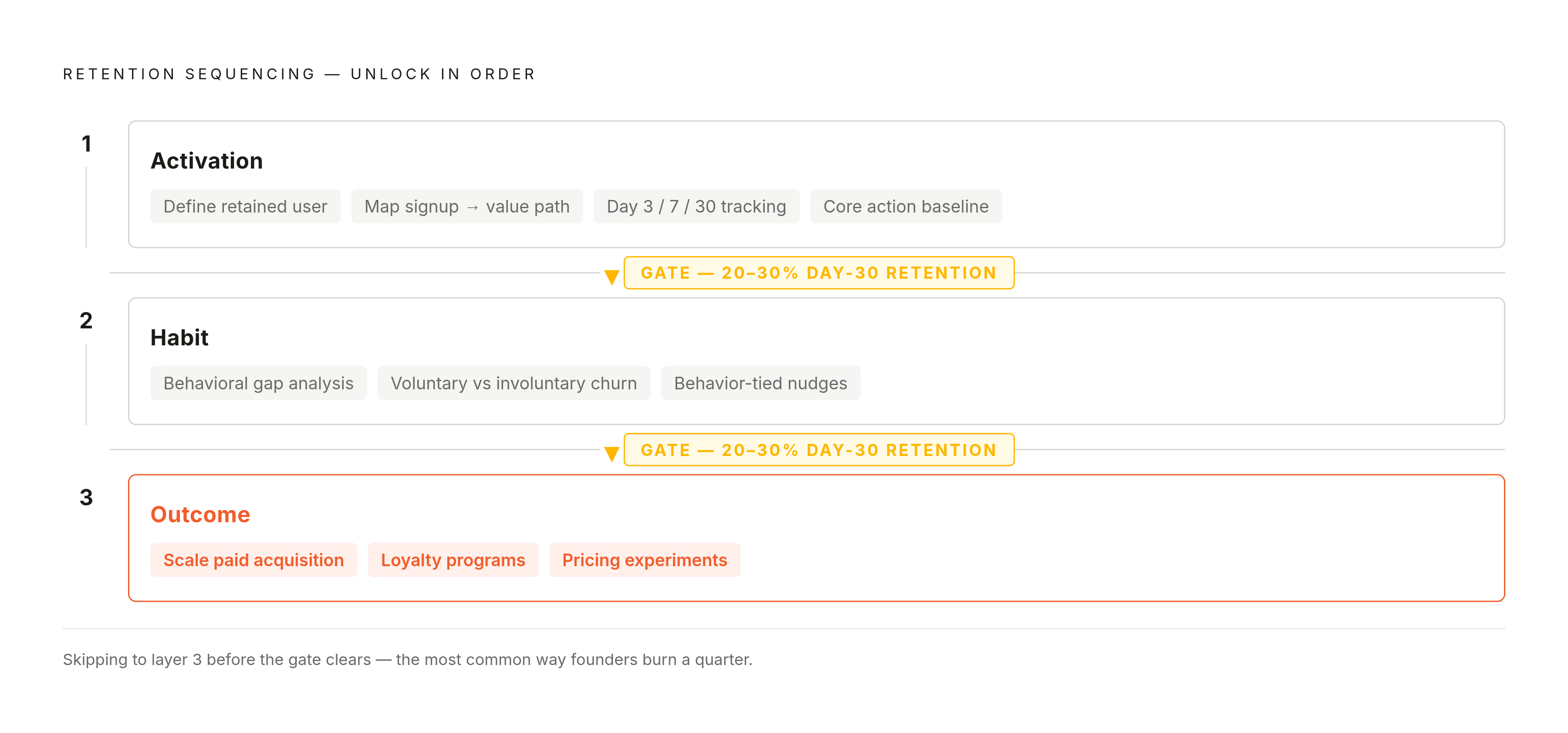
Retention breaks into three problems stacked on top of each other: activation, habit, outcome. Building the habit layer before activation works is wasted effort. Building the outcome layer before the habit sticks is premature, and skipping ahead here is the most common way founders burn a quarter for nothing.
Build these first, in this order. Write down the definition of a retained user before touching a single tool, including one core action, a minimum frequency, and a tracking window. Map every step from signup to first value and delete anything that doesn't serve that path directly. Set up Day 3, Day 7, and Day 30 tracking against the core action, not logins, not session counts, not anything that looks good on a slide but means nothing operationally.
Track these early: logo retention on the core action, not revenue retention, until enough users have gone through the funnel for revenue numbers to mean anything at all. Track the behavioral gap between users who stick and users who leave, what session one actually looked like for each group. Keep voluntary and involuntary churn separate, since they need completely different fixes, and blending them into one number just hides the problem.
Ignore these until the 20 to 30% Day 30 threshold is crossed: paid acquisition scaling, loyalty programs, community features, pricing experiments beyond the basic annual-versus-monthly call. None of it matters yet, and all of it distracts from the one number that actually does.
Check the core retention metric weekly. It moved or it didn't, and that plain fact forces an honest read instead of a story about why this particular week was different. Companies that act on user feedback within 30 days of launch are three times more likely to reach product-market fit, with the same feedback loop doing double duty: proving out retention and proving out PMF at once.
A consumer startup that clears the retention bar before it scales is running a fundamentally different machine than one that scales first and hopes retention catches up later. Every acquisition dollar compounds instead of draining out through the same hole, and the product gets better faster, because the signal underneath it is finally clean.