SAFE Note Terms Every First-Time Founder Should Understand
Know which SAFE terms determine how much of your company you're actually selling.

SAFE notes make it easier to raise money early, but even a short contract can sell a large share of your company. The terms every first-time founder needs to understand are the ones that turn today’s cash into tomorrow’s ownership. Reading the terms together and modeling their cumulative effect lets you sign with confidence before Series A reveals the bill.
Why SAFEs dominate early-stage fundraising and what that means for founders who sign them
Founders can sign a SAFE as if it were routine paperwork, then discover the dilution when the Series A cap table arrives. The gap between how easy a SAFE is to sign and how much ownership its terms can commit poses a problem for founders.
Carta’s Q1 2025 data shows SAFEs accounted for the vast majority of pre-seed deals and a clear majority of seed deals on its platform. Y Combinator introduced the SAFE in late 2013, with Carolynn Levy drafting it to replace convertible notes and cut legal time and cost from weeks to days. No interest accrues, no maturity date needs extending, and founders can close investors one at a time. YC’s free standard templates also give investors a document they know, so often the amount and cap are the main terms left to agree on. That convenience makes fluency in the terms a basic founder skill.
What a SAFE actually is, and what it is not
A SAFE is a Simple Agreement for Future Equity. The investor sends money for the right under the contract to get shares later, usually preferred shares issued when a priced round closes. Acquisition and dissolution provisions can provide a payout before common shareholders, typically with a 1× floor. That floor does not put SAFE holders ahead of creditors, and a failed company may leave them with nothing.
YC’s current US library has three post-money versions, which are cap only, discount only, and MFN only. Cap-only sets a conversion ceiling, discount-only reduces the next round’s share price, and MFN-only lets the holder adopt qualifying better terms offered later. A combined cap-and-discount version remains common but is no longer a standard YC form and calls for drafting with counsel. Older pre-money SAFEs also circulate, so check the version before reasoning about ownership. The distinction changes who absorbs dilution.
The valuation cap and how much of your company you are selling
The valuation cap sets a ceiling on the valuation used to calculate the SAFE’s conversion price. If the priced round values the company above that ceiling, the SAFE holder converts at the cap and receives more shares per dollar than the new investors. The cap therefore determines a large part of the bargain you are making today. It is not decorative optimism about what the company might become.
For a clean example, take a post-money SAFE whose investment amount is one-tenth of its cap. Dividing the investment by the cap gives roughly 10% ownership at conversion, before the priced round’s new money dilutes it. If Series A prices well above that cap, the holder still converts using the lower cap. A new investor writing the same check at the Series A price receives fewer shares.
A lower cap is better for the investor, while a higher cap usually means less founder dilution. Negotiate it from a defensible view of where the first priced round could land, checking the fit of any comparable deals. An artificially low cap can close a raise faster while committing more ownership than necessary. The opposite risk matters in 2026 too, when an “AI-company” cap unsupported by AI-level economics can leave the company facing a down round if Series A investors reject the label.
The discount rate and its traps
With a discount, the SAFE holder pays less for each share than investors in the next priced round. A 20% discount means a 20% reduction from that round’s price per share. Unlike a cap, it does not set a ceiling on the conversion valuation. Its value depends on the price the next round establishes.
When a SAFE contains both a cap and a discount, the investor gets whichever produces the lower share price. The two do not stack as successive price reductions, but the choice gives investors the better outcome across different round prices. Cap-only is the dominant structure in practice, so a combined version deserves deliberate attention.
Discount-only has a particular argument in hard-to-value sectors, including biotech, deep tech, and hardware. When core feasibility is unproven, investors may consider a discount more honest than a speculative cap. It rewards early risk without pretending anyone has already found the right valuation.
Pre-money versus post-money SAFEs and who bears dilution
YC’s shift to post-money SAFEs in 2018 changed how multiple investments share dilution. The original pre-money form set the cap before SAFE money was included. As more pre-money SAFEs accumulated, they diluted earlier SAFE holders as well as founders. That spread the dilution but made the final ownership harder to predict.
The post-money form counts SAFE money when working out the cap, so it is easier to predict how much each capped investor will own. In the cap-based example above, the roughly 10% commitment remains intact when the company signs another post-money SAFE and is subject to dilution from the priced round’s new investment. “Post-money” is not a lifetime force field against dilution.
The important consequence is that post-money SAFE holders do not dilute one another. Additional SAFEs instead reduce the ownership left for founders. Each agreement therefore belongs in a cumulative model. Keep all SAFEs on the same version, because mixing pre-money and post-money forms makes conversion harder and can create disputes at the next round.
How stacking multiple SAFEs creates dilution founders do not see coming
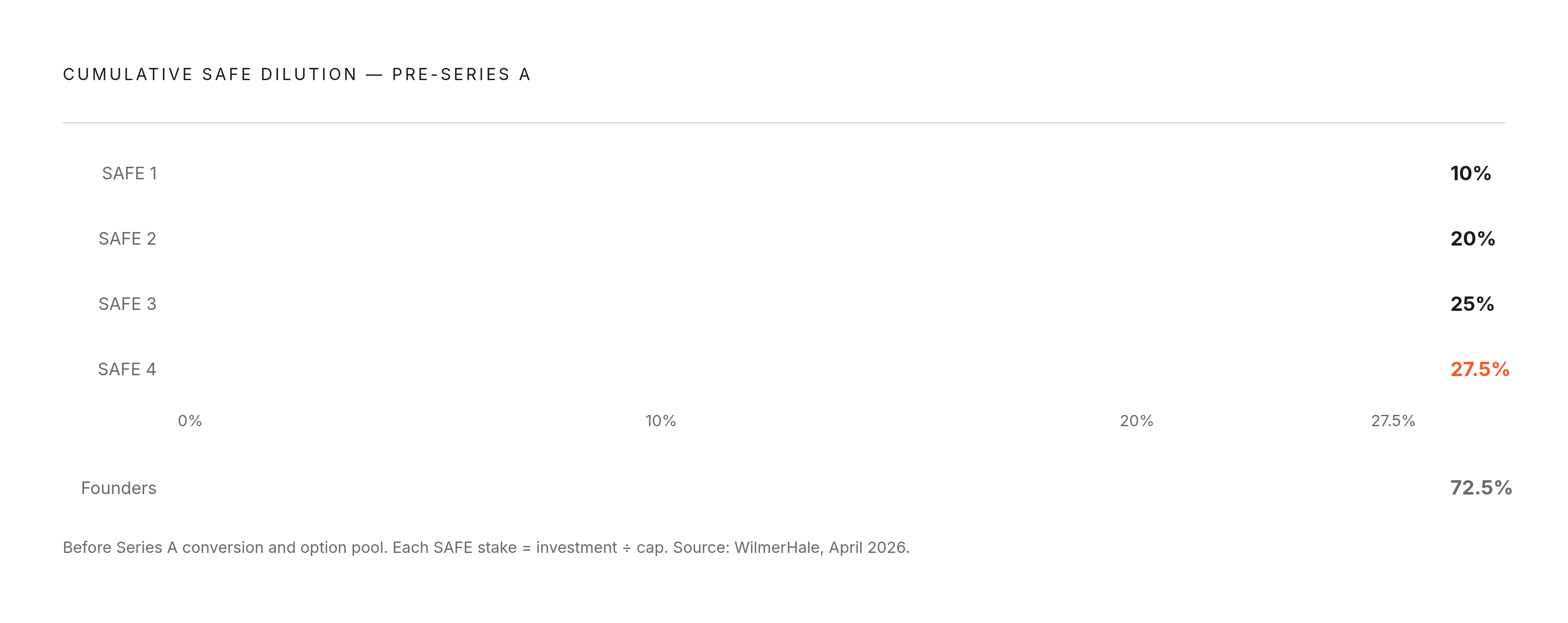
Each deal in a rolling raise can look sound on its own while the deals together promise a large share of the company. Higher caps on later checks do not erase ownership already promised at lower caps. To start the calculation, divide the amount of each post-money investment by its cap. Those percentages then add together. The total is the useful number.
WilmerHale’s April 2026 warning illustrates four stacked SAFEs at rising caps producing cumulative investor stakes of more than a quarter of the company before a priced round closes. The sequence is what matters. First, calculate the ownership represented by the earliest SAFE. Then add each later SAFE’s percentage to the running total. Only after accounting for the whole stack does the Series A investment enter the picture.
The option pool also takes a share of the company. Priced-round investors typically require it to be set or refreshed before their money comes in, leaving founders to bear the additional dilution in a post-money SAFE structure. A pool of 10% or more is a meaningful further cost. Model the existing SAFEs, the proposed check, the Series A, and a realistic pool refresh before signing each new agreement. If you cannot explain your remaining ownership in one sentence, the spreadsheet needs another visit.
The MFN clause and how earlier investors can inherit later terms
A most-favored-nation clause lets an earlier SAFE holder take better terms that later SAFE investors are offered before the priced round. Suppose an early investor signs an uncapped MFN SAFE and a later investor negotiates a low cap. The earlier holder can adopt that cap too. A concession made to close a small check can therefore reprice a much larger amount of earlier money.
MFN clauses are most common in uncapped SAFEs, where the investor lacks other price protection. Their effect is retroactive, so the cheapest cap you offer may become the cap available to every eligible MFN holder. Limit MFN protection to truly uncapped SAFEs where the investor has no other price safeguard. Before offering new terms, model what happens if every MFN holder adopts the lowest cap you are likely to offer. The new check is not necessarily the full size of the new commitment.
Pro-rata rights and side letters that complicate Series A
Pro-rata rights give a SAFE investor the option to invest more in the next round to maintain ownership after conversion. They reserve potential demand for the next round’s allocation. If five or six investors hold these rights, a Series A lead may find a meaningful share of the round already spoken for. That can create friction when the lead wants control over allocation.
Give pro-rata rights only to those who write the largest checks, and only for the next priced round. Side letters also deserve attention because they can carry information rights and board observer rights as well as pro-rata provisions. Different letters with slightly different promises become a reconciliation job when the Series A lead wants them brought into order. A consistent template helps keep that job manageable. Side letters are not inherently a problem, but closing day is a poor time to discover you have collected a matching set of mismatched obligations.
Terms that do not belong in a SAFE and should prompt a conversation before signing
Start with every departure from the standard YC form and ask why it is there. A standard liquidation floor is different from language that gives an investor debt-like priority over creditors. The former provides a defined payout position before common shareholders in relevant exit or dissolution circumstances. The latter changes the structure of the bargain and deserves scrutiny before signing.
Anti-dilution protection is another change from the standard form to ask about. Broad-based weighted average anti-dilution belongs to priced-round negotiations and adjusts an investor’s share price when a later round prices lower. Putting it in a SAFE gives early investors protection that is usually negotiated at Series A. An unusually high discount also needs to be talked through, especially if it comes with a low cap. The resulting economics need to be explainable.
Issuing a SAFE also creates securities-law obligations outside the contract’s conversion terms. For a Regulation D offering, Form D must be filed promptly after the first sale. Failure to file can create liability. Talk with counsel about the required filing before closing.
What the SAFE does not cover, and what founders need to have in order before signing
The SAFE governs an investment. It does not settle equity splits, vesting, or ownership of work already created. Yet the YC form includes a company representation about sufficient rights to the intellectual property needed for its business, subject to its knowledge and the stated terms. Known IP disputes, contractor assignment gaps, or unresolved co-founder claims can undermine that representation. Resolve or disclose those problems before signing.
Set co-founder equity and vesting before raising. The YC model uses an equal or near-equal split with 4-year vesting, a 1-year cliff, and monthly vesting thereafter. Vesting can address early-work imbalances without baking them into a permanently unequal split. Written IP assignments should cover every founder and early contractor, as well as any work they did before incorporation.
Leaver provisions also need a clear agreement. The arrangements described here distinguish buyback at par for departures that breach obligations from fair market value for clean departures. Settling those terms early keeps an unresolved founder dispute from becoming an investor’s problem. The company making the SAFE’s promises needs to be in a position to keep them.
A working checklist for reading and signing any SAFE
Begin by comparing the document with the free YC post-money form. Mark every change, ask the investor to explain it, and push back where the explanation does not justify the departure. Next, confirm whether the SAFE is pre-money or post-money and whether it matches the agreements already signed.
Then run the cumulative cap table model. Work out how much ownership each capped post-money SAFE promises by dividing its amount by its cap, add the proposed agreement, and model the Series A with a realistic option pool refresh. Check whether the resulting founder ownership is acceptable. After that, test existing MFN clauses against the new cap or discount. Map each pro-rata right and side letter, including which round the right covers and how much allocation those commitments could consume.
Finally, have a lawyer review the first SAFE even if it uses the standard form. The review must cover the company’s ability to make its legal representations and the wording of the template. This routine turns a quick signature into an informed decision.