Vesting Schedules for Startup Founders and Early Employees
How to protect your startup from dead equity and misaligned incentives.

Picture two co-founders, 50/50 split, no vesting schedule, shaking hands on a dream. Six months later, one of them decides the startup life isn't for them and walks. They keep their entire half of the company. The one who stayed is now building a business with a silent partner who did roughly two quarters of work and gets paid like they did four years of it.
That silent partner isn't just an awkward line on the cap table. They have blocking power over acquisitions, investment rounds, and strategic decisions, simply by virtue of owning a large chunk of a company they no longer work for. The industry has a name for this: dead equity. It's ownership with no ongoing contribution attached to it, and it sits there, inert, while everyone else keeps working.
Dead equity doesn't stay contained to the two people who split the company. It travels. Future investors who look at the cap table see it. Every new hire who gets an offer letter sees it, indirectly, in the size of the option pool left for them. Every acquirer doing diligence sees a chunk of ownership sitting with someone who has nothing to do with the business anymore. Investors don't want to see shareholders holding large stakes while contributing nothing to the product or the growth of the business going forward, and a departed co-founder with a sizeable minority stake can block decisions the active team needs to make, simply by refusing to sign.
Vesting isn't a favor to investors; it's self-protection for whoever ends up staying and doing the work. Founders who've lived through a bad split, whether it happened to them directly or to a friend down the street, tend to become the loudest advocates for vesting on their next venture. That's what happens when someone's watched a company get stuck because an ex-partner won't return an email.
How the standard four-year vesting schedule works
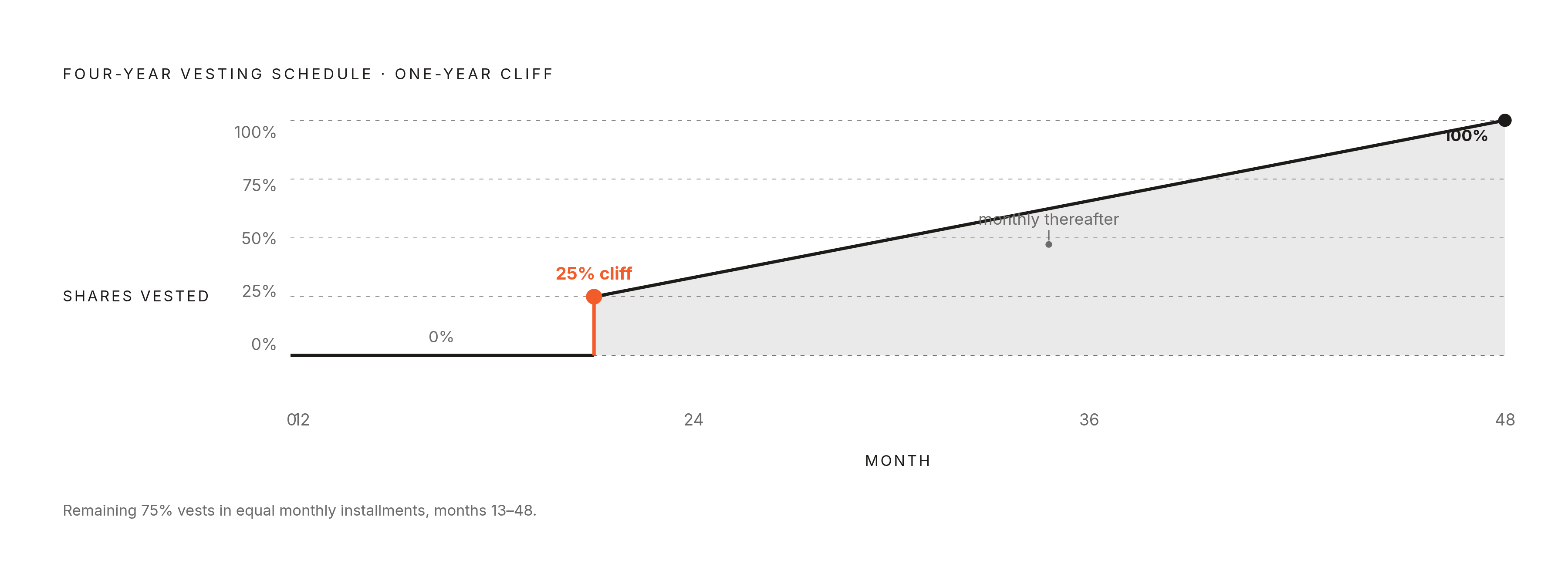
Across the startup world, one structure has become close to universal: four years of vesting, with a one-year cliff, applied the same way to founders and employees alike. Capbase calls this the norm for founders and all startup employees.
Year one is the cliff. Nothing vests. If someone leaves in month three, or month eleven, they walk away with zero shares. At the twelve-month mark, a quarter of their total grant vests all at once, a lump sum often called the cliff grant. From that point through the end of year four, the remaining three-quarters vests monthly, in small, equal slices, until the whole grant is earned.
What does "unvested" actually mean for the shares someone hasn't earned yet? They're not simply erased. The company holds a right to buy them back at the original issue price, which at incorporation is usually a tiny fraction of a cent per share. Capbase notes a 90-day window after a founder stops working for the company to exercise that repurchase right. That window is the mechanism that keeps a quick departure from turning into permanent dead equity: the company can reclaim the shares before they calcify into someone else's leverage.
The cliff exists for a specific reason. It filters out the people who aren't a long-term fit before any ownership changes hands. Leaving in month eleven means there's nothing to claw back, because nothing was ever handed over. The company keeps full flexibility, and the business isn't stuck untangling equity from someone who barely got started.
A quick note on frequency: once the cliff passes, vesting usually happens monthly, which gives employees a steady, predictable trickle of ownership. Some companies vest quarterly instead, cutting down on the paperwork, though that can produce lumpier outcomes if someone leaves mid-quarter. Whichever cadence a company picks, it should apply it the same way across every grant. Switching frequencies partway through creates a mess once several employees are vesting on different clocks at once.
Variations from the standard four years exist, and investors read them differently depending on which direction they go. A five-year schedule is perfectly reasonable, and for a founding team planning to build for the long haul, it can line up incentives even better than the standard four. A shorter schedule, or a thinner cliff, tends to raise eyebrows. Capbase notes that a shortened vesting period is likely to get renegotiated the next time the company raises money. No vesting schedule at all, for an institutional investor, is close to a dealbreaker.
Founders versus employees: the same schedule, different instruments
Founders and early employees both live on the same four-year, one-year-cliff timeline. What differs is the legal paperwork underneath that timeline, and that paperwork changes the tax bill considerably.
Founders typically hold restricted stock. That means they own the shares outright from day one, subject to the company's right to buy back whatever hasn't vested yet. Because the shares are owned immediately, the tax question isn't whether they're taxed, it's when the IRS considers them taxable. The 83(b) election, covered next, exists to solve that timing question.
Employees typically hold something different: stock options, which is the right to buy shares later at a price fixed today. Vesting for an option holder unlocks the right to purchase, not ownership itself. Until someone exercises an option, they don't own any shares at all. Two flavors of these options exist, incentive stock options (ISOs) and non-qualified stock options (NSOs), and they carry different tax treatment. The exercise price for either type gets set at fair market value on the grant date, determined by a formal 409A valuation.
The 90-day window matters here too, and it catches a lot of departing employees off guard. Exercising an option costs real money (the strike price multiplied by the number of shares), and it can trigger a tax bill before there's any actual cash from a sale. Leaving a company with a pile of vested, unexercised options sounds like a win on paper. In practice, it can mean writing a check to buy shares in a company that may never go public, just to keep the option from expiring. Some companies have started extending that post-termination exercise window as a retention tool, recognizing that a 90-day deadline can push departing employees to abandon equity they'd otherwise want to keep.
A third instrument, restricted stock units (RSUs), appears less often at early-stage startups but is common at later-stage and public companies. RSUs skip the purchase step entirely: no buying, no exercise price. The holder simply waits until the vesting conditions are met, and the shares get delivered. Delivery creates taxable income right at that moment, which gets complicated fast at an early-stage valuation where there's no market to sell shares and cover the tax bill. That's why RSUs tend to wait until a company is bigger and more liquid.
Advisors sit in their own, smaller category. They typically receive options rather than restricted stock, and the schedule is shorter across the board: two years with a six-month cliff instead of four years with a one-year cliff. The shorter timeline reflects the shape of the relationship. Advisors aren't in the building every day running the company. Their equity should match the size of their involvement.
The 83(b) election: the one filing founders cannot miss
Missing this filing by a single day makes the tax benefit it offers disappear permanently. There's no appeal process, no grace period, no "the dog ate my paperwork" exception.
The 83(b) election solves a specific problem. Without it, the IRS taxes a founder on the fair-market value of their shares at every single vesting milestone, not just once at the start. If the company grows in value between incorporation and each vesting date, that founder owes ordinary income tax on increasingly expensive stock, for shares that were worth almost nothing when they were first issued. A founder could end up owing real tax money on paper gains in a company they can't yet sell a single share of.
Filing an 83(b) election flips that. It tells the IRS to tax the shares once, at the grant date, when the price per share is close to zero. Every dollar of appreciation after that point gets treated as a capital gain rather than ordinary income, which, depending on the numbers, is a meaningfully lower rate. Capbase notes that for most early-stage founders paying a nominal price per share at incorporation, the entire upfront tax bill from filing amounts to a few dollars. The long-term savings, if the company succeeds, can run into six or seven figures.
The clock on this starts the day the shares are granted, which is typically the day the company incorporates and founder shares get issued. Founders have 30 days from that date to file. Capbase is direct about it: miss it by one day and the election is gone for good, with no way to recover it later. Setting up a vesting schedule at incorporation, rather than adding one later, matters for this reason. The deadline doesn't wait for a founder to get organized.
Filing mechanics changed recently, and for the better. In November 2024, the IRS released Form 15620, the first official standardized form for making a Section 83(b) election. Before that, founders (and their lawyers) were writing informal letters to the IRS and hoping the formatting held up. In July 2025, the IRS opened an electronic filing portal for Form 15620, letting founders submit the election online. Both paths, electronic filing and certified mail, remain valid options.
One distinction carries over directly from the last section: employees holding stock options don't file an 83(b) election the same way founders do. This filing applies only to restricted stock grants. It's the direct product of founders owning their shares outright from day one, while option holders don't own anything until they exercise. Given how much money rides on getting the filing and the timing right, and how specific the rules get depending on company structure and jurisdiction, this is a case where talking to a tax advisor before incorporation is worth the cost of the conversation.
Setting up vesting among co-founders before tension arrives
A founders' agreement, signed at or before incorporation, is what keeps a co-founder falling-out from turning into a company-ending event. Vesting schedules give the structure its teeth, but the agreement is what spells out the terms everyone actually agreed to before anyone had a reason to argue about them.
A solid founders' agreement covers several things at once. It should spell out the company's repurchase rights over unvested shares at the original issue price. It needs an IP assignment clause, making clear that prior work and anything built going forward belongs to the company, not to whichever individual happened to write the code. It should define decision-making authority: what needs unanimous agreement among founders, and what any single founder can decide alone. And it needs to lay out departure terms across every scenario, voluntary exit, termination with cause, and termination without cause, since each one can carry different consequences for unvested equity. A template built for this purpose lists these exact provisions as the core of the document: equity and vesting, IP assignment, roles and responsibilities, decision-making authority, confidentiality and non-compete terms, departure terms, and dispute resolution.
One wrinkle: founders who spent months building a product before they ever filed paperwork to incorporate. Those founders can reasonably negotiate some credit for that earlier work, starting the vesting clock partially filled. Framed simply, it's crediting time already served against the four-year schedule. Investors are generally fine with a reasonable credit for work genuinely done. What raises concern is backdating aggressively enough that a founder is nearly fully vested the moment the company incorporates. That defeats the entire purpose of vesting and signals to anyone looking at the cap table that the founder isn't actually committed to sticking around for the next four years.
There's a quieter benefit to setting equal vesting terms across every founder, and it has nothing to do with investors. A founder who accepts the same vesting schedule as everyone else is the only one in a position to ask co-founders to accept it too. A founder who carves out special terms for themselves while holding co-founders to a strict schedule has already spent some trust before the company has even gotten going. Setting equal terms at the start, before anyone has a reason to feel slighted by them, is the easiest point at which to get everyone to agree.
Skipping this step at incorporation doesn't make it go away. It comes back, usually at the worst possible time. Founders without an existing vesting schedule by the time they raise a priced round will often find investors insisting on one as a condition of the deal. At a Series A, if founders have already vested more than investors think is reasonable, a common compromise is credit for time already served plus a fresh vesting period on whatever's left. Setting vesting up correctly at incorporation sidesteps that negotiation entirely, so it pays to get it right on day one.