Series A Funding Requirements and Readiness Signals
Investors now demand proof of durable revenue and retention before writing Series A checks.

Series A funding requirements in 2026 demand more than a convincing growth story. Founders need evidence that customers stay, sales repeat, and capital produces durable revenue. Build toward those signals during seed, with enough runway to prove them before approaching investors, so the pitch does not have to fill the gaps.
Why Series A requirements are materially higher in 2026 than founders expect
Founders who last studied Series A in 2021 are working from an outdated map. The destination has not disappeared, but the road is longer and the tollbooths are less forgiving. The “growth at all costs” era ended as investors shifted toward requiring a path to profitability before committing capital. That is a lasting change in how they judge a business. Planning around a return to the old standards means building toward the wrong target.
The time between seed close and Series A has stretched from roughly 18 months to 24–30 months, so founders must fund more time to demonstrate that the model works. Yet the market is not uniformly cautious. In Q1 2026, foundational-model AI companies had median valuations far above those of non-AI companies at the same stage. Those deals do not provide a reliable benchmark for everyone else, however tempting the headline may be.
What Series A actually is and how it differs from seed in practice
Seed pays for a team to find out whether it can build something worth buying. Series A finances whether that business can scale, which shifts the investor’s bet from vision toward numbers. It also introduces institutional governance and diligence standards that change the company permanently. The capital comes with a continuing relationship.
A lead investor takes a board seat and an active governance role. Term sheet clauses, including liquidation preferences, anti-dilution protections, protective provisions, and information rights, shape that relationship for years. These are not decorative legal terms to skim after agreeing on valuation. Institutional investors buy a sizable ownership stake but expect founders to keep majority control through Series A so they still have a real say in the company.
Pre-money valuations span a wide range, but valuation multiples have compressed significantly from the 2021 peak. A larger headline number alone does not explain the bargain a founder is making. Because investors will have both an economic stake and formal oversight, the company’s performance must withstand more than a persuasive presentation. Getting the metrics right before entering that relationship is preparation for running the company.
The revenue and growth metrics that now determine whether a founder gets a meeting
For B2B SaaS founders, ARR is an entry filter, but it is not a universal password. Revenue floors differ across benchmarks, and the relevant range depends on the growth and retention attached to that revenue. Strong ARR growing slowly belongs in a different conversation from the same ARR growing very fast. Sector also matters. There is no useful shortcut in borrowing the most flattering comparison.
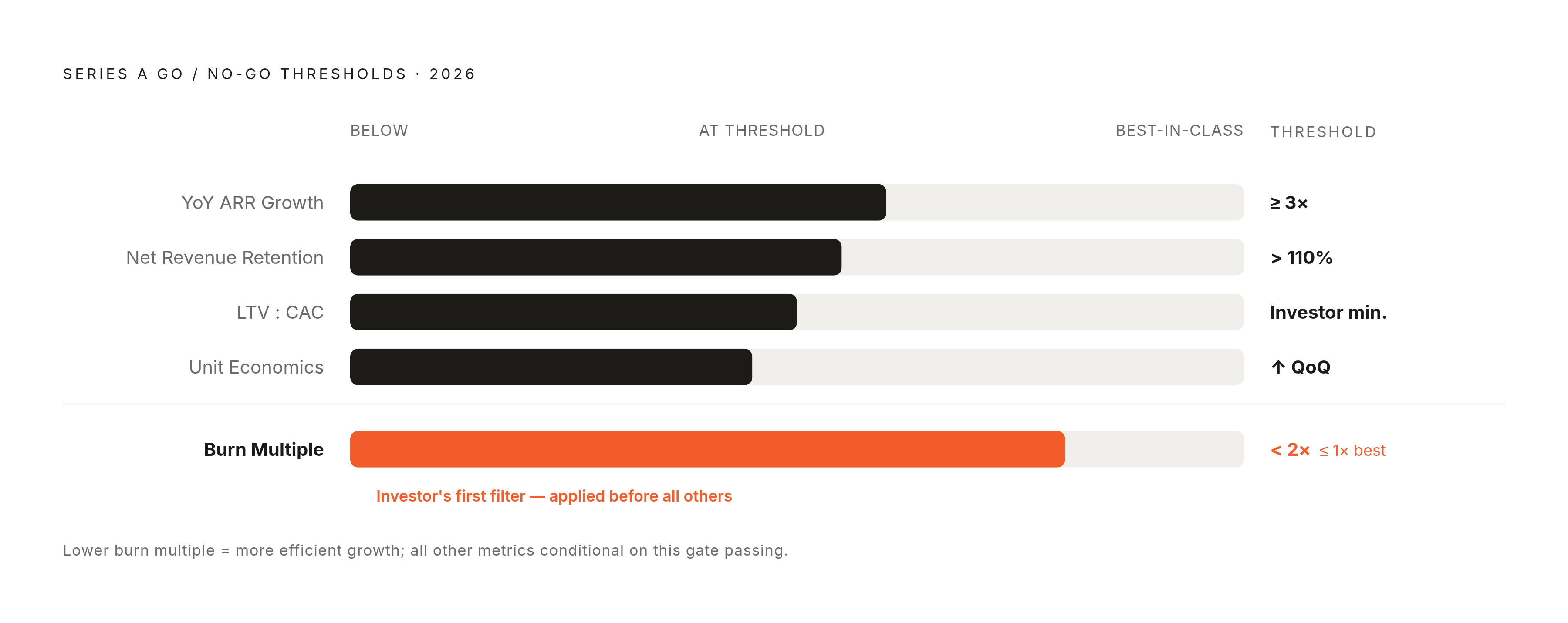
The growth benchmark is demanding, with a minimum of 3x year-over-year growth. Above that floor, percentage growth helps show which deals can compete and which draw enough interest to be oversubscribed. A company that triples from a smaller base draws more attention than one that reaches the same revenue level through modest growth from a larger base. ARR says how much recurring revenue exists, while growth shows how quickly the business is adding to it.
Investors also examine what that growth costs. Burn multiple is net burn divided by net new ARR, making it a direct measure of capital consumed for new recurring revenue. The readiness test is to keep it under 2x, with best-in-class companies running leaner still. Investors then apply ARR multiples that vary with growth rate and retention quality. For most companies, the elevated multiples of 2021 are gone, so valuation is better understood as an output of performance than a number chosen for the pitch deck.
Why net revenue retention and unit economics have become the deciding factors
Net revenue retention above 110% matters because it helps show whether customers keep finding value in the product or the company has to keep spending to bring in revenue. Growth can look strong even as the company keeps losing customers. NRR and unit economics show that weakness by testing whether the model works beyond the next push to win customers. They have become decisive filters because revenue alone cannot answer that question.
Retention cohorts provide the behavioral evidence. When cohort activity flattens above zero across successive periods, it shows that a group of customers continues to find value in the product. That is a stronger signal of durable product-market fit than a burst of early use. With high churn, cohort activity keeps falling, so the company has to win new customers just to stay flat. This acquisition treadmill uses up cash, leaves the company with fewer choices, and makes its growth projections harder to believe.
CAC payback, LTV:CAC, and gross margin need to meet the relevant thresholds, with LTV:CAC above the minimum investors require. Revenue quality matters too, because relying too much on one customer is risky no matter how fast the company grows. Investors give less weight to month-to-month contracts than to multi-year agreements with auto-renewal. Together, these measures show why investors care not only about the amount of revenue, but also about its durability and cost.
What investors evaluate beyond the numbers: team, market, and defensibility
Good metrics do not excuse a team that cannot manage the next stage. Investors assess whether the CEO can recruit senior talent and whether the CTO can architect systems beyond the initial product. They also look for coachability when market feedback contradicts the original plan. Complementary technical and domain or business leadership, supported by A-level early hires or advisors, strengthens the case.
Market diligence is similarly concrete. Investors want proof of TAM from the bottom up, proof that the company leads in its beachhead, and clear ways to reach more markets. A large top-down estimate counts for little without that proof. Competitive positioning must also survive scrutiny through defensible advantages, including proprietary data, network effects, patents, or switching costs. A promise to execute better expresses ambition.
Execution connects those claims back to the operating business. Predictable sales cycles, a repeatable go-to-market motion, and improving unit economics quarter-over-quarter show that growth comes from systems. Investors also expect exit clarity through specific potential acquirers with a strategic rationale or an articulated IPO pathway. That reflects portfolio construction discipline. Even when the numbers clear the filters, weak answers on team, market, defensibility, or execution can still end the discussion.
How a founder can honestly assess whether they are Series A ready today
An honest readiness assessment tests the business as it operates today. Start with whether CAC payback, LTV:CAC, and gross margin meet the relevant thresholds and improve quarter-over-quarter. Then examine whether net burn per dollar of new ARR is under 2x. Test runway as well, asking whether there will be 18–24 months of cash after any current raise or whether a bridge is already looming.
Sales repeatability deserves an equally plain test. If nobody other than a co-founder has closed a customer, the company has not yet demonstrated that sales can work beyond its founders. Retention needs the same close look at cohort behavior and NRR, even when the overall numbers look good. These questions often lead to “not yet,” which is a strategically useful answer. A specific gap in retention, repeatability, or burn multiple can define a 6–12 month sprint.
Approaching investors before that work is done has costs beyond rejection. It trains investors to pass, weakens valuation leverage, and consumes founder time that should go into building. Companies that arrive oversubscribed have usually spent roughly 20–26 months since seed working on the metrics investors use, though the strongest often close in 14–15 months. Those periods are not a countdown to readiness, because elapsed time is not evidence. Knowing the gap only helps when the company has an operating structure capable of closing it.
How to structure the seed stage so that it builds toward Series A readiness
The seed stage is the window for building the evidence that later diligence will inspect. During the 18–30 months between seed close and a Series A approach, the choices a team makes about the product should help it learn as well as ship releases. Launching to a small group of early adopters, measuring closely, and iterating quickly produces real cohort data. The product that reaches diligence should reflect what the team learned after the first build. Otherwise, the company risks showing up with a set of metrics but no proof of demand.
The Dropbox principle keeps the distinction clear. A working demo that proves demand is more valuable than a full build with demand still unproven. The goal of the MVP stage is learning. Hiring aggressively before product-market fit is confirmed works against that goal by consuming runway and inflating burn multiple.
When founders sell directly, they save cash and learn enough about their customers to build a repeatable sales playbook. Handing sales off before documenting the process means handing over something the founder cannot yet describe. Weekly progress tracking then keeps the team focused on outcomes and makes burn visible. That discipline helps prevent the quiet drift that turns a 24-month runway into a 10-month one.
Seed financing decisions also shape the company that Series A investors see. Y Combinator introduced SAFEs in 2013, and their lack of interest or a maturity date distinguishes them from convertible notes. Their ease of use also matters because investors prefer a clean balance sheet and cap table. Multiple post-money SAFEs can leave founders with less ownership than expected because dilution falls on founders, with prior SAFE investors protected from that dilution. Model that dilution before each seed round.
Using structured resources and accountability to close the gap faster
External knowledge helps most when it is tied to a specific operating gap. Structured resources and consistent internal accountability give founders a clearer route to readiness than informal advice and ad-hoc milestones. Vague goals such as improving retention leave too much room for interpretation. A time-bound target for monthly churn creates a finish line the team can inspect.
Weekly check-ins should cover completed tasks, next steps, and blockers, with the discussion anchored in outcomes. Tracking MRR, churn, active users, and the conversion funnel keeps attention on what Series A investors will eventually examine. Tracking hours worked does not answer whether the business improved. Each goal also needs one owner who answers for the outcome, even when others support the work.
The same intentional approach applies when the gap is in the founding team. Finding a complementary technical or business co-founder should be a structured process because the decision affects both fundraising and long-term stability. Y Combinator’s free co-founder matching platform makes it easier to find that pairing. Series A readiness comes from closing specific gaps until the evidence supports the raise.