Share Incentive Plans for Early-Stage Startup Teams
Founders need the right structure early to attract talent without overspending their equity budget.

Equity is what lets a two-person startup hire like a company ten times its size. That's the whole premise, and the stakes are simple: a founder who can't match a competitor's salary is still in the game, as long as the offer includes a real piece of what the company becomes. Over 80% of venture-backed startups in the US use stock options or other equity plans to attract and retain talent, Qubit Capital reports, so a founder without a structured plan is showing up to a hiring negotiation without the one tool everyone else at the table is using.
Equity works because it ties a hire's financial future to the company's growth. A candidate who takes a below-market salary in exchange for options is betting on the business, and that bet only pays off if the business is actually worth something later. That alignment is the point. It's also a budget that shrinks every time it's spent: every grant dilutes everyone who already holds shares, so handing out equity casually in a round of excited early offers can leave a founder boxed in before the first product ships.
What follows is for founders working through pre-seed, seed, or Series A, before the habits around equity harden into a cap table nobody wants to open. Get the structure right early, and later hires, later rounds, and later headaches all get easier. Get it wrong, and the fix usually costs more than the plan would have.
What a Share Incentive Plan actually is and what it covers
An Equity Incentive Plan is the formal structure a company sets up to grant shares, or the right to buy shares, to employees, advisors, directors, and consultants. Think of it as the container that holds every individual grant a company will ever make. Without one, a founder can still hand out equity, deal by deal, but each grant has to be built from scratch, with its own paperwork and its own legal exposure. With a plan in place, each new offer slots into a structure that's already been through the legal wringer once.
The plan exists to do two things at the same time: give recipients a reason to build value in the company, and line up their interests with the company's own. An engineer who holds options cares whether the product ships on time in a way that an engineer paid flat salary, with no stake in the outcome, might not.
A plan also carries a legal function worth setting up formally. Adopting an EIP generally lets startups fall within an exemption from SEC registration requirements under the Securities Act of 1933, requirements that would otherwise apply to any offer or sale of securities, including equity handed to a contractor or an advisor. The plan also fixes the size of the pool of shares set aside for this purpose, called the option pool, so that every grant going forward can be measured against a known, fixed denominator. That matters to a startup's own team, and matters just as much to investors, who expect the pool sized and sitting in a standard range by the time a financing round closes. A plan is expected infrastructure, the same way a cap table or a bank account is.
Four Award Types, and Which Ones Make Sense Early On
The plan is the container. The award type is what actually goes inside it, and the choice determines who's eligible to receive it, when taxes get triggered, and how much of the upside the recipient actually walks away with.
Stock options are the most common award across startup stages: the right, not the obligation, to buy shares at a fixed exercise price within a set window. Options split into two flavors that matter for very different reasons. Incentive Stock Options, or ISOs, go exclusively to W-2 employees and come with a notable tax break: exercising an ISO doesn't trigger ordinary income tax, and the eventual gain can qualify for long-term capital gains rates if the holder meets specific holding periods. Non-Qualified Stock Options, or NSOs, can go to anyone doing work for the company, including advisors and contractors, but they don't carry the same tax treatment. The exercise price on either type has to equal fair market value on the day of the grant. Setting it lower, even with good intentions, leaves the recipient with an unwelcome tax bill. Fair market value for a private company comes from a 409A valuation, an independent appraisal, and the sensible order of operations is: adopt the plan, then get the 409A done, then start granting.
Restricted Stock Awards work differently. An RSA is an outright grant of actual shares, not a right to buy them later. The recipient owns the stock immediately, with voting rights and dividend rights attached, though the shares stay on a leash: a repurchase right or forfeiture condition that only releases as vesting conditions are met. RSAs make the most sense when a company's valuation is still close to zero, since "owning the shares outright" is cheap when the shares aren't worth much yet, and that's also where the clock starts on one of the sharper deadlines in startup equity: the 83(b) election. A recipient of restricted stock has 30 days from the grant date to file an 83(b) election with the IRS, locking in today's low valuation as the taxable event instead of waiting for the stock to vest (and potentially be worth a lot more by then). Missing the window leaves no do-over. Founders who treat RSAs as a handshake and a stock certificate, without flagging this deadline to the recipient in writing, create a problem that appears at tax time with no fix available.
Restricted Stock Units are the fourth type, and the early-stage founder's relationship with them should mostly be "know they exist, use them later." An RSU is a promise to deliver shares, or their cash value, once vesting conditions are met, but unlike an RSA, the recipient holds nothing real until settlement, so no voting rights and no dividends during the vesting period. RSUs carry tax complexity that mostly pays for itself at later-stage and public companies, where there's a liquid market to sell into. Before a liquidity event is anywhere in sight, that complexity buys a pre-seed company very little.
Two more award types round out the list, mostly so a founder recognizes the names if they come up: phantom stock and stock appreciation rights, or SARs, tie a payout to company growth without handing over actual shares, usually settled in cash. Both are uncommon in early-stage US startups and generally sit outside the scope of a first equity plan. For the founder building a first plan, the practical default is options and RSAs: simpler to administer, standard at seed and pre-seed, and the choice between the two mostly comes down to where the company's valuation sits and whether the recipient is a W-2 employee eligible for ISOs or an outside service provider who isn't.
How Vesting Schedules Create Commitment
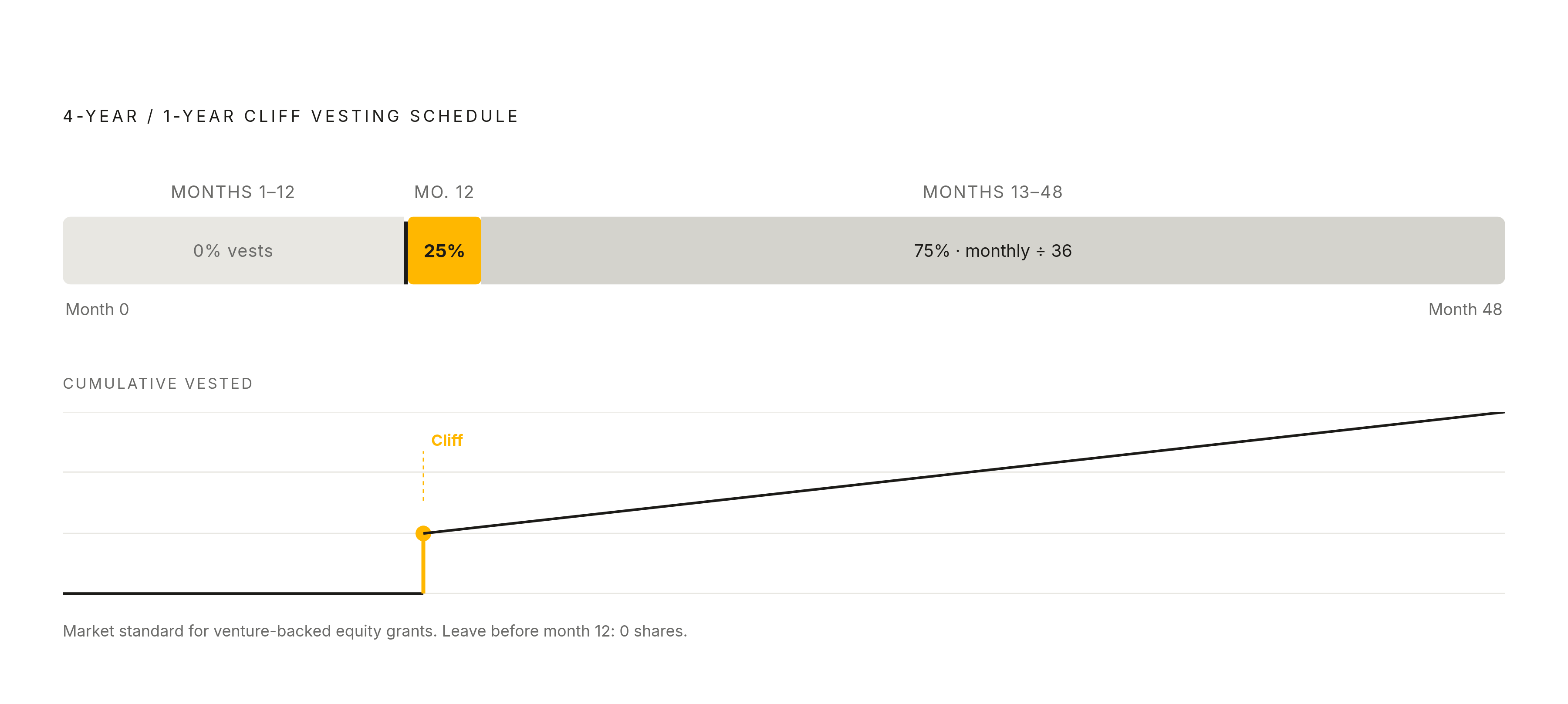
A grant is a promise. A vesting schedule is what turns that promise into a reason to stick around. Picking a vesting structure that doesn't fit the company's actual timeline can quietly undo the retention value the whole plan was built to create.
Three structures cover most cases. Time-based vesting, the most common by far, earns shares over a defined period, with anything unvested at departure returning to the pool. Milestone-based vesting ties shares to specific achievements, like shipping a product or hitting a valuation target, and tends to suit advisors or contributors brought on for a defined project. Hybrid vesting blends the two, less common, but useful when a founder wants both time in the seat and results on the board baked into one grant.
The market standard for venture-backed startups is four years with a one-year cliff. Nothing vests until the recipient's first anniversary. At that point, a quarter of the grant vests all at once, and the remaining three-quarters vest monthly over the next three years. The cliff isn't an arbitrary hurdle. It gives the company a clean exit if a hire isn't working out: leave before the one-year mark, and all the equity returns to the pool with zero cap-table cleanup required. Research on startup cap tables shows employees who vest through a cliff are significantly more likely to stay past year one, which makes the cliff one of the highest-leverage design choices in the entire plan.
The trouble starts when founders copy the four-year-with-cliff structure reflexively, without checking it against how the company is actually likely to exit. Picture a startup built for an acquisition inside two to three years, a common timeline in AI infrastructure deals right now. Standard four-year vesting on that timeline means early employees may never vest enough stock to feel the upside before the acquisition happens, defeating the entire purpose of offering equity. The opposite mistake happens too: a founder stretches the cliff past one year, assuming a longer runway to commitment means more loyalty, and instead finds that employees who clear year two have nothing left to vest toward and leave right when the company can least afford it.
The fix is to match the vesting schedule to the realistic path to liquidity, and say that timeline out loud during hiring. A company targeting acquisition inside 36 months might be better served by a three-year schedule with a six-month cliff, something that actually lets early employees feel real ownership before the exit happens. Companies building on a longer horizon face a related problem a few years in: early employees whose original grants are mostly vested by year two or three start looking like flight risks. Refresh grants solve this by re-upping top performers at that point, without needing to carve out an oversized pool for every new hire who walks in the door.
One more detail worth building into offer letters from day one is the post-termination exercise window, the period after someone leaves during which they can still exercise vested options. Standard windows are short, often just weeks to a few months, which can force a departing employee to either come up with cash fast or forfeit equity they already earned. Document the window clearly in the offer letter, and consider cashless exercise provisions or secondary sale opportunities so vested equity means something real to someone who's leaving, not just a number on a cap table they can't afford to claim.
Sizing the Option Pool for Early and Later Hires
Pool sizing is one of the few equity decisions that's genuinely hard to fix cheaply once it's made. A pool that's too small forces the company to go back for more before it's finished hiring the team it needs. A pool that's too large means the founder absorbed dilution upfront that a tighter plan would have avoided. Both mistakes are expensive, just on different timelines.
Option pools generally run somewhere between a modest single-digit percentage and roughly one-fifth of the company's fully diluted capitalization, with smaller pools more typical at later stages. The pool itself has to be established by the plan and approved by both the board and the stockholders, and institutional investors will expect it sized within a standard range on a post-money basis by the time a financing round closes.
Timing changes the math in a way that's easy to miss. The earlier the plan gets set up, the lower the 409A valuation tends to be at grant time. Early hires then get a lower strike price and more room for the stock to appreciate underneath them. Wait until after the first few key hires are already in the door, and those same hires end up with a higher strike price and a smaller financial incentive for taking the early risk.
There's a dilution mechanic here that catches founders off guard in term sheet negotiations: investors often require the pool to be "topped up" to a target percentage right before a priced round closes, and that top-up comes out of the founders' and existing shareholders' ownership, not the new investors'. Knowing this before sitting down to negotiate a term sheet changes how a founder reads the proposed terms.
The practical defense against an unplanned top-up is to size the pool around the next 12 to 18 months of hiring, mapped out role by role, rather than picking a round number because it sounds generous. Grant benchmarks help calibrate whether a given pool size will actually hold up. Pear VC's guidance notes that the baseline for early hires has moved upward, pushed by competitive pressure from heavily funded AI companies, with the first couple of pre-seed hires now often receiving grants around 1% or more of outstanding shares. By Series A, cap table data shows CFOs, VPs of Engineering, and senior software engineers typically holding a fraction of a percent each, with the exact number shifting based on seniority and when they joined.
None of these figures should be copied onto a term sheet as a universal rule. The ranges exist because the right pool size depends on a specific hiring roadmap, not a template borrowed from a blog post. The test that actually matters: can this pool fund every hire planned through the next fundraise without forcing a top-up before that round closes? If yes, the pool is sized about right for where the company stands today.
Founder equity splits and vesting why this is not a conversation to defer
Every decision covered so far assumes the founding team itself already has its equity sorted out, and that assumption is where a lot of startups quietly go wrong. Founder splits and founder vesting are decisions that happen before the EIP exists, yet they shape everything the plan touches afterward.
A founding team that puts off the equity-split conversation, on the theory that there's no urgency while everyone's still friendly, creates the exact resentment and cap-table confusion that appears later when a cofounder leaves early or contributes less than expected. The fix looks the same as it does for employees: founders vest too. A founder who holds shares outright with no vesting schedule, and leaves eighteen months in, walks away with a full stake in a company they stopped building, while the cofounders who stayed do all the remaining work for a smaller share of the outcome.
A new cofounder brought onto a company that's already operating is a related, slightly different case. That person typically receives meaningful equity, since the company needs them enough to make room, but less than the original founders hold, since the original founders carried the risk of the zero-to-one stage. Their vesting cliff is often shorter too, because the company already has a working product and a functioning team, so there's less uncertainty left to vest through.
None of this needs to get resolved in a single afternoon, but it needs to happen before the first outside hire asks what their offer looks like, not after. A founding team that can explain its own equity split clearly is a founding team that can set up every other equity decision in this piece with a straight face, and the fastest way to lose a candidate's trust is to make a promise that falls apart the first time someone looks closely at the cap table.