Competitor Analysis Template for Pre-Launch Startups
This template guides founders to identify market gaps their team can credibly capture and own.

A competitor analysis template for pre-launch startups should do more than organise research. It should reveal a specific gap the startup can credibly own, then turn that finding into product choices and an investor story. The useful output is a reason to build one thing, skip another, and enter the market in a particular place.
Why most competitor analysis templates fail pre-launch founders
The grid is complete, the logos line up, and the founder still cannot say where the product belongs. That is the familiar failure of a template built to hold information. Lists of features, funding histories, and notes on pricing can all be right without making it any clearer what to do next. A beautifully formatted shrug is still a shrug.
The missing pieces are usually a scoring rubric, instructions on where to find evidence, and a column that asks what the finding means. Without those, filling out the document becomes the goal. A pre-launch startup has no sales history, customer base, or live product to defend, so its analysis has a narrower job than an established company's competitive research. It must point toward a gap and explain why this team can credibly enter it. Any section that does not help answer that question is storage.
The three competitor categories a pre-launch analysis must include
Before listing companies, write one sentence that says what the customer wants to get done. That sentence sets the boundary of the market more usefully than a product category does. A buyer trying to manage projects might look at software built for that job, but might also keep using a spreadsheet. Framing competition around the job brings both into view and stops the analysis from becoming a directory of companies that look like yours.
Direct competitors sell a similar product to the same buyer and appear when a prospect searches the category. Indirect competitors solve the same problem differently, including the spreadsheet or manual workaround already in use. The status quo belongs here too, because doing nothing is often the rival a pre-launch startup loses to. It only needs the buyer to leave things as they are.
Aspirational competitors are the third category, brands buyers judge price, quality, or trust against even when the products differ. Their role is to show the expectations your product will face. Keep detailed research to three to five competitors so the work has depth. If the field is crowded, group smaller players into a long-tail summary and focus on the names that appear most often in target customers' consideration sets.
What to research on each competitor, and where to find it without paid tools
With the field scoped, collect evidence across five dimensions, which are product, pricing, positioning, customer perception, and strategic direction. Start with competitor websites, product documentation, changelogs, and free trials to find out what each product offers. Mark features as present, partial, or missing. These labels show whether a feature is there, while the scoring stage will later judge how good it is.
For pricing, capture the current pricing page and use the Wayback Machine to look for historical changes. Then read pricing mentions in G2 and Capterra reviews, where buyers may quote the number that surprised them. For positioning, copy each competitor's homepage headline verbatim. It records the claim the company wants buyers to remember.
For customer perception, gather the praise and complaints that come up often in reviews, looking for patterns instead of taking one angry comment as the view of the whole market. Search Reddit using “site:reddit.com [competitor name]” to find opinions beyond curated review platforms. The value is not simply learning whether customers are happy, but learning what they value and where the product disappoints them.
Finally, scan job postings for strategic direction. A wave of enterprise sales hires points to a move upmarket that may leave the current segment more open to rivals, while patent filings and press releases can show which product bets a company is making before launch. LinkedIn company pages show how big the team is and some signs of funding without a paid subscription. Most of this research is public, even if paid tools can help with collection. A pattern in complaints or a change in hiring can tell more than another polished company profile.
How to structure the template itself — the sections that do analytical work
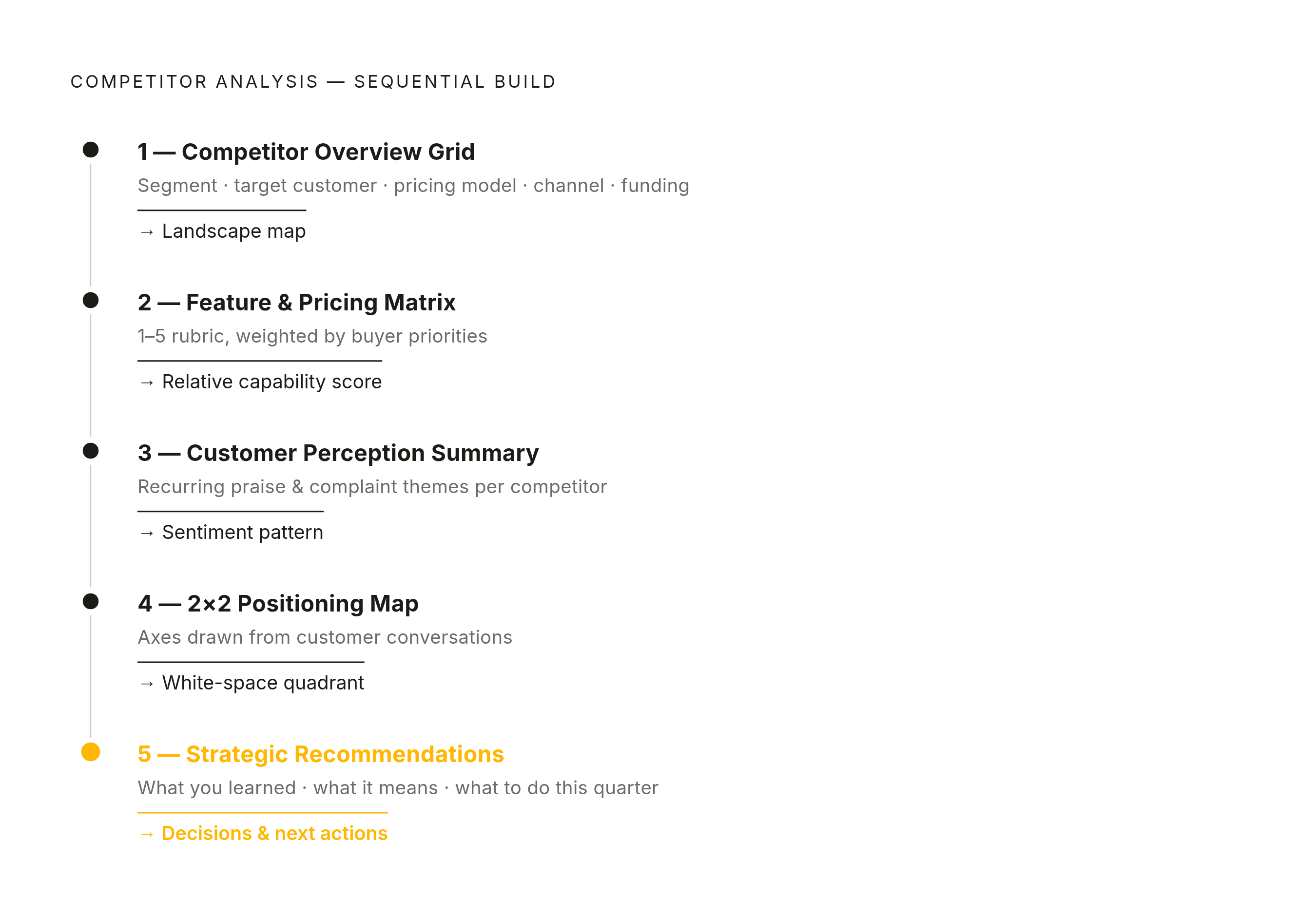
Build the template in the order the reasoning needs to happen. Begin with a competitor overview grid, using one row per competitor and columns for segment, target customer, pricing model, primary acquisition channel, and funding stage. This establishes the field at a glance and helps the team avoid repeating work.
Next, build the matrix that compares features and pricing. Use a consistent 1–5 rubric with a note explaining each feature score and making descriptions such as “good UI” specific. Weight the dimensions to reflect what buyers prioritise, so a minor feature does not count as much as the capability that drives a purchase. The matrix should show differences that matter instead of giving the highest marks to whoever has the longest feature list.
Follow that with a customer perception summary containing recurring praise themes and recurring complaint themes for each competitor. Skipping this section before filling out a strategic assessment is a specific mistake, because it lets internal judgments outrun buyer evidence. Use those findings to build a 2×2 positioning map on two axes customers actually use to choose. Price versus depth for a specific segment may work, but the axes should come from talks with customers.
Finish with a strategic recommendations column divided into what you learned, what it means for your product, and what you will do about it this quarter. Require concrete outputs, including a positioning statement, features you will deliberately not build, and the competitor you expect to encounter most often in early conversations. That is where the template starts earning its keep.
Reading the competitive map to find the gap worth owning
An empty quadrant is a candidate gap. Consider a fictional time-tracking startup for creative agencies. If the comparison shows weak agency reporting and profitability views, and customers report limited budget forecasting, those findings point to a narrow way into the market. The map becomes useful because it connects a product weakness to an underserved buyer.
Look for evidence that reinforces the pattern across the template. A recurring complaint cluster that no player has addressed is stronger than an isolated missing feature. A thinly served quadrant is more convincing when the players in it also have weak customer perception scores. Visible retreat from a segment, signalled by hiring patterns, renewal pricing jumps, or a feature set that stopped evolving, adds another reason to examine the opening.
However, a visible gap may exist because incumbents tried and failed to serve it. The analysis therefore needs a hypothesis about why the gap exists and why it is now enterable. It also needs a specific reason this founding team could do better, such as a technical advantage, distribution channel, customer relationship, or domain knowledge. Quantitative measures can show performance, while reviews and other qualitative signals reveal pain points.
Turning the analysis into the evidence layer for early product decisions
Once the gap is clear, use it to divide the product scope into what buyers require, what the startup will skip, and where it will go deeper. At launch, the product needs the table-stakes capabilities customers already expect from the category. It also needs the one or two differentiating capabilities that make the chosen entry point real. Parity features that add cost without supporting that position belong on the deliberate-not-build side of the decision.
For the fictional agency product, deep profitability views would therefore help define the MVP before the team spent time copying a wide range of features. The aim is to meet the minimum threshold for consideration and be meaningfully stronger where the target buyer is underserved. Otherwise, the roadmap becomes a shopping trolley filled from competitors' shelves.
The same reasoning applies to onboarding and pricing. If recurring complaints across competitors concern slow time-to-value, activation has a specific design problem to solve. If buyers repeatedly complain about a pricing jump at renewal, that finding can support a choice to avoid that jump in the startup's pricing structure. The evidence identifies a source of dissatisfaction the pricing decision can address.
The pricing matrix also shows where the market clusters and where price-point gaps exist. Choosing a crowded band without a differentiation rationale leaves cost doing the competitive work. Product scope, onboarding, and pricing should therefore all support the same intended position. If the analysis changes nothing about what gets built, cut, or charged, it remained a research exercise.
Using the same analysis to build the investor narrative on market positioning
A claim that the market is large does not show that the team knows where to enter it. The positioning map, customer perception summary, and strategic recommendations already have the evidence that backs that entry point. Use them as the raw material for the competitive slides in a pre-seed deck rather than building a separate landscape from scratch. The pitch should not introduce a market the product team has never met.
The narrative needs to make the underserved segment or use case clear, then show the evidence behind it. Complaints that keep coming up, pricing tiers that companies have dropped, and weak customer perception can show where current offers fall short. Next comes the structural reason incumbents have not closed the gap, rather than the hopeful claim that they have not got around to it. Finally, the team's technical, distribution, or domain advantage must show why it has a credible chance of entering the market. This turns “why us, why now, why this gap” into an argument.
That argument should also name the competitor most likely to appear in early customer conversations and recognise its strongest case. Knowing why a buyer might choose the other product helps the startup be more precise in its positioning. It also shows investors that the team has considered the actual choice customers face. Differentiation is more credible when the comparison is fair.
Keeping the analysis current — when and how to refresh it
The competitive field will move after the first version is complete. Competitors can raise money, change pricing, launch features, or change which customers they go after. An analysis left as it is can therefore grow old and lead the team astray. Give it a full refresh before a fundraise and before a major launch, when stale assumptions carry directly into investor claims or product decisions. Six-month-old positioning data is a credibility risk in an investor conversation.
Between those events, a brief update each quarter works for most markets that change fast. Check pricing pages, scan new G2 and Capterra reviews, and revisit job postings for changes in direction. Keep the scoring rubric consistent so movement is visible. A product score moving from 3 to 4, supported by an explanatory note, says more than discovering that someone called it “pretty good” six months ago.
Assign one person on the founding team to own the file and put the quarterly review on the calendar. Treat an empty cell as an open question. That discipline keeps uncertainty visible and gives the next research pass a purpose. The template stays useful when each update checks whether buyers still have the unmet need, the team can still enter the gap, and it is still the right place to build.