Sample Business Plan PDF for Pre-Revenue Founders
A template designed for testing hypotheses, not impressing investors who won't fund you yet.

Sample Business Plan PDF for Pre-Revenue Founders.
What a business plan is for a pre-revenue founder
Most people picture a business plan as a polished PDF, the kind you email to a bank or slide across a table to an investor. That image is basically useless if there's no revenue yet, because polish implies proof, and there's nothing to prove. No paying customers, no retention numbers, no unit economics that have survived contact with reality. Dress that up in a nice PDF template and you haven't written a business plan. You've written fan fiction with a table of contents.
A more honest way to think about it: the plan is an inventory of hypotheses. What do you believe. What have you not tested yet. What order do you need to test things in so the expensive mistakes come later instead of first. That's a different document than the one banks want, and it should read differently too.
There are really two modes a founder can write in. One is defensive: you've already decided what you believe, and the plan exists to defend it, dressed up with charts that make the conclusion look inevitable. Pre-revenue founders need the second mode almost exclusively. The first mode is for later, once there's something worth defending.
Why most sample business plans mislead the founders who download them
Search "business plan template" and download the first PDF that shows up, and there's a decent chance it was written by, and for, a company that already has customers, revenue, and a few years of operating history behind it. Those plans model what to report. A pre-revenue founder needs a plan that models what to test, which is a completely different exercise wearing the same outfit.
A few sections tend to do the most damage. Financial projections stretching three to five years out with precise revenue figures, as if anyone pre-revenue can know what year three looks like. Market size numbers presented as settled fact instead of the sourced guess they actually are.
Filling those sections in feels productive. That's the trap. You spend an afternoon formatting a table, and it feels like you did work, but nothing got validated. No hypothesis got tested. No assumption got checked against an actual human being with the problem. That's exactly the failure mode the whole MVP philosophy exists to prevent: motion mistaken for progress. A leading reason startups fail is building something nobody needed in the first place, and a nicely formatted PDF does absolutely nothing to stop that from happening. It just makes the eventual failure look more professional on the way down.
How the MVP mindset reframes what each section of a business plan is for
Run each standard section through a simple filter: what question is this section actually supposed to answer, and have you answered it yet, or are you just describing it. The problem section is asking whether this is a real problem people will pay to solve, and that's the foundational hypothesis everything else sits on top of. Get that wrong and nothing downstream matters.
The product section is asking something narrower: are you solving it the way users actually want, not the way you'd want if you were the user. You cannot answer that from a whiteboard. It requires real people reacting to a real thing. Market size, likewise, isn't a projection exercise dressed up with a pie chart, it's a research question about whether enough people share this problem to build a company around. The business model section asks whether anyone will pay, and in what form, which at this stage is one of the highest-stakes guesses on the page, since pricing gets treated as settled when it's really the least tested number in the whole document.
This is the Lean Startup logic in practice: a section written without real users behind it is a guess wearing a business-casual outfit. The Build-Measure-Learn loop is the only mechanism that turns that guess into something you can actually trust. Some sections deserve urgent attention right now. Others are scaffolding, placeholders that exist structurally until real data arrives to fill them in properly.
The problem and solution sections: where honest founders do the hardest work
Here's the move nearly every founder makes: write the problem section from gut feeling, then move on to the fun parts. Skipping that leaves the whole plan sitting on a foundation nobody poured concrete for.
Fifteen to twenty interviews is a reasonable bar, and it has to be actual strangers who match the target user, not your college roommate who's contractually obligated to be nice to you. Track which pain points appear constantly and hurt, versus which ones are occasional annoyances people shrug off. And write down the exact words people use to describe their frustration, because that language belongs in the plan verbatim. It's more convincing than any adjective you'd choose yourself, and it proves you actually talked to someone instead of just imagining them.
The solution section has its own version of this problem. Feature bloat sneaks in exactly the way it sneaks into a product spec: founders list everything the product will eventually do rather than the one thing the MVP must do. Roughly 70% of MVP failures come from building too many features, and the instinct behind that failure is the same instinct that turns a solution section into a wish list. Say the one thing the MVP does. Then stop typing.
Product and MVP planning inside the business plan: scope as the key decision
Treat the product section as an MVP specification, not a roadmap with a longer runway. A roadmap is what you'll build eventually. A specification is what you're building now, on purpose, to test one specific thing.
What is the single core user workflow the MVP covers end-to-end? And what result, after launch, tells you the hypothesis held up?
Cost and build approach matter here too, and they vary wildly depending on what you're actually building. AI-assisted development has shaved 40 to 60 percent off some of those timelines for teams that actually know how to use the tools well, so that should be factored in before assuming the slower, pricier path is the only option https://modall.ca/blog/mvp-development-for-startups. None of that should be a default choice made by inertia. It should appear in the plan as a decision, made on purpose, with a reason attached.
Skipping the planning phase to save money is its own kind of expensive. That's not a small edge. Build approach options and their cost range from research show no-code simple MVPs in the $5K to $15K range over weeks, while complex AI or fintech builds reach $60K to $150K+ over months, so the plan should reflect a deliberate choice, not a default. A $3K–8K discovery and planning phase prevents an estimated $50K in rework, and teams that invest in pre-development planning are 3x more likely to ship a successful product.
The market and business model sections: what pre-revenue founders can and cannot honestly claim
There's a meaningful gap between a market size number pulled straight from an industry report and one built bottom-up from an actual count of the specific people who'd use this thing. The first is borrowed confidence. The second is at least yours.
Honest market sizing rests on three admissions. The total addressable market is a statement about eventual potential, not a claim about next year, and treating it otherwise is where the fan fiction creeps back in. The serviceable segment, the slice actually reachable in the next twelve to eighteen months, is the number that matters right now. And market size only means anything once the problem itself is confirmed. A big market attached to an unvalidated problem is just a bigger number attached to the same guess. It's just a bigger number attached to the same guess.
Pricing deserves the same honesty. At pre-revenue stage it's a hypothesis, full stop, and the plan should say what price gets tested first and what evidence would flip that decision. Founders write business model sections implying positive unit economics with zero data behind the claim. The useful version does the opposite. It says what retention rate and what acquisition cost the model actually needs to survive, and leaves the rest blank until real numbers arrive to fill it in.
The go-to-market section: planning for first users, not scale
The single most common mistake in this section: jumping straight to scale tactics, paid ads, content SEO, an influencer partnership, before anyone has figured out how the first users will be acquired manually. Scale tactics are built for a company that already knows its channel works. Pre-revenue founders don't have that yet, so borrowing the tactics is like buying a megaphone before you know what you're going to say into it.
Do things that don't scale first. Founder-led outreach, direct sales, showing up in the communities where the target user already spends time, before any paid channel enters the picture. The plan should name the first ten to fifty users specifically, not as a demographic profile but as actual named communities, companies, or networks the founder can point to and reach directly. It should say how the founder plans to reach them, one by one if needed, and what result counts as proof the channel actually works.
Retention deserves a place in this section too, and most plans skip it. A go-to-market section obsessed with acquisition and silent on retention is only half a plan. Research shows retention is 5–25x cheaper than acquisition, yet only 18% of companies prioritize it, so a go-to-market plan that optimizes for acquisition without specifying a retention hypothesis is incomplete at the pre-revenue stage.
The team section and the co-founder question every pre-revenue plan surfaces
The team section's actual job is exposing the gap between what the plan requires and what the people in the room can currently do. If the core hypothesis needs a working technical build and nobody on the team can build it, that's not a footnote. That's the whole plan waiting on a hire that hasn't happened yet.
Whether anyone wants it to or not, the article must address whether the company needs a co-founder. If the team section reveals a real gap, the honest move is to name it as a founding-team decision that needs making, not to smooth it over with a job description nobody's filled. Harvard Business School research found that 65% of high-potential startups fail from co-founder conflict, not product failure, which makes this section a lot higher-stakes than a resume dump https://modall.ca/blog/best-co-founder-matching-platforms. A team section that lists names without touching roles, decision rights, or equity is dodging the one question that actually predicts whether the company survives its own founders.
Going solo isn't a disqualifier. The plan needs an honest account of who does what, and who breaks the tie when two people disagree about something that matters.
The financial section: building a constraint model instead of a forecast
At pre-revenue stage, a five-year revenue forecast is a guess compounded annually, and investors who matter know this.
What the section should contain instead: a burn rate and runway model, covering what it costs to operate for the next twelve to eighteen months and which milestones that runway needs to hit before the money runs out. And a funding needs statement: how much capital gets the company to the next validation milestone, and in what form.
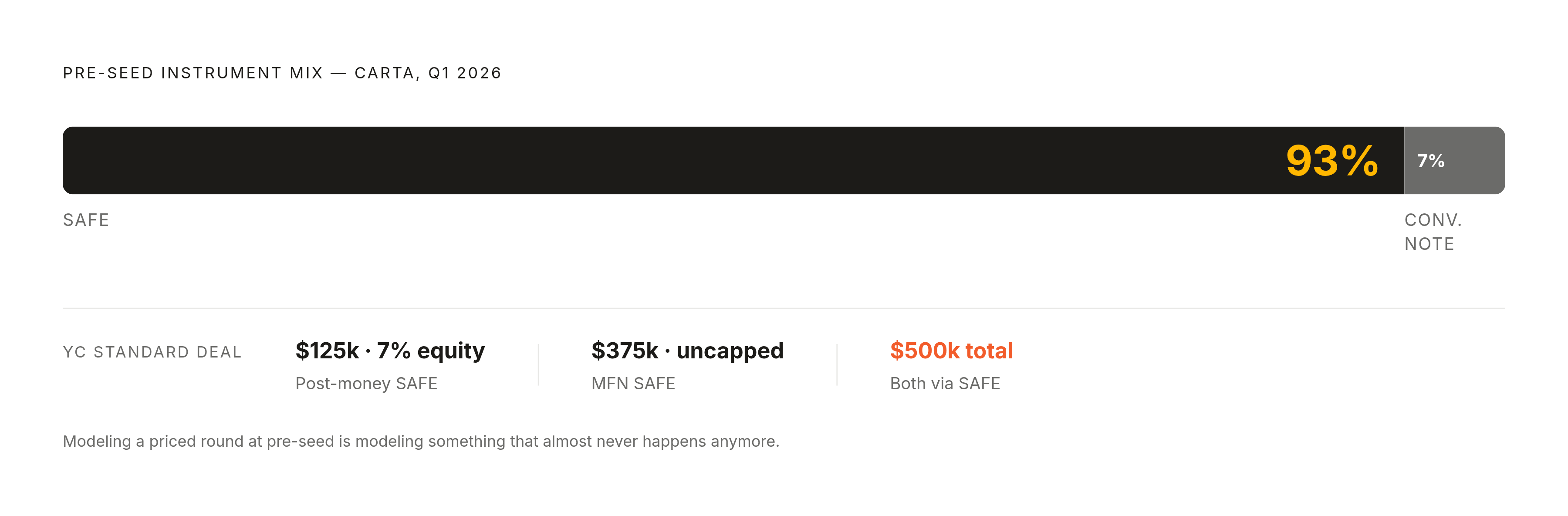
On that last point, the form matters more than founders often realize. The SAFE, created by Y Combinator in 2013, is the instrument built for exactly this stage: capital now, equity later at the next priced round, no interest, no maturity date, nothing to repay. The valuation cap is typically the only term actually negotiated. And the instrument has basically taken over the category. SAFEs made up 93% of all pre-seed deals on Carta in the first quarter of 2026, with convertible notes down to just 7% https://carta.com/learn/startups/fundraising/convertible-securities/safes/. A plan modeling a priced round at this stage is modeling something that, statistically, almost never happens anymore. For scale, YC's own standard deal runs $125,000 for 7% equity through a post-money SAFE, plus $375,000 through an uncapped SAFE, totaling $500,000 invested https://www.joinleland.com/library/a/yc-application https://www.wearefounders.uk/y-combinator-acceptance-rate-2026/. This is a reference point, even for founders who never apply.
Reading a sample business plan PDF: a section-by-section annotation guide
Approach any downloaded sample plan as a checklist of questions somebody else wrote down, not a template with blanks waiting for your answers. The structure is useful. The confident tone filling in each section is the part to ignore.
Mark a section "test now" if it can only be written honestly after real validation work, the problem, the solution, the first users, the pricing hypothesis. Mark it "design now, fill later" if the structure matters but the content needs real data before it means anything, financial projections, retention benchmarks, CAC estimates. And mark it "placeholder until traction" if it belongs in the plan eventually but would be premature to write with any confidence right now, scale-phase go-to-market, partnership agreements, detailed operations plans.
A couple of signals give away whether a sample plan was built for funded companies rather than pre-revenue founders. If the financial section opens with revenue projections instead of burn rate and runway, that's a plan written for someone who already has revenue to project from. And if the market analysis leans entirely on industry reports with no bottom-up user count anywhere in sight, that's a plan borrowing confidence it hasn't earned yet, same as the founder would be doing by copying it word for word. Each section should be tagged as one of three types. Teams that invest in pre-development planning are 3x more likely to ship a successful product https://uinno.io/blog/mvp-development-for-startups. A discovery sprint costing $3K–8K prevents an estimated $50K in rework on a typical project https://uinno.io/blog/mvp-development-for-startups. 70% of MVP failures stem from building too many features https://wearepresta.com/the-complete-mvp-roadmap-guide-for-2026/. Companies that iterate based on user feedback within 30 days of launch are 3x more likely to achieve product-market fit https://wearepresta.com/the-complete-mvp-roadmap-guide-for-2026/. Simple no-code MVPs typically cost $5K to $15K over 4 to 6 weeks https://modall.ca/blog/mvp-development-for-startups. Complex AI or fintech builds can reach $60K to $150K+ over 4 to 8 months https://modall.ca/blog/mvp-development-for-startups. YC has funded 40+ solo founders since W24 https://ycinsight.com/yc-cofounder-matching. Retention is 5–25x cheaper than acquisition https://www.startupbricks.in/blog/customer-retention-complete-guide-startups/. Only 18% of companies prioritize retention https://www.startupbricks.in/blog/customer-retention-complete-guide-startups/. Even low monthly churn of 5% means losing 46% of customers annually https://www.startupbricks.in/blog/customer-retention-complete-guide-startups/. Monthly churn of 5% means losing 46% of customers annually https://www.startupbricks.in/blog/customer-retention-complete-guide-startups/. Founders should aim for under a 3% monthly churn rate for SMB https://www.startupbricks.in/blog/customer-retention-complete-guide-startups/.