Pricing Strategy for a New Product at Pre-Launch Stage
Test your price with real money before launch, not surveys or guesses.

Pre-launch pricing is a process of testing what buyers will pay. A defensible launch price starts with costs and market context, then improves through paid pilots, deposits and preorders. The aim is to replace a comfortable guess with evidence, without teaching early customers that the full price is decorative.
Why pre-launch pricing feels like a decision but functions as a guess
The number looks fair next to a competitor’s price, ends neatly and feels just expensive enough to show ambition. Publish it and move on? That instinct treats price like a finished product spec. Yet gut feel, one competitor’s price and a round number reveal nothing about what your buyer will exchange money for. Before launch, the number is a hypothesis about willingness to pay.
Getting that frame wrong is costly in either direction. Underpricing can signal low quality, attract price-sensitive customers who churn quickly and leave too little margin for growth. Overpricing can collapse conversion before there is enough evidence to explain why. Neither extreme produces a useful test. The goal is not a price everyone accepts, but one that can survive contact with actual buyers.
What your costs and your market tell you before you can test anything
Without customer data, cost-plus pricing is the honest starting constraint. It establishes what sales must cover. Count development time, infrastructure, support, customer acquisition, payment fees and returns allowance. For a physical product, adding landed cost, payment fees and a returns allowance puts numbers to the calculation. The attractive margin on the box is not necessarily the margin left in the business.
For a digital product, the MVP budget shapes that floor, whether the build is lean and AI-assisted or substantially more complex. Those costs must eventually make sense in the unit economics. Write the floor down before writing the pricing page. A launch offer that ignores it is a subsidy with better typography.
Competitor prices supply a different kind of boundary. They show what buyers in the market already pay, but not how much value rivals leave uncaptured or whether their costs resemble yours. Matching them makes sense mainly with a genuine cost advantage or in a true commodity market. Choose which competitors to compare with, then decide whether to compete on price, delivery, proof or positioning. Costs and competitors still leave the central gap open, because neither tells you which outcome your specific customer values.
Why survey-stated willingness to pay systematically misleads
Asking customers what they would pay seems like the obvious next step. But saying yes in a survey costs nothing. Stated willingness to pay systematically exceeds what people will pay when faced with a real checkout. An answer about an imagined purchase is being asked to do the work of an actual purchase.
The Van Westendorp method gives this research a useful structure through four price thresholds. It asks when a product would seem so cheap that its quality becomes doubtful, and what price would represent good value. It also asks when the product starts to feel expensive and when the respondent would refuse to buy. The overlap across responses suggests an acceptable price corridor.
Used this way, the method can rule out obviously wrong prices and narrow the range to test. It cannot turn stated intent into spending. Free users present a related problem, because their choices and feedback differ from those of paying customers. Charging even a small amount from day one begins to establish that the product has enough value to warrant a sacrifice. Compliments, sadly, remain difficult to deposit.
The evidence hierarchy: why real payments beat every other signal
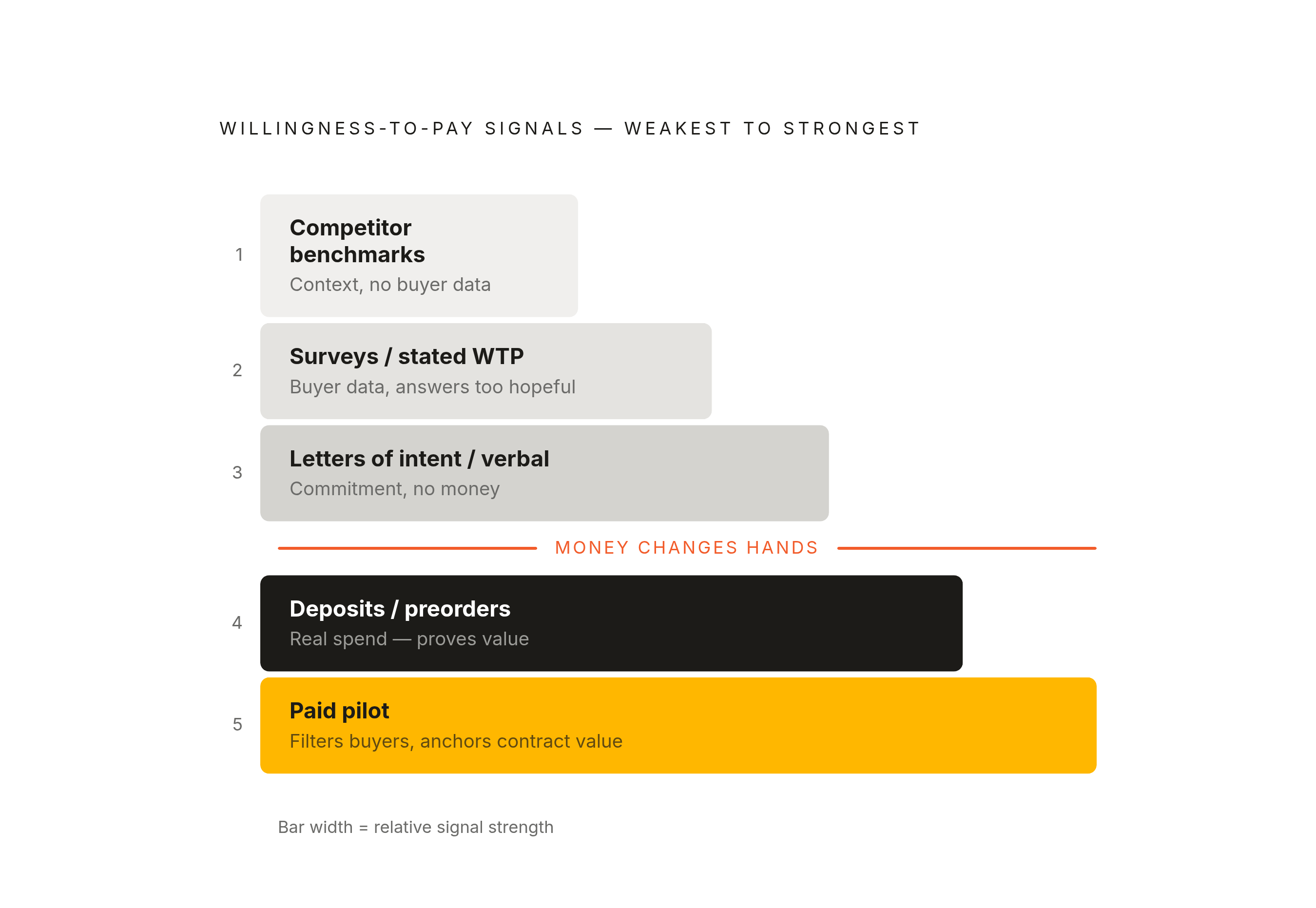
Competitor benchmarks offer context but no direct evidence about your buyer. Surveys add information about your buyer, though the answers still tend to be too hopeful. Letters of intent and verbal commitments go further, but still require no money to change hands. A deposit, paid pilot or preorder crosses that boundary. It proves that someone valued the offer enough to give up money for it, rather than merely agreeing that it sounded promising.
For B2B products, a paid pilot is especially useful because it filters serious buyers from tourists and anchors the value of the eventual contract. A free pilot starts that relationship at zero and rarely turns into a paid contract. If getting the buyer to agree to the pilot takes a low price, set a firm date for a decision and spell out what would count as success. The pilot needs an ending. Otherwise, a test can become an indefinite relationship with no meaningful revenue.
For consumer products, preorders and deposits put a real spending decision in front of the buyer. A preorder at the intended price tests that number directly, while a discounted preorder tests the offer instead. If buyers will not pay the intended price before the product exists, the launch hypothesis needs rethinking. One deliberately uncomfortable test is to start at twice the price that feels comfortable, measure conversion and adjust.
How B2B and B2C contexts change what willingness-to-pay evidence looks like
The same price can meet different resistance from a business buyer and an individual consumer. Professionals tend to weigh price against what they will gain in money terms and are less price-sensitive than consumers buying the same product. That changes the question behind the purchase. B2B pricing is often most defensible when it captures roughly ten to twenty percent of measurable value delivered. If software cuts waste each month, for example, there is a clear case for a price that takes around twelve percent of those savings.
That argument requires evidence about the outcome buyers actually value. Paid pilots help reveal it, while procurement conversations and objections at a real price show where the argument holds or breaks. An implausibly low price can undermine credibility here. For premium B2B products, round numbers can signal confidence. The cheapest option is not automatically the safest-looking one.
Consumers more often compare perceived value with a competitor’s shelf price or a category norm. Charm pricing and anchors therefore play a different role, and a premium needs visible proof. When the price is within five percent of the main rival’s shelf price, the focus should be on value. More than twelve percent above it calls for a proof story above the fold. Real conversion on the product page, early return rates and referrals then show whether buyers accept that story, without counting on them to work out a financial gain they may never calculate.
Forming the price hypothesis: what structure to use before you have enough data
To turn that evidence into an offer, build the hypothesis around both a number and a structure. The cost floor remains the constraint, while pilots, preorders and conversion tests suggest how far above it buyers will go. Start simply if the evidence is thin. A single price makes sense before real usage shows that buyers fall into different segments. One paid pilot can teach more about the right structure than a polished pricing page built entirely from assumptions.
Once different segments show up, three tiers are a practical way to set up pricing. The entry tier lowers the barrier to trying the product and stays limited enough for growing customers to outgrow it. The middle tier has what most buyers need and should carry the target price, since buyers often choose the middle option. The premium tier anchors value higher while serving customers who really are willing to pay more.
A fourth or fifth tier usually adds hesitation. A free plan works when it lowers the acquisition barrier and creates a natural upgrade trigger as usage grows. If it supplies everything users need, it produces fans without a reason to pay.
A hybrid usage-based model is another choice when the value customers get tracks how much they use the product. A platform subscription pays for base costs and access, while a usage fee rises with the value metric that tracks what customers get. This can capture more revenue from heavy users without excluding lighter ones. The fit depends on the value metric. Usage-based components are increasingly part of startup pricing in 2026 as per-seat pricing declines as the primary SaaS metric, but a market direction is not proof that the structure suits every product.
Discounts and early offers that test the hypothesis without poisoning future pricing
At the first sale, the temptation is to remove resistance with a discount. That can generate revenue and evidence, provided the discount has a defined purpose. A blanket code with no end date, a sale repeated every weekend or a reduced price presented as the real price teaches buyers to wait.
An early-bird offer works better when it acknowledges the slim launch feature set and explains why the price will rise as features are added. The buyer gets a short-lived bargain in return for taking an early risk. The sunset date must hold. Extending it teaches customers that the deadline was theatre and weakens the next offer before it appears. A credible path to the higher price is part of the product promise.
Other offers can reward commitment without cutting the headline price. Bundles, gifts and thresholds, such as free next-day delivery above a spend level, give buyers a reason to act without a blanket percentage discount. To see whether buyers want the product or the bargain, use a simple A/B test of the launch offer against the stated full price. Discounted customers are still real buyers. Their feedback about value, usage and what would justify paying more is useful, but their purchase does not establish conversion at the full price.
Reading the signals and iterating toward a defensible launch price
The evidence now has to support a price you can explain to a buyer, justify to an investor and raise without breaking trust. Very high conversion suggests room to charge more, while very low conversion calls for diagnosis. The middle ground is where iteration begins. A one hundred percent win rate is a warning of underpricing, and some lost deals at the edge are part of finding the range.
If nobody raises a price objection, increase the price until some buyers do. When conversion is weak, though, do not assume that cutting the price is the right move. “Too expensive” can mean that the value is unclear. Strengthen the proof story before cutting the number, particularly when the product costs substantially more than its main rival. Without a positioning change, a price cut can teach buyers that the original offer was overpriced.
The work also needs a schedule and an owner. Build a quarterly pricing review into the process because product value, market conditions and competitor prices change, while inflation erodes real revenue. Regular increases can make price changes more familiar to buyers. Assign one founder to own the hypothesis, track conversion weekly and bring the evidence to a standing review. Launch then becomes a checkpoint in price discovery.