Go-to-Market Strategy Examples for B2B and B2C Startups
Real companies show why B2B and B2C need completely different go-to-market approaches.
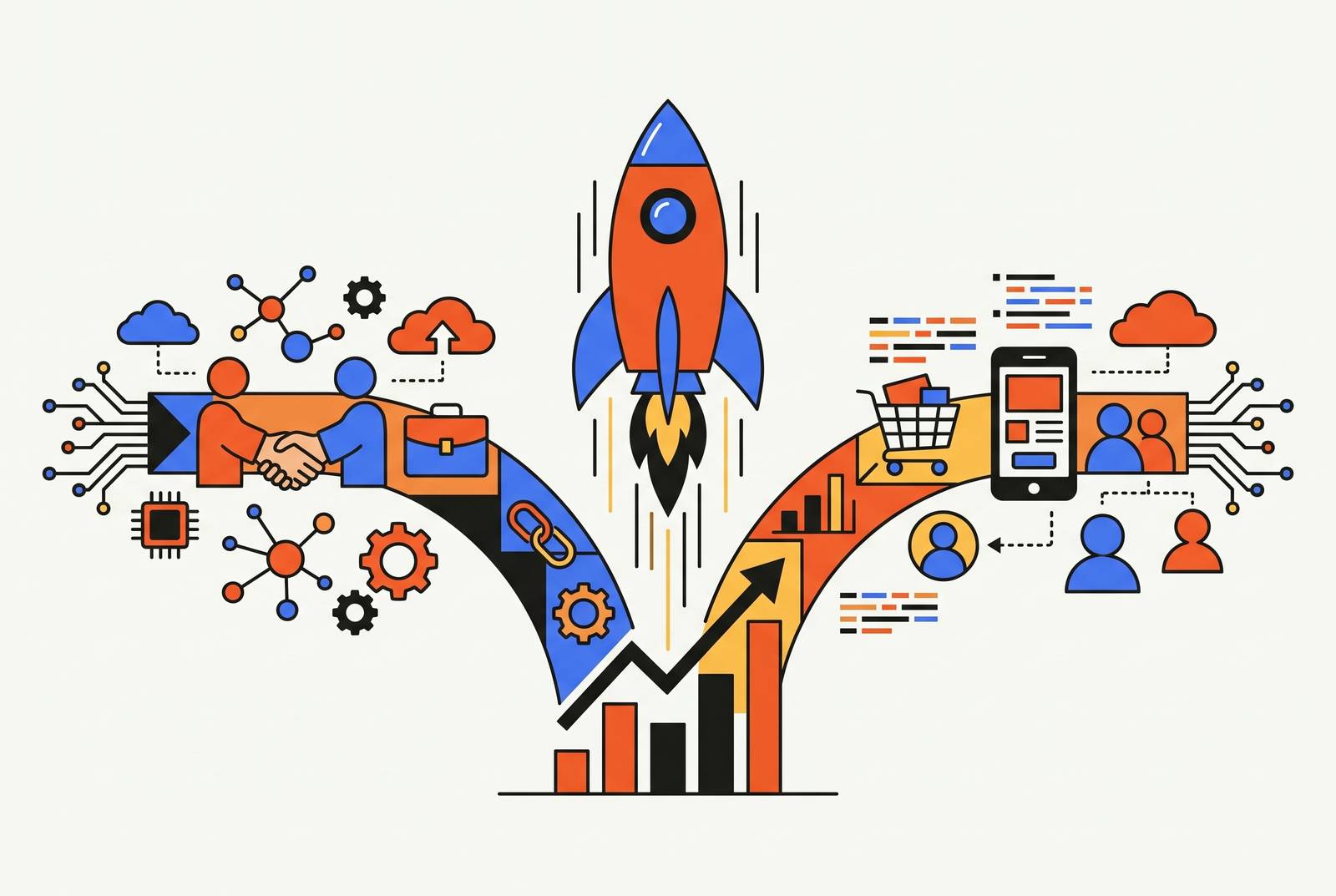
A go-to-market strategy is the plan for how a product finds its buyer: who that buyer is, what problem they're stuck with, which channels reach them without burning the budget, and how the product gets priced and sold. Stripe's framing is useful here: a GTM strategy is narrower than a business plan. It's not "how does this company make money for the next five years." It's "how does this one product reach this one market, starting now."
Get any piece of that wrong, and you're not iterating, you're just quietly running out of runway while telling yourself it's a messaging problem. And per Stratabeat's take on this, GTM isn't a document you write once and laminate. It shifts as the market shifts, because the buyer who existed when you wrote the plan is not always the buyer who shows up six months later.
The fastest way to actually understand any of this is to stop reading GTM as a category and start looking at what it looked like inside real companies. Because "sell to businesses" and "sell to consumers" are, structurally, almost different sports wearing the same jersey.
Why B2B and B2C GTM strategies diverge at almost every level
Both motions want the same outcome: a product in the hands of someone willing to pay for it. That's where the similarity ends.
B2B messaging leans on ROI, use cases, and long-term payoff. The sales motion is slow by design: demos, consultations, pilots, procurement. B2C messaging leans on feeling, identity, and how simple something makes your day. Distribution leans on reach: social, influencers, whatever gets in front of the most eyeballs fastest.
The B2B buying group is its own special kind of headache. The 2025 B2B Buyer Experience Report clocked average buying cycles at 10.1 months in 2025, down slightly from 11.3 months the year before. On the bigger deals, the ones with a median value in the $200K to $300K range, buying groups average 10 or more people. A common analyst framing splits that group into initiators, influencers, deciders, buyers, users, and gatekeepers, each of whom needs a different pitch. Ten people, ten sets of concerns, one deal. It's less a sale and more a hostage negotiation with a Slack channel.
That same 2025 report found 95% of winning vendors were already on the buyer's shortlist before the formal search even started, which should terrify anyone doing outbound cold. Which means B2B GTM really comes down to being the name someone already trusts by the time they open a spreadsheet to compare options. It's about being the name someone already trusts by the time they open a spreadsheet to compare options.
B2C skips almost all of that. Decisions happen fast, often solo, often on feeling rather than a comparison chart. That speed shifts the GTM weight almost entirely onto awareness and first impression, because there's no procurement team standing between the ad and the "buy now" button.
Subscription pricing also raises customer lifetime value on both sides, and that number quietly rewrites how much a founder can spend to acquire a customer in the first place. And then there's AI, elbowing its way into the calculus regardless of buyer type. G2's 2025 data found 89% of buyers purchased a solution with AI features that year, and 62% were mandated or strongly nudged toward AI-enabled tools. Nobody's shopping in a vacuum anymore.
HubSpot: how category creation replaced direct competition as a B2B GTM motion
HubSpot launched in 2006 into a market full of marketing automation tools built for enterprises with big budgets and bigger IT departments. Small businesses were left standing outside that party, overwhelmed and underserved.
Instead of trying to out-feature the incumbents, HubSpot invented a category. "Inbound marketing" wasn't a known term before HubSpot made it one, and the company's real distribution channel wasn't ads. It was education.
The ICP was narrow on purpose: not enterprises, but SMBs drowning in complexity they didn't have the headcount to manage. Everything downstream followed from that one narrowing decision.
The tactics still hold up as a masterclass. Genuinely useful guides and ebooks that taught marketing rather than pitched software. A free tool, Website Grader, that gave instant value and captured a lead in the same motion. A freemium CRM that lowered the barrier to zero and created a natural, almost gravitational upgrade path toward paid tools. And every piece of content built to rank in search, so the traffic showed up already looking for answers.
The company hit $100 million in ARR by 2012, six years after launch. The lesson this produces: when your content teaches your ICP their own job before they've entered a buying cycle, you're already on the shortlist when the search finally starts. That's the 95% stat from earlier, playing out in real time.
Founders can steal the shape of this without the budget: a free tool that solves a sliver of the problem, content that actually teaches rather than sells, and a freemium tier with an upgrade path that makes sense.
Slack: product-led growth as a B2B GTM motion when the product itself spreads the sale
Slack showed up in 2013 to fight Microsoft, Skype for Business, and a graveyard of enterprise chat tools nobody enjoyed using. Its answer wasn't a marketing department. Literally: no marketing chief for the first year. The company bet everything on the product being good enough to sell itself.
That bet paid off through a few specific mechanics. The freemium model let teams start without ever talking to a salesperson, generous enough to prove value, structured enough to nudge an upgrade. Network effects did the rest: one user pulls in a team, one team pulls in a department, and the product gets more valuable with every person added, not less. Channel invites, shared workspaces, and integrations with tools people already used created loops that spread without anyone pushing them.
Growth analyses cited by Vehnta show Slack picked up a large user base within 24 hours of launch and scaled with remarkable speed from there. That's not a marketing budget story. That's a "the product did the selling" story.
The lesson: when users like a product enough to recommend it unprompted, the product becomes the sales team, and CAC drops because the humans on payroll aren't doing all the convincing. Founders should design for the moment a user would want to invite a colleague, then make that invite as frictionless as physically possible.
ChartMogul's research backs up why this matters at scale: the top-performing B2B companies hit 1,000 subscribers in 11 months, versus two full years for the median. PLG is one of the main engines behind that gap.
Zoom: combining freemium and enterprise sales into one B2B GTM system
Video conferencing before Zoom meant WebEx, GoToMeeting, and Skype dominating consumer calls, none of them exactly a joy to use. Clunky downloads, dropped calls, and pricing that didn't make sense for a five-person team. Zoom's GTM didn't pick a lane between bottoms-up adoption and top-down enterprise sales. It ran both at once.
The freemium tier offered 40-minute group meetings for free, with unlimited one-on-one calls until May 2022, enough runway to let people fall in love with a product that just worked. Joining a meeting didn't require a download, which quietly removed the single biggest friction point competitors never bothered to fix.
Then came the sales layer on top. Zoom's 2019 10-K filing shows 55% of customers contributing more than $100,000 in revenue started out with at least one free host. Sales teams watched usage patterns on free accounts to spot conversion opportunities before the customer even asked for a demo. Smaller deals went to inside sales, with larger accounts receiving more intensive attention, a tiered system that matched effort to deal size instead of treating every lead the same.
Tiered pricing across multiple plan levels meant a five-person startup and a much larger enterprise could both find a price that made sense without a custom negotiation.
The real insight: freemium wasn't just a growth lever here. It was a lead qualification engine, feeding usage data straight into a sales motion built to catch the moment a free account turned into a paying one. Founders should define that usage threshold early: at what point does someone using the free tier become worth a sales conversation?
What these B2B examples share: the structural logic behind each GTM motion
Line these three up and the pattern gets obvious fast. Each one started with an ICP defined down to a specific pain, felt by a specific role, in a specific context, never a vague "SMBs" or "teams." Each one used a free or near-free entry point to collapse the distance between first contact and first real value.
And each GTM motion matched the size of the deal it was chasing:
- Low price, high volume: PLG and freemium, the Slack and Zoom playbook
- High price, relationship-heavy: content-led inbound backed by a sales team, the HubSpot playbook
- Hybrid: PLG to get in the door, enterprise sales to close the big accounts, Zoom's actual system
A contrasting approach these motions largely set aside is account-based marketing, which flips the funnel entirely. Instead of casting wide, ABM picks a short list of dream accounts and coordinates sales and marketing entirely around winning them. It suits high-ACV, multi-stakeholder deals where depth beats reach.
These choices are not decoration. ChartMogul's GTM Report found only 13% of SaaS companies ever reach $10M in ARR after ten years. The GTM motion a company picks in year one is doing a lot of the heavy lifting on whether it's still standing in year ten. The most common failure across B2B is launching without ICP precision, which produces messaging that resonates with absolutely nobody and a channel budget spread so thin it might as well be confetti. It's launching without ICP precision, which produces messaging that resonates with absolutely nobody and a channel budget spread so thin it might as well be confetti.
How B2C GTM is built differently: emotion, reach, and the speed of the individual decision
B2C buyers decide alone, or with one other person, usually fast, and usually driven by feeling as much as logic. That's not a flaw in the system. The system itself is what causes it.
Channel logic flips entirely. No sales reps, no demos, no procurement. Instead: social media, influencers, and content loops that spread because people find them entertaining, not because a rep followed up. Targeting starts wide and narrows later, the inverse of B2B's narrow-first approach.
Word of mouth still exists, but it moves differently. A consumer recommends a product to a friend over dinner, not to a colleague during a procurement review. That's a social spread, not an organizational one, and it moves faster because there's no committee slowing it down.
Pricing psychology also gets to actually do something in B2C. Anchoring, countdown timers, "only 3 left in stock," social proof at the checkout page. All of it moves the needle on individual consumers in ways it mostly can't on a procurement officer working through a vendor checklist.
Airbnb's earliest version makes the clean case for how this plays out. In 2008, the entire product was a website advertising air mattresses in an apartment during a conference. No global inventory, no fancy search, nothing sophisticated at all. Just a bet, tested in one place, that strangers would pay to sleep in someone else's home. Supply and demand got seeded by hand in a single city before anyone thought about scaling.
Airbnb: how a B2C GTM strategy starts with a single, tightly constrained market before scaling
Peer-to-peer home rental was an unfamiliar concept in 2008, and the cultural resistance (why would anyone sleep in a stranger's apartment) was arguably a bigger obstacle than any technical one.
Airbnb's answer was to prove the idea in one place, during one moment of real demand, before building anything close to infrastructure. It targeted a single high-demand event, a conference that had overwhelmed available hotel accommodation in the city, rather than chasing a broad audience from day one. Hosts and guests got recruited by hand, one conversation at a time, not through paid ads. And supply came first, deliberately: get the air mattresses listed before worrying about who's searching for them, a sequencing choice a lot of marketplace founders get backwards by chasing demand before there's anything to sell.
The early growth trick was borrowing traffic that already existed: cross-posting listings to Craigslist, tapping into travelers who were already out there searching for something other than a hotel. That's distribution on loan, not distribution built from nothing.
Trust was the real product problem, and it caused all of it. The whole thing falls apart if a guest doesn't believe the listing is real or decent. Early GTM effort went into raising the perceived quality of listings, small tactical moves that paid off in conversions before any other marketing had scaled at all.
The takeaway for anyone building a marketplace: pick the single place or moment where your buyers are already gathered, launch there first, and prove supply and demand can actually connect before spending a dollar on expansion.
Notion: how community-driven distribution built B2C (and prosumer) GTM without paid acquisition
Notion walked into a crowded room, Evernote, Confluence, and other collaboration tools already sitting at the table, and skipped the traditional launch entirely. No big ad spend, no splashy PR campaign.
Instead, the bet was on shareability itself. Build a product flexible enough that power users would want to build things in it and show those things off, and let a community of exactly those users become the growth engine.
It worked because of a few reinforcing loops. Tutorials, template galleries, and workflow breakdowns made by users, not by Notion's own team, became the main way people discovered the product. Reddit threads, YouTube walkthroughs, and Twitter threads from enthusiastic users functioned as free distribution that no ad budget could buy at that scale. The template marketplace gave people a reason to share their own setups, and every shared template worked as a tiny, unpaid advertisement. And a freemium entry point meant nobody had to commit money just to try it, which sped up how fast word of mouth could travel.
None of it required a media plan. It required a product worth showing off, and a community that wanted to show it off for reasons that had nothing to do with getting paid to do so.