Feature Prioritization Frameworks for Pre-Revenue Product Teams
Learn which prioritization method matches your team's evidence and runway constraints.

Feature prioritization for pre-revenue product teams is about choosing what to learn. The right framework fits the evidence available and the decision at hand. With limited runway and thin data, a simple method that gets a core assumption in front of users beats an elaborate score built from guesses wearing office clothes.
Why pre-revenue teams need a different prioritization logic than everyone else
Growth-stage prioritization tools often ask questions a pre-revenue team cannot answer. The team may not yet have revenue attribution, customer success data, NPS trends, or statistically significant survey samples. Yet weighted scoring, WSJF, and cross-departmental scoring sessions can work on the assumption that the team has those inputs. The mismatch is structural. A smaller spreadsheet does not fix it.
Without revenue signal or much usage data, the team cannot reliably distinguish a valuable feature from a persuasive idea. Meanwhile, its backlog grows faster than a small team can clear it. Using a framework that needs evidence the team lacks leaves it just as unsure. It merely takes time to process it. That time comes out of the runway available to discover what users actually need.
The danger is building the wrong thing well. Features built without the right signal can go unused, however well the team used its time to ship them. Shipping a feature alone cannot prove product–market fit, because it tells the team nothing about whether anyone wants it. So a pre-revenue team must give work that tests demand priority over work that adds more to an untested product.
The single trap that kills pre-revenue MVPs before they gather signal
Over-building is the central trap for a pre-revenue MVP. The failure is not usually a shortage of features, but too much scope built too slowly before users justify it. Every addition extends the wait for feedback while consuming the runway needed to act on that feedback. An MVP can take months to build this way. By launch, the team has made a large bet before learning whether the core assumption holds.
That changes what “impact” should mean. Before revenue comes in, guesses about how much the product could earn cannot take the place of evidence. Impact means learning speed, or how quickly a feature shows whether the core assumption is true or false. The backlog is not an audition for ambition.
The minimum lovable product, or MLP, argument does not justify broader scope. It calls for polish on the few things the team ships, so they feel finished. A team can cut features ruthlessly without treating the remaining experience carelessly. The test belongs at the entrance to the backlog. Does this feature directly validate whether users will pay to solve this problem?
Impact/Effort: the right tool before you have users to count
Impact/Effort lets the team use that test before it has paying customers or enough usage data to learn from. It requires no quantitative inputs, so the team does not have to manufacture numbers before making a decision. Its job is to identify the quickest route to useful evidence. Simplicity is the advantage at this stage. The team needs a direction it can act on.
To apply it, plot backlog items on a two-by-two matrix with high or low impact on one axis and high or low effort on the other. There is no numerical scoring and no formula. The whole team can do this on a whiteboard in minutes, provided the backlog stays small. For each item, ask whether it will help the team learn whether customers want the product. Then ask whether it can ship this week.
Start with the work in the high-impact, low-effort quadrant. Here, “high impact” means strong learning value. That distinction keeps a quick test of demand ahead of a substantial feature whose value rests on untested assumptions. The method gives the team permission to make a directional choice. It does not require a precision costume.
Personal bias can still skew these choices because they are not based on data. At pre-PMF, that is a limitation to acknowledge rather than a reason to adopt a heavier framework that needs equally speculative inputs. The immediate goal is to generate signal. Once the team has paying customers and repeatable demand, Impact/Effort has done its job as the main tool. Even before then, what early users say can help the team use a simple confidence score.
ICE scoring: adding confidence as a check on founder optimism
ICE fits when the team has early users but still has little evidence. Impact/Effort asks whether something looks useful and can be built, while ICE also checks how much the team knows. Confidence is the important addition here. It tells apart an idea that looks good because of user feedback and one that looks good thanks to a keen founder and excellent coffee.
The formula is Impact × Confidence × Ease, with each factor scored 1–10. Multiplying the scores quickly puts the backlog in order, without meetings to get teams across the business to agree or people set aside to do research. One person can score the items and review the results with the team. The process stays light enough to use. Its value comes from exposing assumptions.
A feature may look as though it will have a big impact and be easy to build, but a low Confidence score should pull it down the ranking. That helps keep a moonshot with little evidence behind it from taking up the quarter. To use the check honestly, base the Confidence score on ongoing talks with users rather than on how strongly the team believes in the idea. Confidence records how much support the estimate has. It is not a rating of how confidently someone presented it.
ICE still works with estimates. It can make decisions faster and more consistent, but it cannot replace feedback from users. As the paying customer base grows and usage analytics accumulate, Confidence can rest on evidence. At that point, the team can consider a framework that also accounts for how many users a feature will reach. Until then, ICE adds discipline without demanding data the team cannot supply.
MoSCoW for hard deadlines: cutting scope when a launch date is fixed
A fixed demo, funding conversation, or public launch creates a different problem from choosing the most promising feature. A ranked backlog does not establish what must fit before the date. MoSCoW makes that boundary explicit by separating necessities from work the team can omit. The deadline changes the question being asked. Instead of only deciding what comes first, the team must decide what stays out.
MoSCoW uses four categories, including Must-Have, Should-Have, and Could-Have. A Must-Have is something without which the product cannot ship. A Should-Have is significant but not fatal to omit from v1, while a Could-Have is attractive and easy to defer. The fourth category covers work intentionally excluded now. That last category helps the team turn a hard conversation into a clear choice of what stays out.
For an MVP, more than three to five Must-Haves is a warning that the team has merely relabeled its wishlist. Not everything gets a backstage pass. Founders with competing instincts about scope must agree on what is genuinely non-negotiable. In that sense, MoSCoW is a negotiation tool as much as a prioritization framework. It makes the cost of insisting on everything visible in the launch boundary.
However, categories do not rank the work inside them. Two Should-Haves can still compete for the same remaining time, and MoSCoW provides no score to break the tie. Use it to set the boundary, then use Impact/Effort or ICE to sequence the work inside. This is a complementary tool. Its trigger is an external deadline.
The Kano Model and RICE: why they belong after, not during, pre-revenue
Kano and RICE are useful frameworks, but they can ask for more than a pre-revenue team knows. Their weakness here is timing. A detailed model can create false precision when the team mistakes its output for evidence that its inputs never contained.
RICE uses Reach, Impact, Confidence, and Effort. Reach asks how many users a feature will affect per quarter, which is a difficult question when there are fewer than a few dozen active users. In that setting, a Reach estimate is invention dressed as measurement. Careful calculation cannot solve this problem. RICE becomes useful when a growing paying customer base and accumulating usage data can ground the inputs.
Kano can help a team tell types of features apart even before it can run the full survey. Basic features are non-negotiable expectations present in every competing product, causing dissatisfaction when absent without delighting users when present. Performance features test the core assumption, while Delight features are attractive but inessential for the MVP. As a scope lens, the instruction is straightforward. Include all Basic features, invest in Performance features, and cut Delight features from the initial scope.
That framing should not be confused with a reliable Kano classification. Structured customer surveys need statistical weight that a small advisory group or a few design partners cannot provide. Their qualitative input is still valuable. Use it to inform Confidence in ICE rather than forcing it into a classification the sample cannot support.
Pattyn, Ahmed & Goetz (2026) propose using a deep learning model to encode labor-market signals from LinkedIn job postings as a scalable proxy for feature demand. The approach points toward external market validation without primary research. This research direction requires infrastructure well beyond what today’s pre-revenue founding team can deploy. For now, the available evidence should determine the tool.
Matching the framework to the moment: a decision map for pre-revenue founders
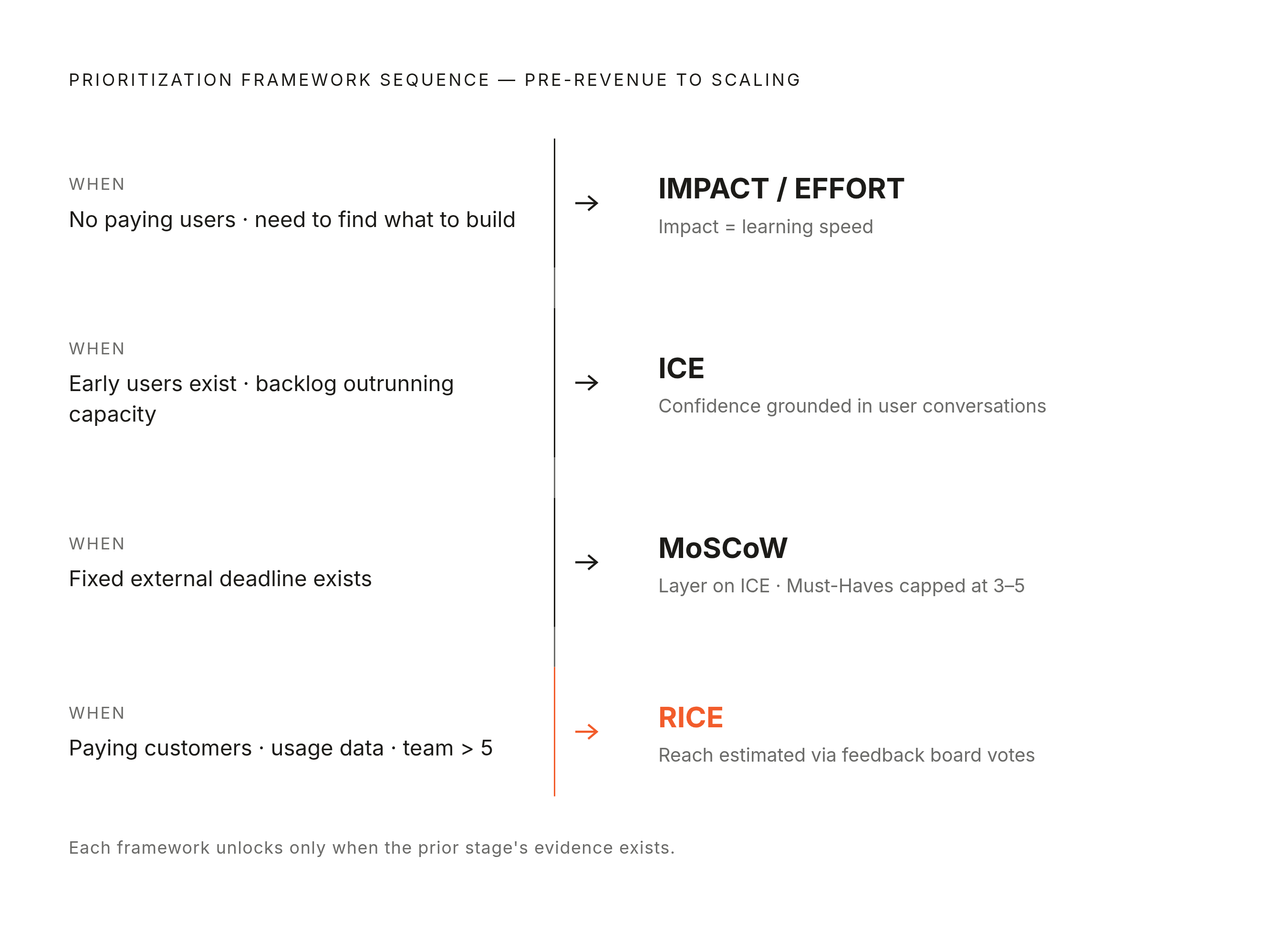
Start with the decision the team needs to make. If there are no paying users and the goal is to find the right thing to build, use Impact/Effort with learning speed as the definition of impact. Keep the backlog small and ship from the high-impact, low-effort quadrant. If early users exist and the backlog is outrunning capacity, move to ICE in a single short session. Give Confidence serious attention and ground it in user conversations.
A fixed external deadline overrides neither choice. Layer MoSCoW on top to establish the launch boundary, hold Must-Haves to three to five, and treat scope exclusions as a commitment. Once paying customers exist, usage data is accumulating, and the team has grown beyond five people, graduate to RICE. Use the votes on the feedback board to help estimate Reach. The numerical result now has a basis beyond the team’s hopes.
A well-scoped pre-revenue MVP typically has three to five core features that address what users primarily need, basic authentication, and a minimal but functional UI. It also needs essential analytics to measure success and ways to collect feedback. Advanced customization, multiple user roles, and extensive integrations stay outside that scope. Those omissions protect the time needed to learn from the core product.
The learning also needs the right sequence. Get retention signal before investing in acquisition, because a handful of users who repeatedly return is more valuable than a much larger number of casual signups from a launch spike. A busy launch is not the same as repeat use. To keep prioritization tied to that goal, review the decision weekly and ask whether the thing shipped moved the team closer to signal. If the framework cannot help answer that question, it is becoming paperwork.