IP Assignment Agreements for Early Startup Teams
Signed written transfers from every creator keep a startup's IP its own.
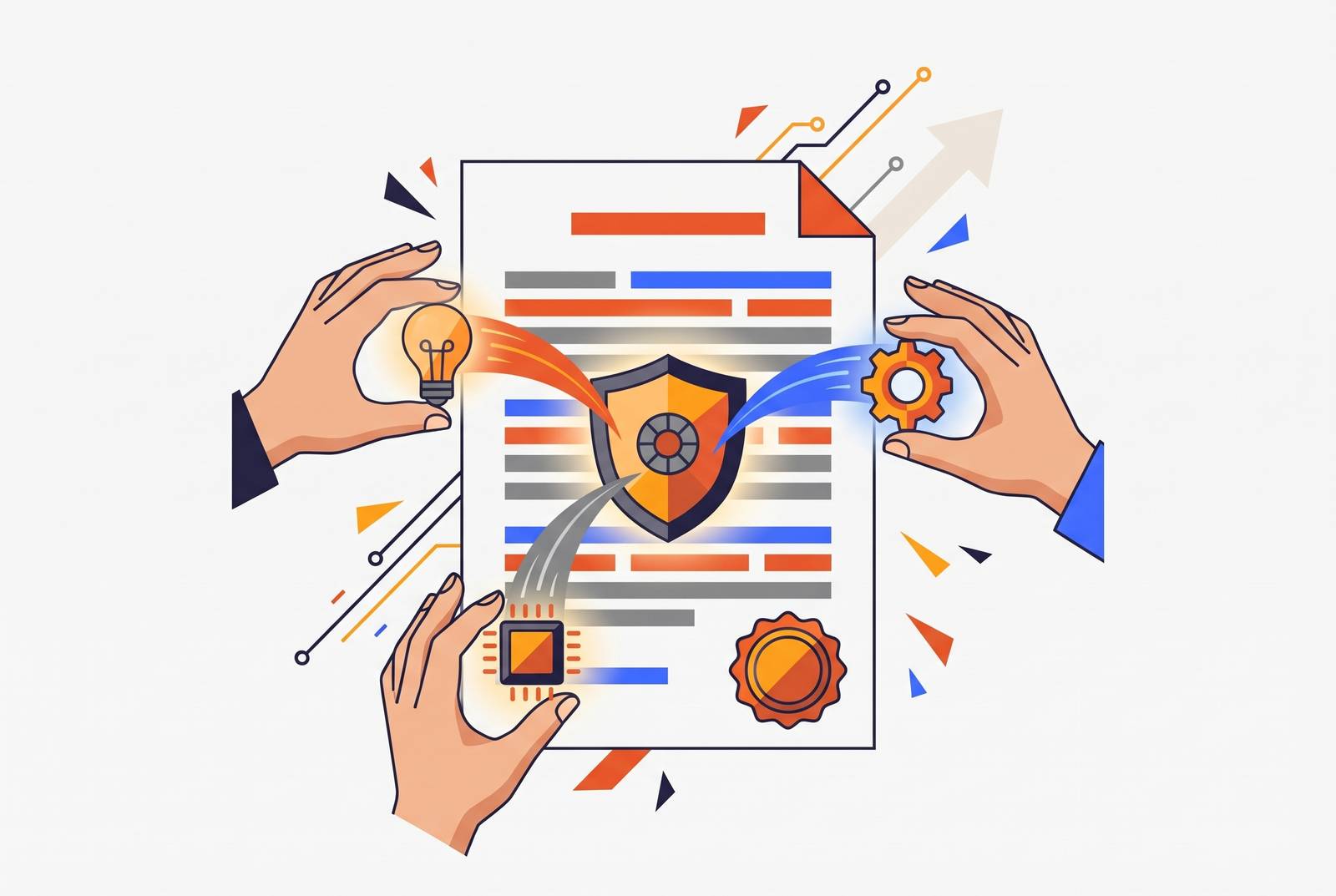
IP assignment agreements give an early startup ownership of the work it is built on. Incorporation alone does not do that, and paying a contributor does not necessarily do it either. Get the right written transfer from every creator before work begins, then keep that ownership chain intact as the team grows. Otherwise, fundraising can become an expensive hunt for signatures.
Why IP created before and during early startup life belongs to individuals, not the company, by default
Most founders assume incorporation sweeps existing work into the company. It does not work that way by default. Under US copyright law, ownership generally starts with the creator. Code written before incorporation, founding-sprint designs, and architecture sketched on a co-founder’s laptop need a written transfer. Before incorporation, the company does not even exist to own them.
“Work made for hire” provides a narrower bridge than founders often expect. Under 17 U.S.C. § 101, it covers employees acting within the scope of employment, but does not cover patents or trade secrets. Remote and after-hours work can also create disputes about that scope. For independent contractors, the doctrine covers only nine narrow statutory categories, and standalone software is not among them.
Who must sign an IP assignment agreement, and why the list is longer than most founders expect
Every creator is a potential break in the ownership chain. Each co-founder must sign their own agreement, which must cover their pre-incorporation work and future work tied to the business. A verbal agreement between founders is not a transfer. Employees need signed agreements too, because work-for-hire protection leaves questions about scope, personal tools, remote work, and after-hours contributions. Designers, writers, and product managers belong in that group just as engineers do.
Contractors and freelancers present the sharpest ownership risk. Paying their invoice does not by itself transfer software copyright, whether they work overseas, do a single job, or work with the team regularly. Flux Law recommends both a work-for-hire designation and a present-tense assignment for contractor software. Informal contributions are not exempt from the problem. A technical advisor who supplies code or product specifications needs IP and confidentiality provisions, because an equity or option grant settles compensation alone.
The five agreements that together close every ownership gap
The co-founder agreement assigns each founder’s contributions to the company, including work created before incorporation. It also addresses invention disclosure and work-for-hire terms. The Proprietary Information and Inventions Assignment Agreement, or PIIA, provides standalone coverage for each founder, employee, and key contractor. Its reach includes business-related inventions created outside normal hours, on personal equipment, and near the edges of the employment relationship.
The Confidential Information and Invention Assignment Agreement, or CIIA, is the form for contractors that combines work-for-hire language with a present-tense assignment. The assignment transfers ownership of standalone contractor software, which work-for-hire language alone cannot do. Employment agreements provide another layer by including assignment clauses synchronized with the PIIA. The offer and standalone agreement should not leave a gap between them.
The fifth agreement, a mutual NDA for talks with investors, protects proprietary information shared before there is a term sheet. Confidentiality is not an ownership transfer, so it cannot replace the other agreements. Founder and employee agreements also need a prior inventions carve-out, commonly called Schedule A. This identifies work excluded from the assignment. It protects the signer and reduces resistance by making clear what the company is not claiming.
Why "hereby assigns" and present-tense language are not stylistic choices
A founder can sign an agreement and still leave the company without an immediate transfer. The difference can come down to two words. TOSLawyer explains that “agrees to assign” creates a future promise, while “hereby assigns” effects a present transfer. If a founder leaves or a contractor disputes ownership before fulfilling the promise, the company does not automatically own the IP. The U.S. Court of Appeals for the Federal Circuit has ruled on this distinction.
The exchange supporting that transfer must also be real and documented. Founder PIIAs typically use the initial issuance of founder stock or a nominal cash payment as consideration. Without consideration, an assignment can be challenged as an unenforceable gift. Precision also applies to what changes hands, including copyrights, patents, patent applications, trade secrets, trademarks, and moral rights where applicable. For contractors, the present-tense assignment does the work that the accompanying work-for-hire designation may not.
When these agreements must be signed, and what happens when timing slips
Founder assignments belong at incorporation and must cover pre-incorporation work. Contractor agreements belong before the contractor starts, while employees should have a signed, dated invention assignment agreement on or before their first day. Advisors need IP and confidentiality provisions before accessing the codebase or roadmap. By the first investor conversation, these agreements should be in place, with any gaps identified and being closed.
Once someone creates IP without signing, cleanup becomes a negotiation. The contractor who built authentication for equity now knows the company needs a signature. The departed co-founder may have moved on, and the informally paid freelancer may be difficult to reach. A Confirmatory Assignment can attempt to close the retroactive gap, but obtaining one is not guaranteed. The creator may demand more money or equity, and a gap uncovered during acquisition diligence can reduce the purchase price or end the deal.
How IP assignment failures surface during the MVP phase and contractor-heavy early builds
The MVP phase makes informal arrangements especially tempting. Founders need a product quickly, so the freelance developer starts before the legal groundwork exists. Yet neither hiring and paying that developer nor including a work-for-hire clause alone transfers copyright in the resulting code. The assignment must expressly cover source code, database schema, infrastructure configuration, and custom integrations, rather than relying on the comfortable vagueness of “the app.”
Ownership is only one part of the problem. A contractor who incorporates code under a copyleft license may introduce licensing obligations that persist regardless of who owns the custom code built on top. The agreement should therefore require the contractor to disclose any third-party code they use, and the company should audit the code before closing a round. Buying the house does not repeal the rules attached to the land.
Nobody gets access to the repository before signing the right agreement. That connects founder accountability directly to how the product is built, instead of leaving ownership as a task for fundraising season. It also fits YC’s principle of taking care with the things that must be done. An assignment is part of the build infrastructure, even if it has no pleasing progress bar.
Why IP assignment is inseparable from co-founder equity and vesting, and what happens when the two are confused
A departing co-founder exposes a different kind of gap. Founders often assume forfeiture of unvested shares protects the company, but equity and IP follow separate legal tracks. Losing shares does not transfer copyright or inventions. The assignment must survive departure regardless of how much equity has vested. In the correct structure, the founder forfeits unvested equity while the assigned IP remains fully with the company.
This difference is harder to talk about when everyone trusts each other. Yet disputes often arise among co-founders, early employees, and contractors whose shared history substituted for documentation. Execute the co-founder agreement with IP assignment before the first line of code and before the relationship makes the conversation awkward. Advisors paid in equity create the same separation between compensation and ownership. If their agreement does not assign their work, Series A or acquisition diligence may require cooperation from someone who has already moved on.
What investors and acquirers actually check, and how IP gaps reprice or kill deals
Institutional IP diligence starts earlier than many founders expect. Flux Law says it is standard even at pre-seed, and missing assignments are often costly to fix late in the process. Investors want the assignment chain, meaning signed agreements from every founder, contractor, and early contributor, with present-tense language and documented consideration. YC requires founders to have PIIAs in place. A folder containing most of the signatures is not a complete chain.
The SAFE also makes ownership a present obligation through the representation that “the Company has sufficient legal rights to conduct its business”. A known IP dispute or missing assignment means that representation is inaccurate and requires disclosure or remediation before signing. This is more than a request to tidy the data room. The company is making a statement about rights it already has.
The resulting deal consequences follow from the missing rights. A round can stall while founders track down contributors and agree on assignments, and an acquirer may lower its price or walk away. The expense is therefore not limited to legal fees. A former contributor’s leverage grows when their signature stands between the company and a transaction.
The 2026 complication — AI-assisted creation and what standard assignment templates do not cover
Older assignment templates were not written to answer the questions that come with AI-assisted development. Flux Law flags ownership ambiguity when contractors generate company code through their own AI tools. Neither a work-for-hire clause nor a standard present-tense assignment fully resolves that problem. The unanswered questions concern AI-assisted outputs, training data, and how contractor tool use interacts with company ownership claims.
Fine-tuning creates a related gap in the drafting. When a contractor or employee uses company data to train a model, the company’s contribution of data and the creator’s training work may support competing ownership claims. General language about “inventions and improvements” may not capture that arrangement clearly. Agreements signed or renewed in this setting should spell out how they cover AI-assisted outputs, training data, and model weights. That is a focused update to the ownership terms, with limits on what a template can settle in AI copyright law.
How to build IP assignment into early team habits rather than treating it as a one-time legal task
The practical response is to make assignment review part of onboarding. Nobody should start work, receive repository access, or touch product files before signing the right agreement. That rule continues after incorporation and applies to each new hire, contractor, and advisor. Every signed document should be dated and stored centrally. Retrieval is part of the protection, because an agreement that cannot be produced does not satisfy a diligence request.
Before the first investor conversation, confirm that every contributor has a signed, present-tense assignment. Before a technical contractor’s first commit, confirm that the agreement precedes the work, and before an advisor receives access, confirm IP and confidentiality coverage. Before signing a SAFE or closing a seed round, confirm that no known gaps remain or disclose them accurately.
Those checks can be part of a review of the business each week. Founders can check which assignments are signed as they keep the cap table current and prepare investor updates, where they already track what they owe and must do before the next round. The work is less dramatic than recovering rights from a departed contributor, which is precisely its advantage.